THE WHITE HOUSE OF THE CONFEDERACY, RICHMOND
Reading edition
One of the Meccas of the Southern States is a house in Richmond formerly known as “The White House of the Confederacy,” and now as “The Confederate Museum.” It is a plain, substantial house with columns at the back and is a typical residence of Richmond and of the Nineteenth Century. The house was built in 1819 by Dr. Brockenbrough for his residence and must have been more imposing with the original garden.
In 1862 Mr. Lewis Crenshaw, the owner, sold it to the city of Richmond for the use of the Confederate Government; and the city, having furnished it, offered it to Jefferson Davis, the President of the Confederate States for his residential and official home. Mr. Davis refused to accept the gift, and it was then rented from the Confederate States for the “Executive Mansion.” President Davis and his family lived here for three years until the evacuation of Richmond, when he left with the government officials on the night of April 2, 1865. The “Mississippi Room” was his study, and in it all the important conferences of the President and his officers were held. It may be interesting to quote here from Mrs. Davis’s Memoirs of Jefferson Davis, regarding this historic house. She writes:
“In July we moved to the old Brockenbrough house, and began to feel somewhat more at home when walking through the old-fashioned terraced garden or the large airy rooms in the seclusion of family life.
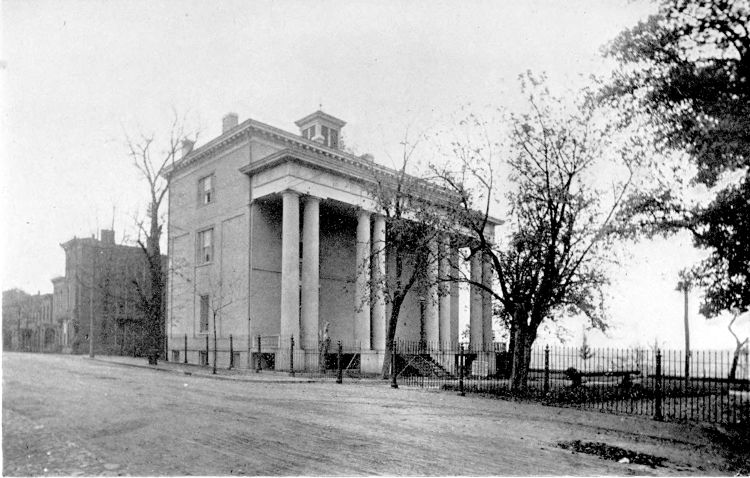
WHITE HOUSE OF THE CONFEDERACY, RICHMOND, VA.
“The mansion stands on the brow of a steep and very high hill that is sharply defined against the plain at its foot through which runs the Danville railway that leads to the heart of Virginia. The house is very large, but the rooms are comparatively few, as some of them are over forty feet square. The ceilings are high, the windows wide and the well-staircases turn in easy curves towards the airy rooms above. The Carrara marble mantels were the delight of our children....
“The tastes, and to some extent, the occupations and habits of the master of the house, if he, as in this case, assisted the architect in his design, are built in the brick and mortar, and like the maiden’s blood in the great bell, they proclaim aloud sympathy or war with those whom it shelters. One felt here the pleasant sense of being in the home of a cultivated, liberal, fine gentleman, and that he had dwelt there in peaceful interchange of kind offices with his neighbours. The garden, planted in cherry, apple and pear-trees sloped in steep terraces down the hill to join the plain below. To this garden or pleasance came always in my mind’s eye a lovely woman, seen only by the eye of faith, as she walked there in ‘maiden meditation.’
“Every old Virginia gentleman of good social position who came to see us, looked pensively out on the grounds and said, with a tone of regret, something like this: ‘This house was perfect when lovely Mary Brockenbrough used to walk there, singing among the flowers’; and then came a description of her light step, her dignified mien, her sweet voice and the other graces which take hold of our hearts with a gentle touch and hold them with a grip of steel. At first it seemed odd and we regretted our visitor’s disappointment, but after a while Mary came to us, too, and remained the titular goddess of the garden. Her name became a household word. ‘Whether Mary would approve’ was a question my husband playfully asked, when he liked the arrangement of the drawing-rooms.”
When General Godfrey Witzel, in command of the Northern troops entered the city on the morning of April 3, 1865, he made this house his headquarters; and it was used as the headquarters of the United States Government during the five years that Virginia was under military rule and was called “District No. 1.” When Abraham Lincoln passed through Richmond a few days after the evacuation, he was received in the “Georgia room” of this old house.
After the war “The White House of the Confederacy” became the home of the first public school established in Richmond and was used as such for more than twenty years. Finally, to save it from destruction, for the house was falling into decay, a mass-meeting was held in Richmond to take measures for its preservation. A society was formed called the “Confederate Memorial Literary Society” whose first act was to petition the city to yield it to its charge for the purpose of establishing a Museum of Confederate relics and a memorial to President Davis.
The Museum was formally opened in 1890. Quoting from the charter:
“The purposes for which it is formed are to establish in the city of Richmond, in the State of Virginia, the capital of the late Confederate States of America, a Confederate Memorial Literary Society or Association, to collect and receive, by gift, purchase, or otherwise, all books and other literary productions pertaining to the late war between the States, and of those engaged therein; all works of art or science, all battle-flags, relics, and other emblems of that struggle, and to preserve and keep the same for the use of said Society and the public.”
A room, bearing the distinctive name, shield, and colours of the State it represents, is assigned to each State of the Confederacy, and is a repository for memorials from that State. A Regent and Vice-Regent are appointed to represent each State and to assume the care and expense of their respective rooms—collecting by loan, donation, or otherwise, contributions of what they think will make their rooms attractive.
The Solid South is represented by a general reception room, library and gallery in which the portraits of the President of the Confederate States and of his Cabinet as well as those of the distinguished civil and military leaders are hung. On the left is the “Virginia Room” and on the right the “Georgia Room” and beyond that the “Mississippi Room,” in which the Confederate Cabinet sat. The relics of Jefferson Davis are appropriately placed here. The Kentucky, Alabama, South and North Carolina and Maryland Rooms are in the second story, and in the third, the Alabama, Arkansas, Tennessee, Florida, Missouri, Louisiana and Texas Rooms are situated.
The collection is exceedingly large and of great interest to the student of the great struggle of 1861–1865.