THE WADSWORTH-LONGFELLOW HOUSE, PORTLAND NATHAN GOOLD
Reading edition
The Wadsworth-Longfellow house was built in 1785–1786, by General Peleg Wadsworth, the grandfather of Henry Wadsworth Longfellow. He was a native of Duxbury, a graduate of Harvard College, and a major-general in the army of the Revolution.
According to the account of his daughter, Zilpah, General Wadsworth’s appearance, at this time, was as follows:—“Imagine to yourself a man of middle age, well proportioned, with a military air, and who carried himself so truly that many thought him tall. His dress, a bright scarlet coat, buff small clothes and vest, full ruffled bosom, ruffles over the hands, white stockings, shoes with silver buckles, white cravat bow in front, hair well powdered and tied behind in a club, so-called.”
At first, the house was of two stories with a pitched roof and was the first house in Portland to have brick walls. The bricks came from Philadelphia to build these walls which are sixteen inches thick. The third story was not added until 1815.
The poet’s mother was about eight years old when her father built this house. In 1804, she was married to Stephen Longfellow, in the house which had been her home from childhood. Longfellow was born in another house in Portland, but at the early age of eight months he was brought by his parents to the Wadsworth House.
Henry W. Longfellow lived here during his childhood, boyhood and young manhood, and here he came, to his old home, to the end of his life. Here were the scenes of his bringing up and here he profited by the examples and precepts of his honoured parents. Here he wrote his first poem and others, together with portions of his prose works. It was really his home until the purchase of the ‘Craigie House,’ at Cambridge, in 1843, a period of thirty-five years. The home remained with the old furnishings undisturbed until the death of Mrs. Pierce. Longfellow’s last visit here was in July, 1881, when he wrote to a friend in Rhode Island:—
“Portland has lost none of its charms. The weather is superb and the air equal to that of Newport or East Greenwich or any other Rhode Island seashore. I shall remain here a week or two longer, and think of running up to North Conway and to Sebago, to see the winding Songo once more. It is very pleasant sitting here and dictating letters. It is like thinking what one will say without taking the trouble of writing it. I have discovered a new pleasure.”
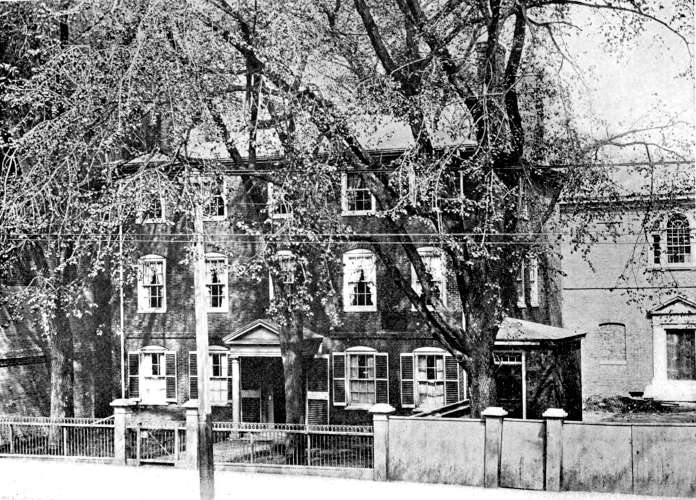
THE WADSWORTH-LONGFELLOW HOUSE, PORTLAND, MAINE
The poems now known to have been written in this house are:—
The Battle of Lovell’s Pond, 1820; Musings, 1825; The Spirit of Poetry, 1825; Burial of Minnisink, 1825; Song: When from the eye of day, 1826; Song of the Birds, 1826; The Lighthouse; The Rainy Day, 1841; Changed, 1858, and probably others. A portion of Hyperion was written here and, no doubt, much was outlined in this house while staying here.
The old house has sixteen rooms. It was the home of the Wadsworth and Longfellow families for one hundred and fifteen years and is in a good state of preservation. It has no
“Weather-stains upon the wall, And stairways worn, and crazy doors, And creaking and uneven floors.”
It was
“Built in the old Colonial day, When men lived in a grander way, With ampler hospitality.”
It has eight open fireplaces, and in former times, during a year, over thirty cords of wood were burned in them. What a tale of bygone days they could tell!
The living or sitting-room has the same general appearance as when occupied by the Longfellows. For about ten years it was used by the father for a law office, and the poet, his brother Stephen, George W. Pierce and others studied law here. The vestibule or “Little Room” was added as an addition or entrance to the law office. His brother wrote of Longfellow: “In this room the young graduate scribbled many a sheet.” After the removal of the office, about 1828, this room was changed into a china closet and the poet wrote his sister Elizabeth, from Göttingen, under date of March 29, 1829: “My poetic career is finished. Since I left America I have hardly put two lines together; ... and no soft poetic ray has irradiated my heart since the Goths and Vandals crossed the Rubicon of the front entry and turned the sanctum sanctorum of the ‘Little Room,’ into a china closet.”
Back of the living-room is the kitchen with its broad fireplace, in which is the old iron back, on which is the fish “that forever bakes in effigy.” This fireplace has never been closed, and the utensils and china seen here were used by these families in the poet’s time and before. This room, being as of old, is one of the most interesting in the house. It tells its own story.
On the opposite side of the front hall is the “Den” or the old dining-room, made especially famous by the fact that here, between the windows, looking out into the garden, on the same desk now standing there, was written “The Rainy Day” in 1841. From these windows the poet saw the flowering grapevine mentioned in the third line,
“The vine still clings to the mouldering wall,”
which is living and is still to be seen there. The furniture on the first floor of the house, on exhibition, was theirs and was used by the family.
The second story has four rooms, the “Mother’s Room,” the “Guest’s Room,” the “Children’s Room” and Mrs. Pierce’s old room. They contain a wonderful collection of the families’ belongings for the inspection of the visitors interested.
The third story, added in 1815, is reached by a wellworn stairway of especial interest from the fact that over these stairs climbed the Longfellow children to their bedchambers where they were under the immediate charge of their aunt, Lucia Wadsworth. This floor has seven rooms. The room of rooms is the poet’s boyhood one, in which he wrote “Musings” and “The Lighthouse.” It is furnished with many of the articles of yore. “The Boys’ Room,” which, at times, has been occupied by all the Longfellow boys, looks out on the garden and the western sky. It contains the old trundle-bed and the writings of the children on the casing of the window, with many articles of much interest. The remaining rooms on this floor are used for exhibition purposes. From the front windows, in those days, could be seen the harbour, its islands, and Cape Elizabeth; from those in the rear, Back Cove, the fields and forests, back of which loomed up the White Mountains. It was a magnificent prospect. Longfellow wrote:—
“Happy he whom neither wealth nor fashion, Nor the march of the encroaching city, Drives an exile From the hearth of his ancestral homestead.”
On the window casing in the “Boys’ Room” one of the children has inscribed, “How dear is the home of my childhood.” The poet expressed his sentiments of the love of the old home in words that will never be stricken from our language:—
“Truly the love of home is interwoven with all that is pure and deep and lasting in earthly affections. Let us wander where we may, the heart looks back with secret longings to the paternal roof. There the scattered rays of affection concentrate. Time may enfeeble them, distance overshadow them, and the storms of life obstruct them for a season; but they will at length break through the cloud and storm, and glow and burn and brighten around the peaceful threshold of home.”
The Wadsworth-Longfellow House came into the possession of the Maine Historical Society in 1901 by donation from Anne Longfellow Pierce, a sister of the poet. She was born here in 1810 and died here in 1901. It is now practically a museum of Longfellow relics and attracts many visitors, no less than 30,000 having been admitted since it was opened to the public.