CARPENTERS’ HALL BENSON J. LOSSING
Reading edition
On Monday morning I visited Carpenters’ Hall, the building in which the first Continental Congress held its brief session. Having had no intimation concerning its appearance, condition and present use, and informed that it was situated in “Carpenters’ Court,” imagination had invested its exterior with dignity, its interior with solemn grandeur, and its location a spacious area where nothing “common or unclean” was permitted to dwell. How often the hoof of Pegasus touches the leafless treetops of sober prose when his rider supposes him to be at his highest altitude! How often the rainbow of imagination fades and leaves to the eye nothing but the forbidding aspect of a cloud of plain reality! So at this time. The spacious court was but a short and narrow alley; and the Hall, consecrated by the holiest associations which cluster around the birthplace of our Republic, was a small two-story building, of sombre aspect, with a short steeple and all of a dingy hue.
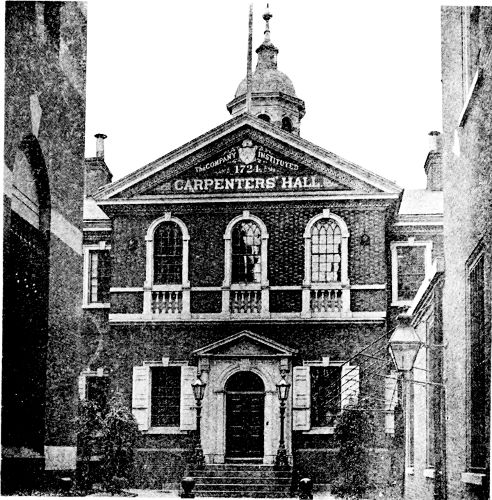
CARPENTERS’ HALL, PHILADELPHIA]
This building is constructed of small imported bricks, each alternate one glazed, and darker than the other, giving it a checkered appearance. Many of the old houses in Philadelphia were built of like materials. It was originally erected for the hall of meeting for the society of house carpenters of Philadelphia. It stands at the end of an alley leading south from Chestnut Street, between Third and Fourth Streets.
The hall in which Congress met is upon the lower floor, and comprehends the whole area of the building. It is about forty-five feet square, with a recess in the rear twenty-five feet wide and about twelve feet deep, at the entrance of which are two pillars, eighteen feet high. The second story contains smaller apartments which were used by Congress and occupied by the society as committee rooms. In one of these, emptied of all merchandise except a wash tub and a rush-bottomed chair, let us sit down and consider the events connected with that first great Continental Congress.
For many years a strong sympathy had existed between the several colonies, and injuries done to one, either by the aggressions of the French and Indians, or the unkind hand of their common mother, touched the feelings of all the others and drew out responsive words and acts which denoted an already strong bond of unity. Widely separated as some of them were from each other by geographical distance and diversity of interest and pursuits, there were, nevertheless, political, social and commercial considerations which made the Anglo-Americans really one people, having common interests and common hopes. Called upon as free subjects of Great Britain to relinquish, theoretically and practically, some of the dearest prerogatives guaranteed to them by the Magna Charta and hoary custom—prerogatives in which were enveloped the most precious kernels of civil liberty—they arose as one family to resist the insidious progress of oncoming despotism, and yearned for union to give themselves strength commensurate to the task. Leading minds in every colony perceived the necessity for a general council, and in the spring of 1774, the great heart of Anglo-America seemed to be as with one pulsation with this sublime idea. That idea found voice and expression almost simultaneously throughout the land. Rhode Island has the distinguished honour of first speaking out publicly on the subject. A general Congress was proposed at a town meeting in Providence on the 17th of May, 1774. A committee of a town meeting held in Philadelphia on the 21st, four days afterwards, also recommended such a measure; and on the 23d, a town meeting in New York city uttered the same sentiment. The House of Burgesses of Virginia, dissolved by Lord Dunmore, assembled at the Raleigh Tavern in Williamsburg, on the 27th, and on that day warmly recommended the assembling of a national council; and Baltimore, in a county meeting, also took action in favour of it on the 31st. On the 6th of June, a town meeting at Norwich, Connecticut, proposed a general Congress; and on the 11th, a county meeting at Newark, New Jersey, did the same; on the 17th, the Massachusetts Assembly, and, at the same time, a town meeting in Faneuil Hall, in Boston, strenuously recommended the measure; and a county meeting at New Castle, Delaware, approved of it on the 29th. On the 6th of July, the committee of correspondence at Portsmouth, New Hampshire, expressed its approbation of the measure. A general province meeting, held at Charleston, South Carolina, on the 6th, 7th and 8th of that month, urged the necessity of such a Congress; and a district meeting at Wilmington, North Carolina, held on the 21st, heartily responded affirmatively. Thus we perceive that, within the space of sixty-four days, twelve of the thirteen colonies spoke out decidedly in favour of a Continental Congress, Georgia alone remaining silent. The Massachusetts Assembly designated the 1st of September, 1774, as the time and Philadelphia as the place for the meeting of the Congress. Other colonies acquiesced and at Philadelphia the delegates convened.
“Now meet the fathers of this western clime, Nor names more noble graced the roll of Fame, When Spartan firmness braved the wrecks of time, Or Rome’s bold virtues fann’d the heroic flame. “Not deeper thought th’ immortal sage inspired On Solon’s lips, when Grecian senates hung; Nor manlier eloquence the bosom fired, When genius thunder’d from the Athenian tongue.” —Trumbull.[1]
On Monday, the 5th of September, fifty-four delegates, from twelve colonies, assembled in Carpenters’ Hall. It was a congregation of men, viewed in every important aspect, such as the world had never seen.
Congress was organized by the choice of Peyton Randolph, of Virginia, as president, and Charles Thomson, of Pennsylvania, as secretary. The credentials of the various delegates were then presented, and now came a pause; who should take the lead? What measure should be first proposed? They had come together from distant Provinces, some instructed by the power that appointed them, others left free to act as circumstances should require. There was a profound silence and deep anxiety was depicted upon every countenance. No one seemed willing to break that silence, until a grave-looking member, in a plain dark suit of “minister’s grey” and unpowdered wig, arose. “Then,” said Bishop White, who was present and related the circumstance, “I felt a regret that a seeming country parson should so far have mistaken his talents and the theatre for their display.” But his voice was so musical, his words so eloquent, and his sentiments so profoundly logical, that the whole House was electrified, and the question went from lip to lip, “Who is it? Who is it?” A few, who knew the stranger, answered, “It is Patrick Henry, of Virginia!” There was no more hesitation; he who startled the people of Colonial America nine years before, by his bold resolutions against the Stamp Act, and a few months afterwards by the cry of “Give me liberty or give me death!” now gave the impulse to the representatives of that people in grand council assembled and set in motion that machinery of civil power which worked so nobly while Washington and his compatriots were waging war with the enemy in the field.
Two days afterwards another impressive scene occurred. It was the first prayer in Congress, offered by the Reverend Mr. Duché. The first day had been occupied in the reception of credentials and the arrangement of business; the second in the adoption of rules for the regulation of the session; and now, when about to enter upon the general business for which they were convened, the delegates publicly sought Divine aid. It was a spectacle of great interest, for men of every creed were there. In this service their creeds were forgotten and the hearts of all united in the prayer which flowed from the pastor’s lips; a prayer which came from a then patriot’s heart, though timidity afterwards lost him the esteem of his friends and countrymen.
The Congress resolved to sit with closed doors, for enemies were around them with open eyes and busy tongues, and nothing was to be made public without special orders. Having no means at hand to ascertain the relative importance of the Colonies, it was agreed “that each Colony or Province should have one vote in determining questions.” One of their first acts was to express an opinion that the whole continent ought to support Massachusetts in resistance to the unconstitutional change in her government; and they afterwards resolved that any person accepting office under the new system ought to be held in detestation as a public enemy. Merchants were advised to enter with non-importation agreements; and a letter was addressed to General Gage, remonstrating against the fortifications on Boston Neck, and his arbitrary exercise of power. On the 14th of October, a Declaration of Colonial Rights, prepared by a committee of two from each Province, was adopted, in which were set forth the grievances complained of and the inalienable rights of British subjects in every part of the realm. As a means of enforcing the claim of natural and delegated rights, fourteen articles were agreed to as the basis of an American Association, pledging the associators to an entire commercial non-intercourse with Great Britain, Ireland and the West Indies, and the non-consumption of tea and British goods. In one clause the slave trade was specially denounced, and entire absence from it and from any trade with those concerned in it, formed a part of the association. Committees were to be appointed in every county, city and town, to detect and punish all violations of it; and all dealings with such enemies of American liberty were to be immediately broken off. One hundred and fifty copies of the Articles of Association were ordered to be printed.
An eloquent address to the people of Great Britain, from the pen of John Jay, and a memorial to the inhabitants of the several British American Colonies, written by William Livingston, were adopted by Congress on the 21st. A petition, drawn by John Adams and corrected by John Dickenson was approved on the 26th. Letters to the Colonies of St. John’s Island (now Prince Edward’s, Nova Scotia), Georgia and the Floridas, enclosing the doings of Congress, and inviting them to join the Association, were also adopted on that day (the last of the session). At the same time they approved of an elaborate address to the inhabitants of Canada. This was drawn up by Mr. Dickenson. Having made provision for another Congress to meet on the 10th of May following, the first general council closed its session by adopting a second humble petition to the King and a vote of thanks to the advocates of Colonial rights in both houses of Parliament.
Congress was in actual session only thirty-one days out of the eight weeks of the term, the remainder of the time being occupied in preparatory business. It was a session of extraordinary activity and a great amount of business of vast importance was transacted, notwithstanding many unnecessary speeches were evidently made. They were certainly more to the purpose than are most of the harangues in Congress at the present day, or, considering the diversity of opinion that must have existed upon the sentiments of the various state papers that were adopted, the session would have continued for several months. We have no means of knowing what harmony or what discord characterized those debates. The doors were closed to the public ear, and no reporters for the press have preserved the substance of the speeches. That every resolution adopted was far from receiving a unanimous vote, is very evident; for we find, by the subsequent declarations and acts of delegates, that some of the measures were violently opposed. Many deplored the probability of an open rupture with the mother country and refused acquiescence in any measure that should tend to such a result. Indeed, the sentiments of a large majority of the delegates were favourable to an honourable reconciliation, and the Congress was determined not to present the least foundation for a charge of rushing madly into an unnatural contest without presenting the olive branch of peace. Such was the tenor of its petitions and addresses; and every charge of desire on the part of Congress for a war that might lead to independence rested solely upon inference. Galloway, Duane, and others, even opposed the American Association; and they regarded the Adamses as men not only too much committed to violent measures by the part they had taken in Boston, but that they were desperate men with nothing to lose, and hence unsafe guides to gentlemen who had estates to forfeit. And yet Galloway, when he became a proscriptive Loyalist, and one of the most active enemies of the Republicans, was forced to acknowledge the stern virtue of many of the patriots of that assembly, and among them Samuel Adams. “He eats little, drinks little, sleeps little, and thinks much,” he said, “and is most indefatigable in the pursuit of his object. It was this man who, by his superior application, managed at once the factions in Congress at Philadelphia and the factions in New England.”
The proceedings of this first Congress went forth to the world with all the weight of apparent unanimity, and throughout the Colonies they were hailed with general satisfaction. The American Association adopted and signed by the delegates was regarded by the people with great favour and thousands in every province affixed their signatures to the pledge. These formed the fibres of the stronger bond of the Articles of Confederation afterwards adopted, and may be considered the commencement of the American Union.