SUNNYSIDE, TARRYTOWN BENSON J. LOSSING
Reading edition
Approaching Tarrytown, we observe upon the left of the highway an already populous cemetery covering the crown and slopes of a gentle hill. Near its base is an ancient church, and a little beyond it flows a clear stream of water, which the Indians called Po-can-te-co, signifying a “run between two hills.” It makes its way in a swift current from the back country between a hundred hills, presenting a thousand scenes of singular beauty in its course. The Dutch named it Slaeperigh Haven Kill, or Sleepy Haven Creek, and the valley in the vicinity of the old church through which it flowed Slaeperigh Hol, or Sleepy Hollow, the scene of Washington Irving’s famous legend of that name.
The little old church is a curiosity. It was built, says an inscription upon a small marble tablet on its front, by “Frederic Philips and Catharine Van Cortland, his wife, in 1699,” and is the oldest church edifice existing in the state of New York. It was built of brick and stone, the former imported from Holland for the purpose. Over its little spire still turns the flag-shaped vane of iron, in which is cut the monogram of its founder (V F in combination, his name being spelt in Dutch Vedryck Flypsen); and in the little tower hangs the ancient bell, bearing the inscription in Latin: “If God be for us, who can be against us? 1685.” The pulpit and communion table were also imported from Holland. The former was long since destroyed by the iconoclastic hand of “improvement.”
At this quiet old church is the opening of Sleepy Hollow, upon the shores of the Hudson, and near it is a rustic bridge that crosses the Po-can-te-co, a little below the one made famous in Irving’s legend by an amusing incident.[21] In this vicinity, according to the legend, Ichabod Crane, a Connecticut schoolmaster, instructed “tough, wrong-headed, broad-skirted, Dutch urchins” in the rudiments of learning. He was also the singing-master of the neighbourhood. Not far off lived old Baltus Van Tassel, a well-to-do farmer, whose house was called Wolfert’s Roost. He had a blooming and only daughter named Katrina, and Ichabod was her tutor in psalmody, training her voice to mingle sweetly with those of the choir which he led at Sabbath-day worship in the Sleepy Hollow Church. Ichabod “had a soft and foolish heart towards the sex.” He fell in love with Katrina. He found a rival in his suit in stalwart, bony Brom Van Brunt, commonly known as Brom Bones. Jealousies arose, and the Dutchman resolved to drive the Yankee schoolmaster from the country.
Strange stories of ghosts in Sleepy Hollow were believed by all, and by none more implicitly than Ichabod. The chief goblin seen there was that of a Hessian trooper, whose head had been carried away by a cannon ball. This spectre was known all over the country as “The Headless Horseman of Sleepy Hollow.”
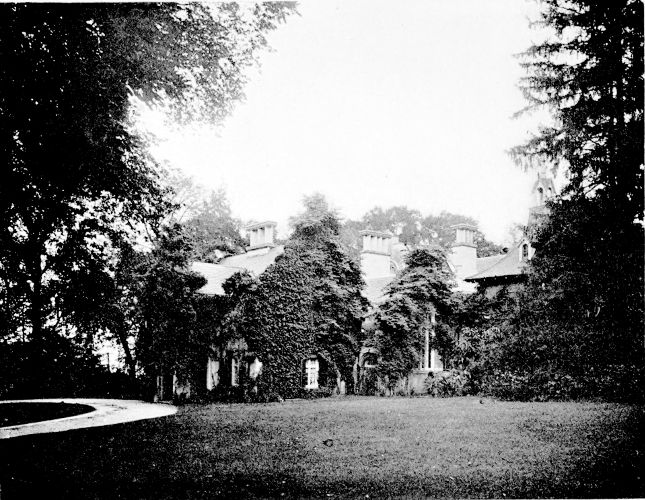
“SUNNYSIDE”, IRVINGTON, NEW YORK
About three miles below Tarrytown is Sunnyside, the residence of Washington Irving. It is reached from the public road by a winding carriage-way that passes here through rich pastures and pleasant woodlands and then along the margin of a dell through which runs a pleasant brook, reminding one of the merry laughter of children as it dances away riverward and leaps in beautiful cascades and rapids into a little bay a few yards from the cottage of Sunnyside.
Around that cottage and the adjacent lands and waters, Irving’s genius has cast an atmosphere of romance. The old Dutch house—one of the oldest in all that region—out of which grew that quaint cottage, was a part of the veritable Wolfert’s Roost—the very dwelling wherein occurred Katrina Van Tassel’s memorable quilting frolic that terminated so disastrously to Ichabod Crane in his midnight race with the “Headless Horseman of Sleepy Hollow.” There, too, the veracious Dutch historian, Diedrich Knickerbocker, domiciled while he was deciphering the precious documents found there, “which, like the lost books of Livy, had baffled the research of former historians.” But its appearance had sadly changed when it was purchased by Mr. Irving, about 1836, and was by him restored to the original form of the Roost, which he describes as “a little, old-fashioned stone mansion, all made up of gable ends, and as full of angles and corners in an old cocked hat. It is said, in fact,” continues Mr. Irving, “to have been modelled after the cocked hat of Peter the Headstrong, as the Escurial was modelled after the gridiron of the blessed St. Lawrence.” It was built, the chronicler tells us, by Wolfert Acker, a privy councillor of Peter Stuyvesant, “a worthy, but ill-starred man, whose aim through life had been to live in peace and quiet.” He sadly failed. “It was his doom, in fact, to meet a head wind at every turn and be kept in a constant fume and fret by the perverseness of mankind. Had he served on a modern jury he would have been sure to have eleven unreasonable men opposed to him.” He retired in disgust to this then wilderness, built the gabled house and “inscribed over the door (his teeth clenched at the time) his favourite Dutch motto ‘Lust in Rust’ (pleasure in quiet). The mansion was thence called Wolfert’s Rust (Wolfert’s Rest), but by the uneducated, who did not understand Dutch, Wolfert’s Roost.” It passed into the hands of Jacob Van Tassel, a valiant Dutchman, who espoused the cause of the Republicans. The hostile ships of the British were often seen in Tappan Bay, in front of the Roost, and Cow Boys infested the land thereabout. Van Tassel had much trouble: his house was finally plundered and burnt, and he was carried a prisoner to New York. When the war was over, he rebuilt the Roost, but in more modest style. “The Indian spring”—the one brought from Rotterdam—“still welled up at the bottom of the green bank; and the wild brook, wild as ever, came babbling down the ravine, and threw itself into the little cove where of yore the water-guard harboured their whale-boats.”
The “water-guard” was an acquatic corps, in the pay of the Revolutionary government, organized to range the waters of the Hudson, and keep watch upon the movements of the British. The Roost, according to the chronicler, was one of the lurking-places of this band and Van Tassel was one of their best friends. He was, moreover, fond of warring upon his “own hook.” He possessed a famous “goose-gun” that would send its shot half-way across Tappan Bay. “When the belligerent feeling was strong upon Jacob,” says the chronicler of the Roost, “he would take down his gun, sally forth alone, and prowl along shore, dodging behind rocks and trees, watching for hours together any ship or galley at anchor or becalmed. So sure as a boat approached the shore, bang! went the great goose-gun, sending on board a shower of slugs and buck shot.”
On one occasion Jacob and some fellow bush-fighters peppered a British transport that had run aground. “This,” says the chronicler, “was the last of Jacob’s triumphs; he fared like some heroic spider that had unwittingly ensnared a hornet, to the utter ruin of its web. It was not long after the above exploit that he fell into the hands of the enemy, in the course of one of his forays, and was carried away prisoner to New York. The Roost itself, as a pestilent rebel nest, was marked out for signal punishment. The cock of the Roost being captive, there was none to garrison it but his stout-hearted spouse, his redoubtable sister, Notchie Van Wurmer, and Dinah, a strapping negro wench. An armed vessel came to anchor in front; a boat full of men pulled to shore. The garrison flew to arms, that is to say, to mops, broomsticks, shovels, tongs, and all kinds of domestic weapons, for, unluckily, the great piece of ordnance, the goose-gun, was absent with its owner. Above all, a vigorous defence was made with that most potent of female weapons, the tongue; never did invaded hen-roost make a more vociferous outcry. It was all in vain! The house was sacked and plundered, fire was set to each room, and in a few moments its blaze shed a baleful light over the Tappan Sea.”