ST. PAUL’S CHAPEL, NEW YORK CHARLES HEMSTREET[24]
Reading edition
ST. PAUL’S CHAPEL, NEW YORK CHARLES HEMSTREET[24]
In the chapel of St. Paul’s, and in the graveyard that surrounds it, there are sights enough to keep a thoughtful person busy during more than one long day. To see the people hurrying along Broadway, without even a glance at the dim, old building, you would never think so. Close by the chapel door, which faces the churchyard, there is a bench which I occupy so often that I have come to feel that it is my personal property. It rests close by the ivy-covered wall, and, although it is but a dozen steps from the street, the intervening churchyard gives it relief and quiet so that all sight and sound of the bustling city seem shut off.
Sometimes there are visitors, doubtless attracted by my at-home appearance as I sit there, who ask me questions about the church and the churchyard. I always like to be asked these questions, and answer them as best I can. If the questioners are interested, I deliver a sort of lecture, telling how very small the city was in the year 1764, when the corner-stone of the church was laid, and how the building was opened in the second year after that. Then I wander on and tell how there were fields all around in those days, and how they sloped from the church door right down to the river. Sometimes, when there is a word of surprise at the many houses that now stand between the church and the river, I explain that a great deal of the land has been filled in during the one hundred and thirty odd years that have passed and that it has become too valuable to be left as a green field.
My last inquirer was an old gentleman, who was so much more in earnest than the usual curiosity seeker, that I asked him if he had lived long in the city.
“I am only here for a time, from the West,” said he. “This is my first visit to St. Paul’s although I love every stone in the old building. My father, when he was a child, lived near here, and, although he left the city with his parents in his youth, he often talked to me of this church, and how he had played among the tombstones when he was a boy. But the church seems smaller than I have imagined it.”
And then I told him that to me, too, the church seemed to grow smaller each year, but this was, doubtless, caused by the tall buildings growing up around it; and that the church had, in the time when his father knew it, been considered a giant of a building.
The old man nodded his head. “Yes, yes; doubtless so,” said he. Then, on my invitation, he gladly followed me into the chapel, and I led the way to the pew, off the north aisle, where George Washington used to sit when he attended service, and which has been preserved as he used it.
“So this is the Washington pew!” said my companion, as he tenderly tapped the woodwork against which he leaned, and looked admiringly at the coat-of-arms of New York on the wall above.
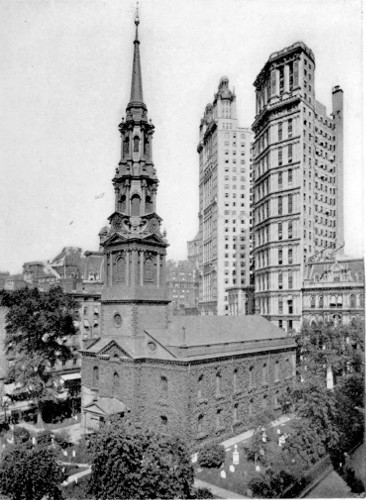
ST. PAUL’S CHAPEL, NEW YORK
“Yes, and you will remember that in 1776, when the invading British force came, the city was fired, Trinity Church was burned, with all its records, and the flames swept away a great part of the western side of the city. St. Paul’s Chapel was saved, and here, during the British occupation, Lord Howe, the English commander, and many soldiers of the King attended service. And when the British left New York, and the American forces came, Washington and his army took their places in the church. And to this church, on the day that he was inaugurated as first President of the United States, came Washington, and sat in this pew in which we now sit. Those who visited the church in Washington’s time have left the record that he was Commander-in-Chief, and in the days when he was President, he always attended the church without the slightest display, that he walked in very quietly, and that when he was in his seat he paid not the slightest attention to anything except his prayer-book and the clergyman. During all the time that he was in the city, he regularly, each week made the entry for Sunday in his diary: ‘Went to St. Paul’s Chapel in the forenoon.’
“And there you see the sounding-board on the pulpit, with the coat-of-arms of the Prince of Wales on the top. During Revolutionary days, patriots rushed through the city and destroyed everything that suggested allegiance to England. In some way, this sounding-board escaped destruction, so that now it is the only pre-Revolutionary relic remaining in the place where it originally stood.
“There, beside the west wall, is a bust of John Wells, erected by the members of the City Bar. He was a talented lawyer, who died in 1823. Wells was the sole survivor of a large family, all the members of which, except himself, were killed by Indians at the Cherry Valley Massacre. That he lived was due to his being at the time away from home attending school. He came to the city, practised law successfully for many years, and died regretted by the entire fraternity.”
These things and others in the chapel I pointed out to my companion, and then he followed me out into the churchyard again. We noted the spot, close by Vesey Street, where lay the remains of George Eacker, who killed the son of Alexander Hamilton in a duel, a few years before the great statesman was himself killed in the self-same way. There was another grave, almost in the centre of the yard, of a man who, in his day, had made a name for himself, which is almost forgotten now. It was the grave of Christopher Colles. He first conceived the idea of the Erie Canal, and delivered lectures on the subject, long years before DeWitt Clinton carried the project to a successful conclusion. It was this same Christopher Colles who built a reservoir by the Collect Pond, giving New York her first water-works, and applying steam practically to his pumping-station ten years before Fulton applied it to navigation. Colles died in 1821, a poor man.
The tall monument to the south of the church, erected to the memory of Thomas Addis Emmett, the jurist and brother of Robert Emmett, interested my companion more than anything else. He took a deep interest in deciphering the inscription on the west side—a curious inscription for a tombstone, for it reads,
40 42′ 40″ N., 74 03′ 21″ 5 W. L. G.,
and tells the exact latitude and longitude in which the monument is.
When we came to the monument set in the chancel window facing the street, my companion looked at me inquiringly. It was just after the celebration of Decoration Day, and a wreath of fresh flowers, bound with a trailing ribbon of imperial purple, quite hid the inscription on this tomb. Then we talked over the story of the brave hero of Quebec—Major-General Richard Montgomery—whose body lies beneath the chancel; spoke of how he had fallen in that fateful battle of 1775 calling on the men of New York to follow where he led; how the men had followed him, and how many of them had fallen with their general; of the day forty-three years later, when the nation for which he had died, remembering his brave deeds, had brought his body home to the city from its first resting place in Quebec; how on that day the city had been draped in mourning; how the streets had resounded to the tread of marching feet, and how the body had been interred beneath the chancel, where a monument was already set up to a great and good man, and a reminder to all that the deeds of men live after them.
And then we reached the gate which opens into the churchyard from Broadway. For a few moments we stood silently looking at the crowds that hurried past. I do not know what were my companion’s thoughts just then, but my own were of those other men who a hundred years before had hurried along the same thoroughfare, and of whom the only reminders now are the tombstones in the churchyard. My companion then left me, mingled with the crowds and was soon lost to sight.
I meant to have told him that to know all the picturesqueness of Old St. Paul’s, it should be visited on a night in early winter; one of those dreary nights when the rain falls blurring the glare of lights until those from each separate store-window seem to melt together. Then all the noise and bustle settle down into a sullen roar. Wet and dripping horses flounder past; cable cars glide along with clanging sound of bell; people knock umbrellas together as they hurry on. The rain, the noise, the confusion, the lights bewilder the brain. As one passes the Astor House, where the confusion is greatest, the lights most dazzling, the crowds largest and most in a hurry, you suddenly come upon the churchyard. It is merely to cross narrow Vesey Street,—but it is like stepping from day to night. The sight of the dark old church and the quiet tombs behind the tall iron fence breathe of silence and comfort. In the daytime the tombstones are brown and faded, but on these rainy nights the lights creeping in through the bars make them white as snow.
A quaint, curious corner, side by side with the roar and rush of the city. The rusty iron railing is a barrier seeming to shut out noise and life, as though to protect the sleepers in their well-earned rest.