NASSAU HALL, PRINCETON
Reading edition
Princeton Univerity, once known as the College of New Jersey, was founded by charter in 1746, under the auspices of the Presbyterian Synod of New York, which at that time included many Presbyterian churches of New Jersey. The college was opened in Elizabethtown in 1847, but was soon removed to Newark, and, in 1757, to Princeton, where a large building had been erected and named Nassau Hall in honour of King William III. of England, who was of the House of Nassau.
Nassau Hall has had an interesting history. During a part of the Revolutionary War, it was used by both American and British soldiers as a barrack and hospital, and during the Battle of Princeton (Jan. 3, 1777), the British troops made a stand within its walls until they were driven out by Washington’s advance. In 1783, the Continental Congress met in it, and in company with General Washington, attended the commencement of that year. At this time General Washington presented the trustees with fifty guineas to aid in repairing the damages caused by the war; and the money was appropriated for a full length portrait of General Washington, painted by the elder Peale, to replace the portrait of George III., which a cannon ball had ruined. Washington’s portrait was placed in the original gilt frame. Nassau Hall was burned in 1802 and again in 1855.
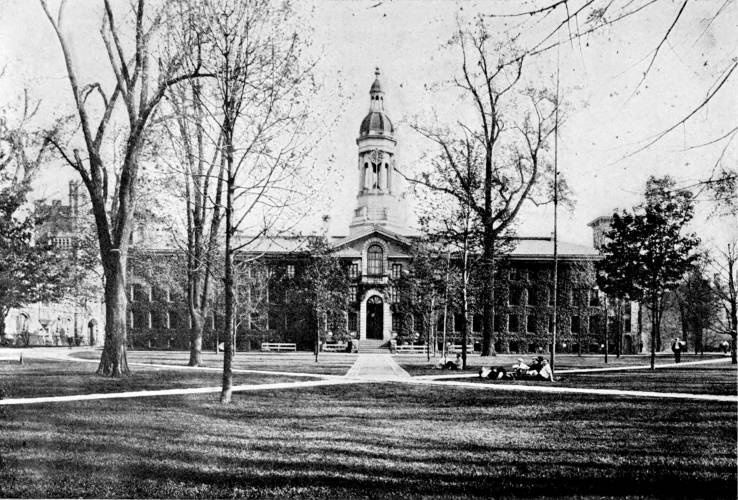
NASSAU HALL, PRINCETON
Many of the buildings suffered during the Revolution, and much trouble was found to raise sufficient funds to repair them; but, as time wore on, the college revived and its income increased. The first president was the Rev. Jonathan Dickinson; the second, the Rev. Aaron Burr (father of the famous Aaron Burr); the third, Jonathan Edwards; and the sixth, Dr. Witherspoon, a member of the Continental Congress and a Signer of the Declaration of Independence.
With a few exceptions, the buildings, numbering forty-two, are grouped around Nassau Hall. They are built, for the most part, of stone, and are situated in the midst of beautiful grounds, composed of hills, meadows and woodlands and avenues of tall elms. One of the most conspicuous of these is known as “McCosh’s Walk,” named for Dr. James McCosh, who came from Queen’s College, Belfast, Ireland, to become the president, a post which he held from 1868 to 1888.
Among the most important buildings are the Library, Marquand Chapel, Witherspoon Hall, Blair Hall, Alexander Hall, the John C. Green School of Science, Dickinson Hall, Murray Hall, Edwards Hall, Reunion Hall, Chancellor Green Library, Biological Laboratory and the Gymnasium. There are also several fine museums and collections of pottery, antiquities, geology and archæology.
The Princeton Theological Seminary associated with the college, was organized in 1812 and chartered in 1822.
Princeton celebrated its sesqui-centennial in October, 1896, and on October 22, 1896, President Patton announced its change of name to Princeton University by the authority of the legislature.