THE CATHEDRAL, MEXICO THOMAS UNETT BROCKLEHURST
Reading edition
When Cortes conquered the country, he had instructions from Ferdinand and Isabella, from Charles V. and from Pope Alexander IV. to Christianize it; and this part of his duty, with the help of his army of priests and the formidable terrors of the Inquisition, he accomplished all too zealously. The successive Spanish Viceroys completed the work in the spirit of their age; indeed, in such a manner, that when the books are opened and the last seal broken, the cries of the heathen will most probably drown the anthems of the saints. The Old Testament injunction, “Thou shall utterly destroy the heathen from amongst you,” without a single gleam from the brightness of the Sermon from the Mount, has under no circumstances been more rigorously enforced than by Spain in Mexico and Peru; and what remains of her glories, but the bitterest of bitter feeling in Mexico, and the hatred of her Cuban subjects?
In the Conquest of Mexico it was the rule to destroy all the high places and all vestiges of the ancient worship. The Teocalli or temples were levelled to the ground; crosses were set up, and churches built on their sites. The magnificent Cathedral of Mexico stands over the spot where the high altar of Montezuma and his predecessors once ran with the blood of human sacrifices. The first church on this site, after the destruction of the Teocalli, was founded by Charles V. His successor, Philip, ordered it to be pulled down, and commenced the erection of the present structure in 1573. It was not finished and dedicated until the 22d of December, 1657. It has a fine dome and two open towers, each 218 feet high, in which are large bells exposed to view. The length of the building is 426 feet; the architecture is Doric; the railings of the choir, and the passage to the high altar were made of tumbago, manufactured at Macao in China, and weighing twenty-six tons. It is a brassy-looking metal, composed of silver, gold and copper, but contains so much gold, that an offer has been made to replace it with pure silver, and give many thousand dollars in addition. The cost of the Cathedral, that is, of the walls alone, was over $2,000,000. The interior of the building forms a Greek cross, and is divided into five naves. On either side of the main nave are wide chapels, elaborately adorned and enclosed by bronze gates; the walls are clothed with pictures in rich old Spanish gold frames; and at one time a Murillo stood over the high altar, but the present archbishop, wise in his generation, after the robbery of a famous picture from a church in Spain, caused it to be removed to the archiepiscopal palace, where it now hangs. There is no stained glass in the windows, and there are no such luxuries as pews; Indian and Hidalgo, Aztec and Spaniard, peon and peasant, kneel on the bare boards. One rude bench is reserved for the old and infirm.
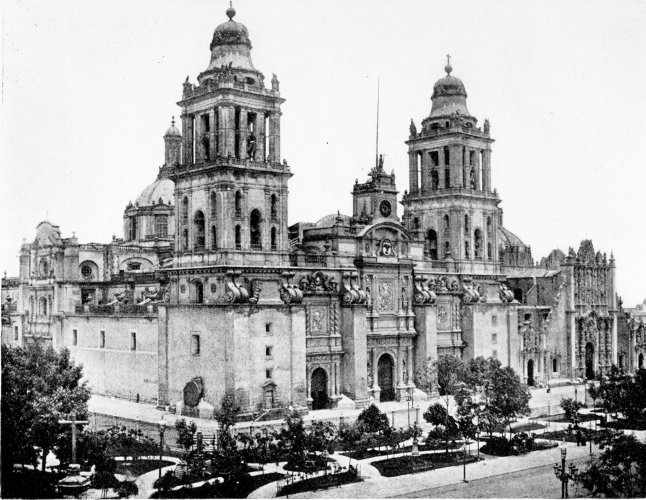
CATHEDRAL OF MEXICO, MEXICO
The choir is one mass of elaborate carving; the choir books, dating from 1620, are of vellum, and painted in black letters. Close to the choir is a magnificent altar, supported by green marble columns resembling malachite. A rich balustrade of tumbago connects the altar and the choir. The picture of the Virgin, in the central nave, was painted by Cabrena in 1700, and a St. Sebastian, in one of the chapels, by Balthasor de Echavi in 1645. The glory of the cupola was painted by Simeno de Planes; on the first plane are placed the ancient patriarchs and the celebrated women of the Old Testament, the colours being as vivid at this moment as when laid in. The balustrade surrounding the grand altar is also of tumbago, as are the sixty-two statues which serve as chandeliers. The high altar is approached by seven steps, the tabernacle is supported by eight ranges of pillars in the form of a colonnade, on the first of which stand the statues of the Apostles and the Evangelists, while those of numerous saints occupy the second range. On the third appear groups of angels, and, rising from the midst, the Mother of God.
The sacristy is fitted up with oak, black as ebony from age, with several large pictures. I often looked into it, and one day I found two or three priests indulging in a quiet chat after Mass, while the attendants folded away the rich vestments. A padre, seeing I was a stranger, offered to show me the magnificent set of vestments worked for the Cathedral by command of Isabella of Spain; they are of cloth of gold, encrusted with gems, and in panels passages from Holy Writ are worked exquisitely in silk, so as to have the effect of the finest painting; it is only on close inspection that I could discover the traces of the needle. These gorgeous vestments are useless for practical purposes, for they are so heavy that no man of ordinary dimensions could sustain their immense weight for more than a few minutes. Saying mass, or even pronouncing the benediction in them, is out of the question. By the kindness of the padre I was also permitted to view the great council chamber, part and parcel of the Cathedral, in which the councils of the bishops were held, the Archbishop of Mexico presiding on a great gilded throne. This is indeed a noble apartment; it has an open groined roof, and around the walls are portraits of suffragan bishops of Mexico—copies only, for the originals are hung in a sort of secret chamber, to which I was subsequently conducted. This chamber was approached through the gates of a side altar, and the cicerone touched a—to me—invisible spring; a door of maximum thickness slowly opened to admit us to a sort of crypt, with formidably barred windows, around which hang the original portraits of the bishops from first to last, in splendid preservation. In this apartment was a massive oaken table, with a sort of funnel in the middle of it. It is on this table that the offerings of the faithful, after a collection, are deposited, counted, and dropped through the funnel into huge, grim-looking, iron-bound boxes, which stood about the room.
During my stay in Mexico excavations were being made in front of the Cathedral to convert the paved ground into a garden, and but a few feet below the surface some octagonal columns of the first church were discovered; also two heads of large stone serpents, some ten feet long and five feet in depth and in thickness; the carving of the feathered ornaments on the heads was perfect; they had originally been the capitals to the doorposts of the pagan temple of Montezuma, and these interesting fragments of both temple and primitive church were conveyed with much labour and care to the National Museum.