MOUNT VERNON ARTHUR SHADWELL MARTIN
Reading edition
Every patriotic American who visits Washington makes a pious pilgrimage to the home and tomb of the Father of his Country. There are two ways of reaching Mount Vernon, one by trolley and one by river. The road passes through a flat, uninteresting and somewhat desolate country; and a loud-voiced cicerone indicates the points of interest on the way. The journey is usually broken either going or returning at Alexandria, a quaint, old, sleepy, dilapidated, little town. Visitors stroll through its grass-grown streets, marvel at its rotting wharf, drop in at the Carlyle House, where the ill-fated Braddock made his headquarters; and then take a look at old Christ Church where Washington worshipped.
The pleasantest and most picturesque route, however, is by river. A delightful sail down the Potomac for about an hour brings one to the landing-stage at the foot of the grounds. The approach to the house is very fine. Mount Vernon stands on a wooded eminence commanding a beautiful view of the reaches of the river and the opposite shores. From the river, the house with its broad pillared colonnade has an impressive air.
The estate of Mount Vernon in Washington’s day was an extensive one of two thousand broad acres. Its owner was very fond and proud of it. He himself wrote: “No estate in United America is more pleasantly situated. In a high and healthy country, in a latitude between the extremes of heat and cold, on one of the finest rivers in the world, a river well stocked with various kinds of fish at all seasons of the year, and in the spring with shad, herring, bass, carp, sturgeon, etc., in great abundance. The borders of the estate are washed by more than ten miles of tide-water: several valuable fisheries appertain to it. The whole shore in fact, is one vast fishery.” Washington was also proud of his trees. To increase their numbers and varieties was the constant occupation of his home life. Every season of the year found him providing for them. The grounds still owe much of their charm to his care. They glisten and bloom with shade trees, evergreens, flowering shrubs and fruit trees:—box, holly, tulip, poplar, sweet-gum, sassafras, dogwood, oak, mulberry, aspen, ash, locust and fringe-tree are plentiful, the deciduous trees in this list being natives of Fairfax County. Washington’s diary shows his interest in forestry and gardening. He notes when the white-thorn is in berry, when he clears the undergrowth of a clump of pines, when he plants hemlock and sows holly berries, when he plants acorns and buckeye nuts brought from the battleground of Monongahela, and horse-chestnuts from his old home in Westmoreland.
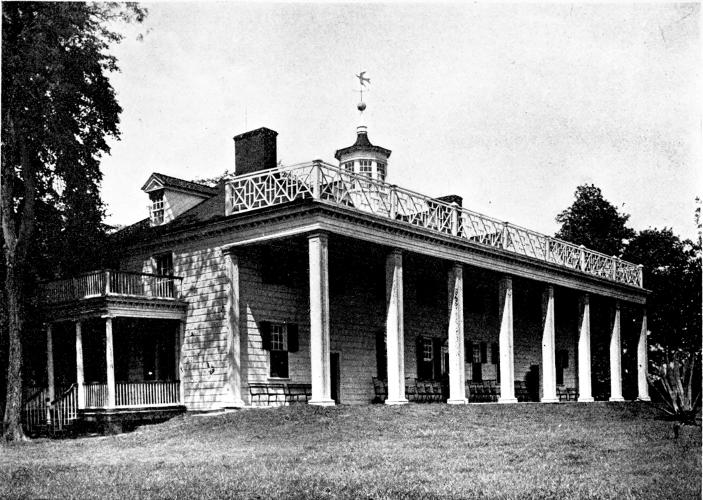
Copyrighted by Soule Photo. Co.
MOUNT VERNON, VIRGINIA
Mount Vernon was originally built by George’s elder half-brother, Lawrence Washington, who laid out the grounds and named the place in honour of Admiral Vernon, under whom he had seen distinguished service at the siege of Cartagena. When George came into possession soon after his generous brother’s death in 1752, Mount Vernon was a modest and unpretending Virginia dwelling. The new owner improved and enlarged it on several occasions, and frequently added to the out-buildings. At some little distance from the driveway facing the east front, the road led through a patch of flowering shrubbery and passed between porters’ lodges built of sun-dried bricks to the gateway familiar to every tourist. This approach opened to view a plain two-story house with peaked roof and cupola, and out-buildings connected with the main structure by an open arcade, in the usual Virginia style. These covered ways are a great protection in cold or inclement weather to those bringing in hot food from the kitchen, which, here as elsewhere, is separate from the house.
The only striking architectural feature of the building was the colonnade, a broad flagged piazza on the side facing the river, supporting by slender wooden columns the eaves of the roof, and affording a shady and cool retreat for family and visitors. The lawns slope away down to the river, and many a pleasant afternoon tea has been enjoyed under those columns.
Leaving the landing-stage we take a short walk up the hill and reach the building where lie the mortal remains of the great liberator and first President of the United States. Considering the memories that cluster around it, the structure is insignificant and unworthy. It is more like an ordinary spring-house than a mausoleum, and when we remember what has been expended on Grant’s tomb and others whose memory the nation delights to honour, we cannot help marvelling at the sordid simplicity of Washington’s last resting-place. The graves of many members of the family lie around it; and in the vault at the back of the mausoleum are the remains of many more. Who they were, however, we have no means of ascertaining because there are no records or tablets to assist us. For more than half a century, this tomb suffered from worse than neglect, for the pious pilgrims and the ordinary curiosity hunters who visited the tomb of the Father of his Country carried away as mementos chips of masonry, pebbles, flowers, ferns, twigs, branches of trees and bushes, and generally devastated the place. These depredations have now ceased, however; and the tomb is now protected by lock and key against vandalism.
The work of protection and preservation is now in the hands of the Mount Vernon Ladies Association of the Union which was the first patriotic organization of women in the United States. It was started in 1853, and received a charter from the Virginia legislature in 1856. After long correspondence Mr. John Augustine Washington consented to surrender the mausoleum, house and 200 acres of grounds for $200,000. The money was soon raised and Mount Vernon now belongs to Virginia, and is under the charge of regents appointed one for each state of the Union. These in turn are under a president. The regents meet at Mount Vernon every year. The house and grounds are under the direct charge of a resident superintendent, who is as courteous and obliging as he is an able administrator. Many of the rooms are under the special patronage of separate states, and there is in consequence a good deal of competition among the regents to supply furniture of Washington’s day, when it is not possible to recover genuine Washington relics. It has been said that Washington snuff-boxes are as plentiful as Mayflower furniture; but now every precaution is taken against labelling anything that is not undeniably authentic.
The house has two important fronts, presenting one to the river and another to the beautiful sweep of turf between it and the road. The gardens, with their greenhouses and thick box hedges, are beautiful at all seasons of the year.
Mount Vernon is by no means a palatial mansion: perhaps the visitor’s first feeling is one of disappointment. The hall with its winding staircase is roomy enough, but the rooms—the bedrooms especially—are undeniably small. However the house is cosy enough, and was ample for the needs of Washington and his small family.
By donation and purchase, the regents have managed to collect quite a respectable number of George Washington’s personal belongings. There is the great carpet specially manufactured for him and presented by Louis XVI.; then we note his parlour mirror, bookcase, travelling trunk, dressing-table, shaving glass and various wearing apparel, besides many chairs, tables, beds and Miss Custis’s harpsichord. Before the ladies took charge, the furniture, panelling, etc., suffered terribly from the depredations of conscienceless relic-hunters,—but now it is protected from goths and vandals by gates.
Mount Vernon during Washington’s lifetime was furnished with comfort and elegance. It may be interesting to the reader to go through some of the rooms with the guidance of the inventory taken after George Washington’s death.
The rooms then were not named as they are now, but they can be readily identified. The “New Room” was evidently used as a dining-room, since it was furnished with two dining-tables, two sideboards, on which stood six mahogany knife-cases, China images and a China flower pot, twenty-seven mahogany chairs, two large looking-glasses, two candle-stands, two fire-screens, two stools, two elegant lustres, two silver-plated lamps and six China jars on the mantelpiece. The hearth was supplied with andirons, dogs, shovel, tongs and bellows; the floor was covered with a good mat; the windows were draped with valuable curtains; and pictures worth nearly a thousand dollars adorned the walls.
The “Front Parlour” contained an expensive sofa, eleven mahogany chairs, a tea-table, a rich looking-glass, three lamps, two of which had mirrors, five China flower-pots, chimney furniture, a handsome carpet and window curtains. Many pictures hung on the walls.
The “Little Parlour” was furnished with a settee, tea-table, ten Windsor chairs, looking-glass, fender and hearth furniture, carpet, window curtains and pictures.
In the “Study” we find a bureau, a tambour secretary, a walnut table, two pine writing-tables, writing-desk and apparatus, circular chair, armchair, dressing-table, oval looking-glass, eleven spy-glasses, a case of surveying instruments, a globe, two brass candlesticks, seven swords and blades, four canes, seven guns, 45 lbs. of silver plate valued at $900, other plate worth $424, and many other articles. This was evidently the General’s sanctum, where he attended to his correspondence and other business.
When the number of guests did not require the use of the “New Room,” the family gathered in the “Dining Room.” Here were two dining tables and a tea-table, a mahogany sideboard, two knife cases and a large spirits case, ten mahogany chairs, a carpet, hearth furniture, window curtains and pictures.
The “Bedroom” contained a bed, bedstead and mattress, looking-glass, small table, four walnut chairs, window curtains and blinds, a carpet, andirons, etc., and one large picture.
All along the staircase were hung a great number of prints, and a looking-glass was in the passage on the second floor. In the lower “Passage” were fourteen mahogany chairs, a spy-glass, a thermometer and pictures. The “Closet” contained a fire-screen and a machine to scrape shoes on. There were thirty Windsor chairs on the Piazza:—ample provision surely for callers!
The walls of the “Front Room” were decorated with prints. It was cosy with window curtains, fireplace and carpet. The rest of the furniture comprised a bed and bedstead with curtains, a dressing table, a large looking-glass, a wash-basin and pitcher and six mahogany chairs.
The “Second Room” was similarly furnished, except for the chairs, of which there were only five, including an armchair. A portrait of General Lafayette hung on one wall, he having occupied this room.
The “Third Room” was furnished exactly like the “Front Room” except for a chest of drawers in addition. Prints ornamented the walls here also.
The “Fourth Room” contained bed, bedstead and curtains, carpet and window curtains, andirons, prints, five mahogany chairs, pine dressing table and large looking-glass, a close chair, wash-basin and pitcher.
The “Small Room” was furnished with bed, bedstead, dressing table, dressing-glass, washstand and three Windsor chairs.
The “Room which Mrs. Washington now keeps” was almost as desolate as her short widowhood. She seldom left it during the short time she survived her husband. It contained only a bed, bedstead and mattress, table, three chairs, oval looking-glass, carpet, fender and andirons. This is quite bare in comparison with “Mrs. Washington’s Old Room,” which contained a bed, bedstead and curtains, a glass, dressing table, writing-table and writing chair, an easy chair, two mahogany chairs, a chest of drawers, a clock, carpet, window curtains, fender, andirons and pictures.
The kitchen, still in its old condition, was thoroughly equipped for the hospitality demanded of the master of Mount Vernon.
The total value of the furniture was nearly $3,500; that of the 139 chairs alone was $658; and of the pictures and prints, $2,000.