YENIKEUIJ.
Reading edition
“Not a soul But felt a fever of the mad, and play’d Some tricks of desperation: all Plung’d in the foaming brine—cry’d Hell is empty, And all the devils are here!” Shakspeare.
There are few prettier villages on the Bosphorus than Yenikeuij, which is situated on the European shore, within two miles of Therapia. The houses, in numerous instances, overhang the sea; and the beating of the waves against the narrow terraces, as the rapid current forces them onward, keeps up a constant murmur, which, in the hot months, is extremely refreshing. The heights above the hamlet are profusely wooded; and many wealthy Armenian Sarafs and Greek merchants have their maisons de plaisance among them.
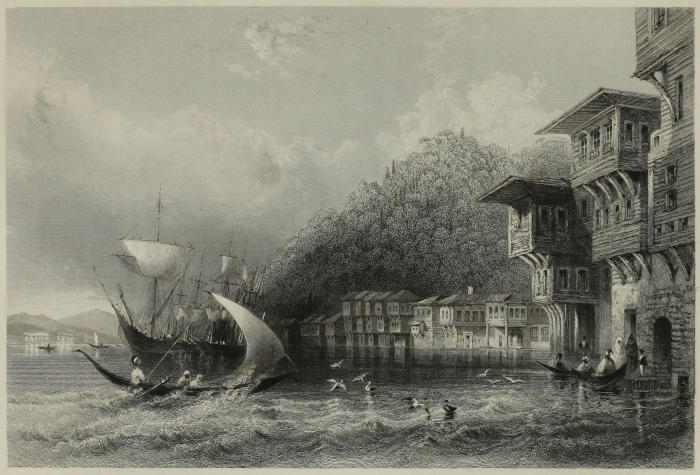
YENIKEUIJ ON THE BOSPHORUS.
YENIKEUIJ SUR LE BOSPHORE. YENIKEUIJ AM BOSPHORUS.
W. H. Bartlett. J. J. Hinchliffe.
London. Published for the Proprietors, by Geo: Virtue, 26, Ivy Lane, 1839.
The largest mansion in the village was built by the celebrated and unfortunate Dooz Oglou, the great banker and diplomatist, and one of the most talented, as well as the wealthiest Armenian in Turkey. When high in favour with the Sultan, he purchased a small kiosque at Yenikeuï, and formed so great an attachment to the locality, that he determined on erecting there a residence worthy of his princely fortunes. This spacious palace—for, although, as is common in the country, the building is almost entirely composed of wood, it cannot be consistently called by any other name—presents a comparatively insignificant façade to the water; but occupies the whole line from thence to the foot of the height, and traverses the public street of the village by a covered bridge, which is occupied by a wide gallery leading to the dining saloon.
To obtain sufficient space for the erection of this noble dwelling, and the formation of the grounds about it, Dooz Oglou purchased no less than five and thirty houses, for which he paid, in every instance, several hundred piastres beyond the demand of their owner; and once established, he filled his spacious apartments with costly furniture, and all the luxuries which unbounded wealth and a fine taste could command. Alas! he was but gilding his own ruin, and lavishing his resources upon a pile which was not even destined to be his monument. This outlay awoke the cupidity of the Ottoman court, which was at that period much more venal than it is at present, and his ostentation alarmed its vanity; he was accused of usury, or treason, or both—for the nature of his crime was never very clearly defined—his property was confiscated, and he was hanged upon his own threshold, from a staple driven into the wood-work of the gate opening upon the seaward terrace. The mansion at Yenikeuï was subsequently presented by the Sultan to Nicholas Aristarchi, the present Logotheti,[35] by whom it is inhabited during the summer.
Yenikeuï is also remarkable as being one of the three hamlets in which the Greek “Festival of Fire,” instituted in commemoration of the second capture of Constantinople by the Cæsars, is still permitted to be held. This singular ceremony was formerly common in all the Greek villages, and even in that quarter of the capital itself in which that nation reside; but the privilege of promiscuous illumination has been withdrawn, owing to the great risk of conflagration to which it subjected the city; and the festival is now held only at Yenikeuï, Therapia, and Buyukdèrè.
Artificial islands, formed of hurdles, and heaped with inflammable matter, are formed in the bay—caïques, saturated with bitumen, are moored off the shore—and lines of bonfires are raised along the coast, linking the three hamlets together—all of which are simultaneously ignited at a given signal, and the effect is awfully grand and impressive. The dim outline of the Asian hills is suddenly revealed, as by the touch of an enchanter’s wand, and seems to be traced in gold; the ripple of the channel dances along like sparks of fire; while around, and on every side, are to be seen groups of people in their holiday-dresses, seated upon mats and carpets, enjoying the extraordinary spectacle.
But, perhaps, the most novel feature of the entertainment is presented by a crowd of men, partially clad in white cotton, their shaven heads bare, and their arms tossing wildly in the air; who, with shrieks and yells, which are sullenly thrown back by the rocky heights above them, at one time feed the fires that are floating in the bay, above their waists in water; and at others, joining hands, dance in a fantastic circle round their flaming islands. Meanwhile, servants are flitting here and there, holding paper lanterns, and guiding the different parties of revellers to the houses of their respective friends; while the channel is alive with caïques, each with a light at its prow, and freighted with mirth and music.
These wild sports continue for hours, until the fuel and the energies of the assistants are alike exhausted, when the fires gradually die away; though the pale light of morning not unfrequently breaks above many a homeward-bound caïque, ere it is safely moored beside the terrace of its owner.