THE MOSQUE OF SULTAN ACHMET.
Reading edition
“The house of prayer profaned by words of strife— The shrine of peace loud with unholy war— The silent courts made vocal with the voice Of human passion——”
The Mosque of Sultan Achmet, although less spacious than that of St. Sophia, and less elegant in its details than Suleimaniè, is superior to both in exterior effect. Its position is admirable; for the noble and well-shaded space in which it stands occupies a side of the Atmeidan, or Place of Horses, one of the most elevated portions of the city, and is only separated from the ancient race-course of the Romans by a handsome wall of white marble, intersected with gilt railing.
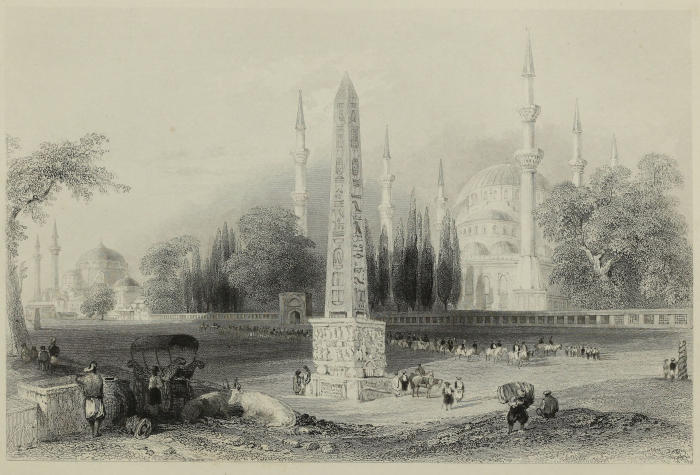
THE ATMEIDAN, OR HIPPODROME.
L’ATMÉIDAN OU HIPPODROME. DIE REITBAHN ATMEIDAN.
W. H. Bartlett. C. K. Richardson.
London. Published for the Proprietors, by Geo: Virtue, 26, Ivy Lane, 1839.
A singular feature in this mosque, and one by which its beauty is much enhanced, is the circumstance of its being the only temple in Constantinople having six minarets; and the peculiarity is stated to have grown out of the desire of its Imperial founder to possess a mosque in his capital rivalling that at Mecca in this particular. The permission of the Mufti having been with difficulty obtained, and the number of minarets at Mecca being increased to seven, in consequence of its not being deemed expedient that any other mosque should emulate that which is sanctified by the tomb of the Prophet, the temple built by Sultan Achmet at once exceeded in beauty every other in Stamboul. The arrangement of the minarets is effected in the most graceful manner; two of them only being attached to the principal building, while the remainder cut sharply and irregularly through the dense mass of foliage amid which the mosque is buried. Their galleries of Saracenic architecture look like fringes of lace, and their slender spires are touched with gold, and glitter in the sunshine; while the extreme beauty of the ancient trees, which are coeval with the building, throw out the dazzling whiteness of the whole pile, and their own sober depth of shadow relieves the eye with its refreshing coolness.
At the upper end of the Atmeidan stands the monument of Constantine, a square pillar, ninety feet in height, and indebted only to tradition for its name. And tradition has been but a sorry godmother, for, in the nineteenth century, she is unable to decide to which of the fourteen Emperors so called, it was really dedicated. It may have been the founder of the Empire—the first and almost the greatest of the whole; and then, indeed, it were worthy to exist for ever as the memorial of a strong arm and a brave spirit; but to him succeeded twelve other Constantines, supine and imbecile; mere cumberers of the earth, to whom it could but serve as a finger pointing to heaven to beckon thence the scorn of the angry gods upon his degenerate and dishonouring successors. It should have been—but, alas! it cannot—a record of the last, who washed away the reproach of the whole world upon his line, in the blood of a heroic heart—of that Constantine Paleologus, who offered himself up on the ruins of an expiring dynasty; the Imperial victim, who fell in the breach he had no longer strength to defend, and left a glorious name and a crumbling city to the victorious arms of the Infidels; the last and greatest of the Constantines, of whom no memorial now exists, save in the pages of the historian, and the strains of the poet. Had the column been indeed erected to his honour, the hand by which it was denuded might well have withered at its work; for the brazen covering by which the imperfect masonry was originally concealed has been torn away, and with it every vestige of its ancient splendour and appropriation. The stones, now laid bare to the unsparing touch of time, have every appearance of being carelessly and inartificially piled together; and traces of the huge brazen nails that formerly secured the outer surface, still remain to attest the Vandalism which no regret can now repair. To a casual observer, it appears incredible that so slight and imperfect a pile, so small in circumference and so great in height, should thus long have maintained its equilibrium.
Near this column, and about midway of the Atmeidan, are seen the remains of the Delphic Tripod—a relic rendered principally interesting by a tradition in which the Turks have firm faith, and which affirms, that when by any accident it shall be either destroyed or displaced, Constantinople will become once more a Christian capital. They furthermore assert that the first brazen head of the three serpents whose evolved bodies form the column, was lost in the transfer of the trophy to Stamboul; that the second was stricken off by Sultan Achmet, at a single blow of his scimetar, to prove the strength of his arm to his assembled troops; and that the third disappeared, no one knew how nor whither. It is certain that the fragment which now remains is headless, and, were it not for this national legend, almost unworthy of notice.
At the extremity of the square stands a handsome Obelisk of red Egyptian granite, raised upon a pedestal of white marble, coarsely embellished with the victories of Theodosius, which blend but badly with the elaborate hieroglyphics inscribed with such minute care immediately above them. The Obelisk is sixty feet in height, and is in itself very beautiful; but its charm is considerably weakened from its juxta-position with the architecture of another age and country.
But the Atmeidan has become in itself famous during the reign of the present Sultan by its historical associations—associations which are far more interesting than even the antiquarian treasures that it contains; for it was here that, during the destruction of the Janissaries in 1823, that fated body made a vigorous though ineffectual stand against the troops of their Imperial master. Thousands are said to have fallen in this square alone by the weapons of the soldiery of the Nizam Attick,[20] and the musketry to which they were exposed from the windows of the neighbouring houses. Here, too, several of the ringleaders were captured, and hanged by order of the Sultan, on a large plane-tree near the gate leading into the outer court of the mosque, which has since been called by the Turks, “the Tree of Groans.”
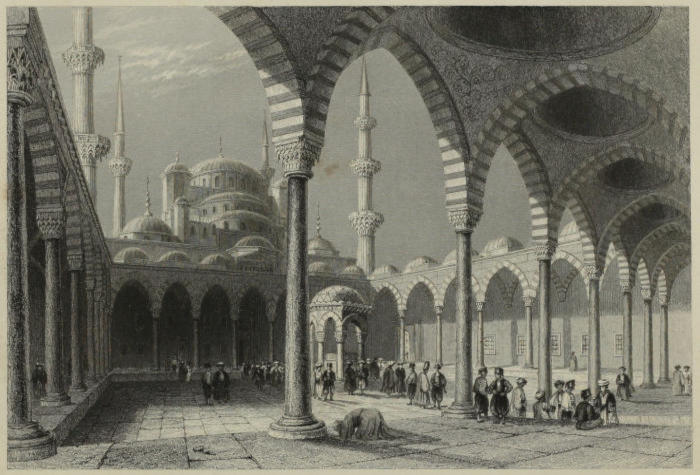
COURT OF THE MOSQUE OF SULTAN ACHMET.
W. H. Bartlett. S. Fisher.
London. Published for the Proprietors, by Geo: Virtue, 26, Ivy Lane, 1839.
The interior of Sultan Achmet is chiefly remarkable, architecturally, for the immense size of the four columns which support the dome; for its spacious and elegant galleries, roofed with mosaic; and for its lofty marble pulpit. Its paramount claim to interest exists, however, in the fact, that it was within these walls that the Sandjâk Sherif, or Sacred Standard of Mahomet was exposed, after the refusal of the Janissaries to submit themselves to the will of the Sultan.
The Sandjâk Sherif had not been publicly exhibited in the capital for half a century; and the idea was a most politic one, as all the enthusiasm and fanaticism of the empire was sure to be enlisted under its folds. This standard, so revered by all good Musselmauns, is believed to have been the nether garment of Mahomet, and is the most solemn relic possessed by his disciples; and its appearance rallied at once every devout Moslem in the ranks of the sovereign.
A procession was formed from the Imperial Treasury to the mosque of Sultan Achmet; the Sultan, attended by all his court and household, was preceded by the Ulema and Softas of the city, rehearsing verses from the Korān. Public criers announced the exhibition of the holy standard throughout the capital, and the excitement was beyond all precedent.
When the cortège reached the mosque, which they entered by the great gate opposite the Atmeidan, the Chèïk-Islam mounted the steps of the pulpit, and planted the Sandjâk Sherif there with holy reverence; and as he did so, the Sultan pronounced an anathema against all those who refused to obey an authority so supported.
These circumstances throw a halo around the mosque of the Sultan Achmet which greatly enhances its actual beauty; and the traveller loiters willingly amid its dim magnificence, calling up visions of the past which stamp an extraneous value upon every detail of the edifice.
A curious and valuable collection of antique vases, of the most graceful designs and beautiful workmanship, many of them inlaid with gems and mother-of-pearl, are suspended throughout the mosque from transverse bars of iron; together with the eggs of ostriches, emblems of dependence on Providence; ears of corn, the symbols of plenty; and similar typical decorations.
But the glory of Sultan Achmet, as an edifice, is its inner, or cloistered court, surrounded by graceful Saracenic columns, whose capitals resemble clusters of stalactites, forming the base of arches of extraordinary beauty. In the centre of the court, which is paved throughout with rich marble, a stately fountain, surmounted by a handsome cupola, gives an aspect of refreshing coolness to the enclosure. On the left hand of the gate of entrance is situated a balcony, upon which opens one of the windows of the mosque, whence all firmans of public interest are read aloud to the people; and, taken altogether, whether as a public building, as a religious monument, or as the site of stirring incident, there is no temple in Stamboul more worthy of attention than the Imperial Mosque of Sultan Achmet.