THE AQUEDUCT OF BAGHTCHÈ-KEUÏ.
Reading edition
Closed be the eye which coldly has beheld The long-enduring monuments of eld, Nor read upon their proud and hoar decay A lesson to the vanity, which, based Upon the empty follies of to-day, Lets all the soul’s best feelings run to waste. MS.
Allusion has already been made to this fine old aqueduct, which spans the beautiful meadow above Buyukdèrè with its lofty arches. The view from it is singularly lovely, and very extensive; valley and mountain, land and water, waste and forest, are spread out on all sides in noble combination; while the deep stillness of the spot gives a sublimity to the landscape which must be felt to be understood.
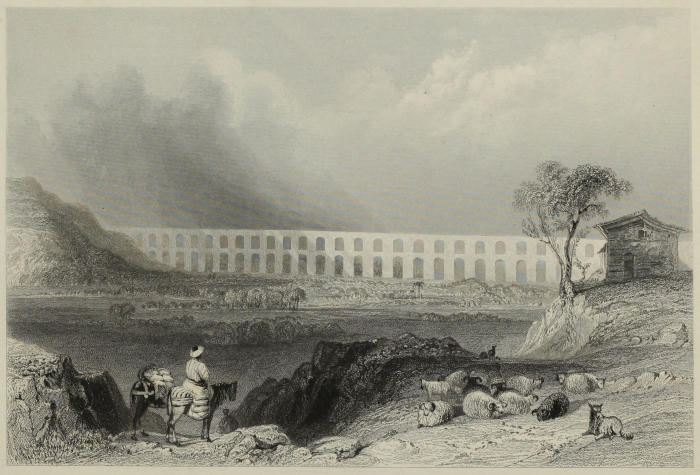
AQUEDUCT OF BAGHTCHÈ-KEUÏ.
AQUEDUC DE LA BAGHTCHÈ-KEUÏ. DER WASSERLEITUNG DER BAGHTCHÈ-KEUÏ.
W. H. Bartlett. J. B. Allen.
London. Published for the Proprietors, by Geo: Virtue, 26, Ivy Lane, 1839.
There is a season called by the Turks Patlinjam Melktem, a time in autumn remarkable for producing a particular species of gourd, when a north-east wind invariably sets in, and the Black Sea, violently driven against the western shore, sends forth a low and solemn moaning like the continuous voice of human agony. The effect of this awful diapason from the aqueduct of Baghtchè-Keuï is thrilling,—one long wail of woe fills the air—while the wild waves, hurled against the rocks at the mouth of the Bosphorus, carry upon their crests the foaming banner of destruction, warning from their vicinage the daring bark which would essay the entrance of the Boghaz. At this period dense banks of fog are packed against the rocks, and the whole line of coast presents one mass of heavy uniform obscurity; rendering a passage, at all times sufficiently perilous, almost impossible: the entrance is flanked by two bold and abrupt promontories, crowned with light-houses, and known as the Phanaraki Points. A small village is situated near each of these beacon-towers: and at no great distance stand two of the channel-fortresses, strikingly defined against the dark green rocks on which they are built.
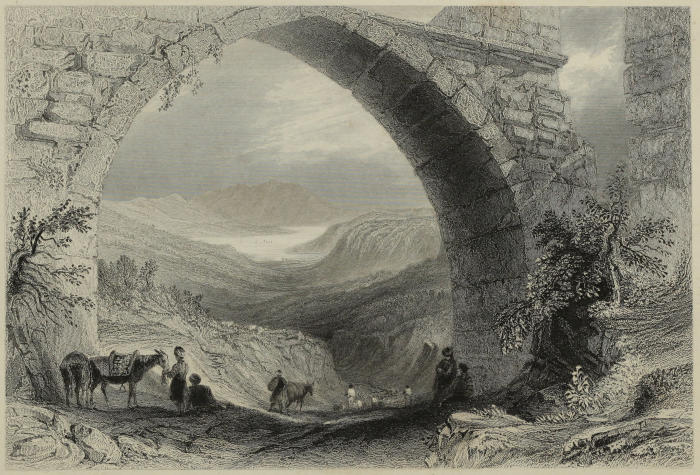
VIEW THROUGH THE AQUEDUCT OF BAGHTCHÈ-KEUÏ.
POINT DE VUE À TRAVERS L’AQUEDUC DE BAGHTCHÈ-KEUÏ. AUSBLICK DURCH DIE WASSERLEITUNG BAGHTCHÈ-KEUÏ.
W. H. Bartlett. J. Redaway.
London. Published for the Proprietors, by Geo: Virtue, 26, Ivy Lane, 1839.
Between the two promontories, but considerably on the European side of the Boghaz, stands one of the Symplegades; the other is at a considerable distance, quite within the Euxine, and very close to the shore. Dr. Walsh, who visited this latter, gives the following very graphic and interesting account of it:—
“We landed with some difficulty, the great swell rising nearly half way up the rock, and threatening to throw our light skiff on the ledge of some precipice. It stands about half a mile from the light-house point of the European shore, just within the Black Sea. It consists of a rocky eminence, twenty or thirty yards in height, and two or three hundred in circumference. On the summit is a very beautiful circular pedestal of pure white marble and fine sculpture. It is four feet three inches in height, and two feet seven inches in diameter; round it is a rich festoon of flowers, supported on bulls’ heads, with stars between the folds. It is of superior workmanship, and seems to have been sculptured at an era when the arts were cultivated; but of its origin, date, or name, there is nothing certain; even its shape is not agreed on. The Byzantine historian, Dionysius, says the Romans erected a fane on this rock, and hence it is called ‘the Altar.’ Whatever might have been its original destination, it was latterly appropriated to another use; this is the opinion of Gillius, who saw it in 1545. There stood upon it a Corinthian column, and the monument obtained the name of ‘Pompey’s Pillar,’ by which it is sometimes known. There was a vague tradition that he had erected it after his victory over Mithridates, whose kingdom of Pontus was close beside, on the coast of Asia. He named a city on the coast, built by that monarch, ‘Pompeiopolis;’[51] but there is no historical record of erecting a column; and Pompey has lost the reputation of this pillar, as well as of that at Alexandria, which it now appears was raised to Dioclesian. When Tournefort visited the rock in 1700, he saw the pillar, twelve feet in length, but it has now disappeared. On the summit of the pedestal which remains, are four square apertures sunk into it, and they seem to have been intended to fasten on the top some other object. There is now no inscription, or trace of it, except some modern scribbling of travellers who have visited the spot; the earliest I could find was dated 1623. This beautiful piece of sculpture, on the summit of so remote and solitary a rock, is a very striking object, and strongly contrasted with the rude wildness of every thing about it.
“The substance of which the rock is formed seems an extraordinary composition. It is a kind of breccia, of various coloured lava, trap, basalt, and limestone, intersected by veins of agate, or chalcedony, of considerable extent. It seems, in fact, an agglomeration of heterogeneous substances, fused together by the action of intense fire. But the colour most predominant is blue or dark green, arising from the presence of some metallic oxide. This has conferred upon the rocks their comparatively modern name: when they were no longer an object of terror, and ceased to crush ships between them, they lost their first appellation, and were called from their hue, Cyanean, a property which remains to this day.”[52]
In a season of storm, such as we have endeavoured to describe, the ear of the wanderer lingering at Baghtchè-Keuï is more thralled than the eye; for it is only when the lightning shimmers for an instant on the foam-crested waves by which the rocks are girdled, that the sublimity of the scene can be discerned,—when the “vexed Symplegades” are battling with the billows, and the dark coast casts back the watery charge with a moan of thunder, as though it mourned over the devastation which might be borne onward upon the wild and reckless storm-waves. The aqueduct should be visited at a more genial season, for its wide sweep of prospect to be fully enjoyed.
The valley of Buyukdèrè is the largest glen on the European shore of the channel, extending for five or six miles, and boasting its historical interest as well as its picturesque beauty; for here it was, in a flower-laden meadow of about a mile in width, that the doughty Godfrey de Bouillon encamped his Crusaders in the year 1097, when they were on their way to the siege of Micæa,—a reminiscence which is often renewed by the sight of Turkish tents on the same spot; the meadow of Buyukdèrè being a favourite resort of the Sultan, who in the summer months repairs thither to witness wrestling matches, the exercise of the jereed, and other athletic games performed in the open air.
Near the centre of the valley stands a platanus of enormous size, which is considered to be probably the largest in the world. It measures forty-seven yards in circumference near the root, and it is asserted that its branches overshadow a circular extent of upwards of four hundred feet. The enormous trunk is divided into fourteen stems, the forks of several being now hidden by the soil which has accumulated above them, while others are distant as much as seven or eight feet from the earth. One has been broken off at an immense height, and another is entirely hollow, apparently from fire, and is frequently used by the goat-herds as a refuge during storms.
Perhaps no platanus ever sung by the ancients, honoured by the admiration of an Emperor, haunted by the philosopher and the patriot, or nourished by the Anacreontic libations of Roman revellers, deserved immortality more fully than that of Buyukdèrè. A French naturalist has conjectured that it must have existed more than two thousand years; yet still its gigantic branches spread far and wide, garlanded with fair fresh leaves, and its sturdy boughs rebound from the pressure of the tempest-wind which sweeps over them in its fury, with all the firm free vigour of eternal youth: generations pass away—the infant rises into the boy—the boy strengthens into the man—manhood withers into old age—and the grave closes over the dead:—another race succeeds, and yet another, and another; while the same tree lives on, hale, and green, and flourishing, mocking at poor mortality, and weaving a new web of beauty with every changing season. The triumph of man’s strength and of man’s ingenuity, the stately aqueduct of Baghtchè-Keuï, still stands indeed, and has also endured throughout its weary centuries; but like all man’s works it is perishable and imperfect. The ponderous masonry is loosened and displaced—the surface of the stone is corroded by the tooth of time, and the action of the atmosphere—lichens and caper-plants have rooted themselves amid the interstices of the building; and while the platanus bursts out into fresh youth with every coming spring, each revolving year renders the human monument more weak and hoar and writes upon its gigantic arches the characters of decay.