AQUEDUCT NEAR PYRGO.
Reading edition
“Relic of nobler days, and noblest arts.” Byron.
This fine remain of by-gone industry and taste is indifferently ascribed to the Emperor Valens, and to Justinian; no positive record of its date or founder being now in existence. It spans a lovely hill-embosomed valley near Pyrgo, and is one of several aqueducts still in existence between the city of Constantinople, and the beautiful, romantic, and Frank-peopled hamlet of Belgrade, on the Black Sea.
The necessity of an ample supply of water to a population of nearly eight hundred thousand souls, and the frequency of drought in the capital, have led to great care and some ingenuity in its conveyance to the cisterns and reservoirs of the city from the numerous streams that fall from the mountains which fence the Euxine, and the rivulets that irrigate the valleys among them. Every rill, however apparently trifling, is arrested in its progress, when it descends from a height into the lower lands; by which means the valleys become inundated, and form deep and extensive lakes, whence the water is conveyed in tile pipes along the mountains, to pour its volume into the aqueducts which span the valleys, and give a noble character to the wild landscape. These artificial reservoirs are called bendts, and were originally formed by the Greeks; and the dams by which they are shut in are mounds, faced with marble, sculptured in oriental devices and characters, which are extremely imposing, and even magnificent. The Turks are, however, suffering the aqueducts of their predecessors to fall slowly to decay; and have supplied their places by detached square hydraulic pillars, sufficiently ingenious in their construction to merit description. A small reservoir is on the summit of each; and tubes, similar to those laid along the heights, pour the water into this tank on one side, and discharge it on the other. Each pillar is six inches lower than that which preceded it; and thus a gradual descent is produced along the tops of these suy-terrasi, or columns, from the mountains to Stamboul; and as they are spread in considerable numbers over the country, the supply is generally abundant, though it sometimes fails when the season is unusually dry, as in the years 1822 and 1836.
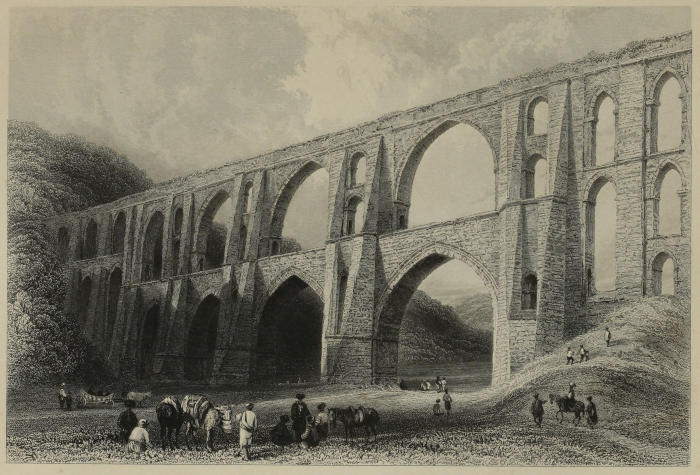
AQUEDUCT OF THE EMPEROR VALENS, NEAR PYRGO.
W. H. Bartlett. R. Wallis.
London. Published for the Proprietors, by Geo: Virtue, 26, Ivy Lane, 1839.
At such periods, the terror of a people like the Osmanlis, who not only connect ideas of comfort and convenience with the pure element, but to whom it is essential in the offices of their religion, may be readily conceived; and not the least affecting of its demonstrations is the appearance of a Dervish on the crest of the Jouchi-Daghi, or Giant’s Mountain, whose duty it is to watch for, and to announce to the thirsting city, the anxiously-awaited appearance of a small, lowering, heavy cloud, hovering above the waves of Marmora, or the Euxine—a certain indication of coming rain, which causes the Christian sojourner in the East to revert at once to the Sacred Volume, whose holy truths are constantly recalled to his memory in the land of the Infidel.
The artist seized a happy moment in which to transfer to his sketch-book the Aqueduct of Pyrgo. The sunshine rested lovingly on the old grey stones of the stupendous pile at one extremity, while the cool shadows of the mountain, with its flowery mantle of cistus, caper-plants, and wild vines, were flung in soft contrast over the other. A party of travellers, with their serudjhes,[13] sumpter mules, and araba drawn by buffaloes, were about to halt for their mid-day meal; and the sounds of human life and human laughter joyously awoke the echoes of the arch-spanned valley.
Nature and art, the present and the past, were before him; and the result has been not only a faithful, but a strikingly characteristic sketch.