THE PORT OF CONSTANTINOPLE.
Reading edition
“Where’er we gaze, around, above, below, What rainbow-tints, what magic charms are found! Rock, river, forest, mountain—all abound, And bluest skies that harmonize the whole.” Byron.
There is no better point whence to obtain a view of the Port of Constantinople than from the great cemetery of the “Infidel Hill” of Pera. The harbour lies at your feet, crowded with shipping, moored in treble lines along the shore, and filling every little creek and bay. The minaretted city cresting the opposite height like a diadem, stretches along in all the splendour of its mosques and palaces; terminated in one direction by the Eski-Seraï, glittering among its cypresses and plane-trees, and enclosed within the picturesque walls, which are washed by the blue waves of the Bosphorus and the Propontis, to which the hoary trees that overhang them pay back their tribute of shade and freshness; and on the other, by the historical suburb of Eyoub; while, in the distance, the bright sea of Marmora dances in the light, bearing a thousand gleaming sails upon its bosom, and its scattered islands heave up their fantastic outline like marine monsters; the Thracian Olympus, and the mountain-chain of which it is the monarch, form the frame-work of the picture; while Scutari closes in upon the eye, sweeping gracefully along the edge of the Propontis, until it grows into majesty as it nears the Bosphorus, and flings over the waves of “the ocean-stream,” the stately shadow of Bulgurlhu Daghi.
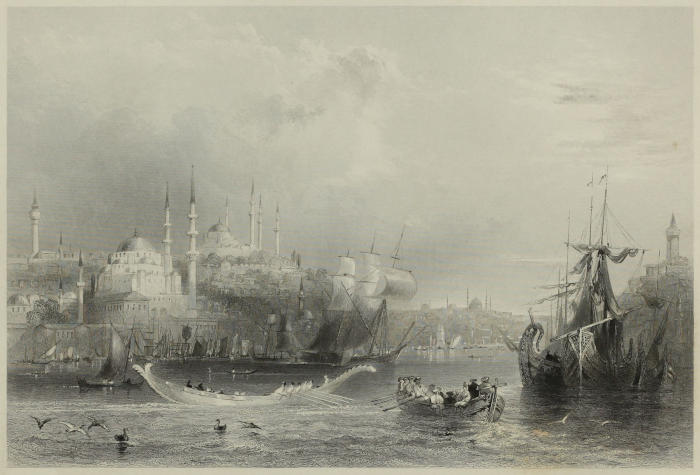
THE PORT OF CONSTANTINOPLE.
PORT DE CONSTANTINOPLE. DER HAFEN VON CONSTANTINOPEL.
W. H. Bartlett. G. K. Richardson.
London. Published for the Proprietors, by Geo: Virtue, 26, Ivy Lane, 1839.
Innumerable caïques dart from shore to shore across the harbour, freighted with veiled women, and men of many lands; and the shrill warning cry of the boatmen as they shoot along, cutting through the water like wild-birds, continually passing and repassing, and yet never coming in collision—the crowds of sea-fowl sporting among the shipping, and diving under the oars of every boat—the light bridge, flung like a fairy-wand across the port—all conspire to render the Golden Horn one of the most picturesque scenes in the world; while above the bright landscape and the glittering sea, spreads a sky of such intense and vivid blue, as invests every object with a tint and a distinctness from which it derives a new and a peculiar beauty.
The variety of costume, the constant succession of living groups, and the rapid motion of the arrowy caïques, are altogether beyond the reach of description; while the pencil of the artist can alone convey any distinct idea of the numerous objects of interest and beauty which throng the shores. Close beside the termination of the floating bridge, where it abuts on the Stamboul side of the harbour, (at a gate-way known as “the Gate of the Garden,” owing to its vicinity to the grounds of the ancient palace,) and close under the walls, stands a green pavilion, in which former Sultans were accustomed to give audience to the European Ambassadors; while immediately above it, erected on a buttress of the wall itself, is a light-looking summer saloon, canopied with creeping plants, called the Kiosque of Pearls, whence the sovereign can overlook the whole extent of the port and the European shore. Not far from this pretty kiosque, and level with the water’s edge, is a low iron door, through which the bodies of those who were executed within the Seraglio are said to have been cast into the sea at midnight, and committed to the current that sweeps rapidly round the point; but it bears little appearance of having latterly been in request, as its massy hinges are rusted, and immovable.
Stately trees, sweeping downward to the water—lofty minarets, shooting gracefully towards heaven—crowds of shipping—groups of human beings, varying alike in feature, language, and costume—lofty mountains, far-stretching forests, and thickly-peopled hills—the junction of two seas—an unrivalled landscape, and a cloudless sky, are among the many distinctive glories of the Golden Horn.