THE GUZ-COULI, OR MAIDEN’S TOWER.
Reading edition
A fairy-fortress, girdled by the sea, Rock-seated, and alone; whose single tower Was mirrored in the waves, and from whose heights The eye glanced round on two fair cities, spread Along still fairer shores. MS.
The popular and poetical traditions attached to this sea-girdled edifice have already been given, and its peculiar position has rendered it a very striking object in several of the sketches of Mr. Bartlett; it is, indeed, so essentially one of the “Beauties of the Bosphorus,” that it could not fail to create its own interest, even were it without its peculiar record; but such is far from being the case. The massaldjhes love to tell the tale of the fair and high-born girl, who died, Cleopatra-like, from the bite of an adder, within its walls; the poets love to sing the adventures of the Persian Prince who delivered the imprisoned beauty on a night of storm, when there was no tell-tale moon to reveal the enterprise to jealous guards and watchful eunuchs; and when the wild waves of the Propontis were lashing themselves to foam against the rocky shores of Asia, while the hoarse gusts which swept down from the Black Sea, driving the current of the Bosphorus madly before them, swelled the midnight diapason, and was sweeter than the voice of the bûlbûl of Nishapor in the ears of the lovers.
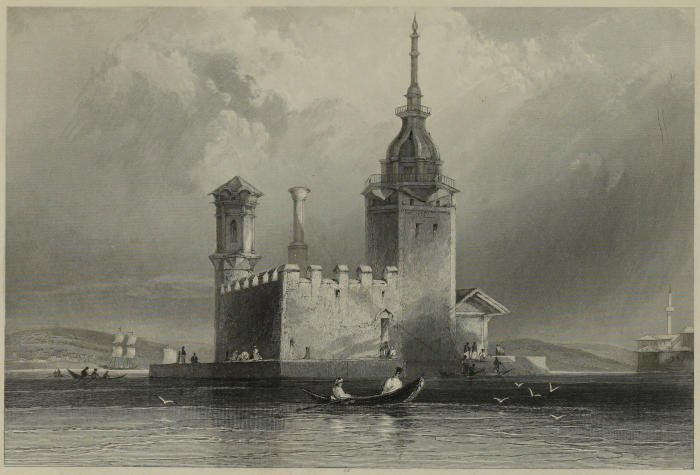
THE GUZ-COULI, OR MAIDEN’S TOWER.
LE GUZ-COULI, OU TOUR DE DEMOISELLE. DER GUZ-COULI, ODER MÄDCHEN THURM.
W. H. Bartlett. R. Brandard.
London. Published for the Proprietors, by Geo: Virtue, 26, Ivy Lane, 1839.
But neither has the sober historian passed it by; and pretty and fanciful as may be the fables which we have quoted, we are bound in our turn to treat the subject more gravely; and to admit that the island-fortress owed its erection to a more rational impulse than obedience to a wild dream, or the desire to counteract a still wilder prophecy.
The Square Tower, now known as the Guz-Couli, was, it is stated, originally built by the Emperor Manuel, for the purpose of communicating with the point of coast occupied by the Seraï Bournou by means of an iron chain, which, on the approach of an hostile fleet, was drawn across the whole mouth of the strait, protecting both the harbour and the channel from the occupancy of the intruders. No other trace of this ingenious expedient now remains, however, and the historian is consequently as traditional as the poet; nor do the Turks appear to be at all aware that the Guz-Couli was ever appropriated to such an use—to them it is now a plague-hospital, and nothing more; while many European travellers, full of old associations, combine the peculiar situation of the castle with memories of Hero, Leander, and the Hellespont, and, confirmed in their error by its modern appellation of Guz-Couli, without hesitation christen it “Leander’s Tower.”
By whatever name it may be called, it is a very pleasing object from both shores, and stands amid the waves like the guardian of the strait.