THE TCHERNBERLÈ TASCH.
Reading edition
“A tale of the times of old.” Ossian.
The Tchernberlè Tasch, or Burnt Pillar, is a striking Roman remain, within a short walk of the Seraskier’s Tower. It is a relic of the Temple of Apollo at Rome, whence it was transported to Stamboul by Constantine, and placed upon an hexagonal pedestal. It was surmounted by a fine statue of the god, from the immortal chisel of Phidias, which the conqueror appropriated with more ambition than modesty, and beneath which he caused to be inscribed, “The Justice of the Sun to the Illustrious Constantine.” The destruction of this noble statue is variously described by different writers. Genaro Esquilichi asserts that it was overthrown by a thunderbolt; while the sententious Anna de Comnena mentions its prostration by a strong southerly wind, during the reign of her kinsman Alexius; and moreover declares that several persons were killed by its fall. Other authors speak more vaguely, naming the storm-shock as a cause of its partial destruction, and alluding to the second accident as having also tended to its final demolition. The shaft of the pillar measures ninety feet in height; it is circular, and girdled at regular distances with garlands of laurel and oak-leaves; but its beauty is entirely gone, as it has suffered so severely from the repeated conflagrations in its immediate vicinity, that it is cracked in every direction, and merely kept together by a strong wirework, which has been carefully woven about it.
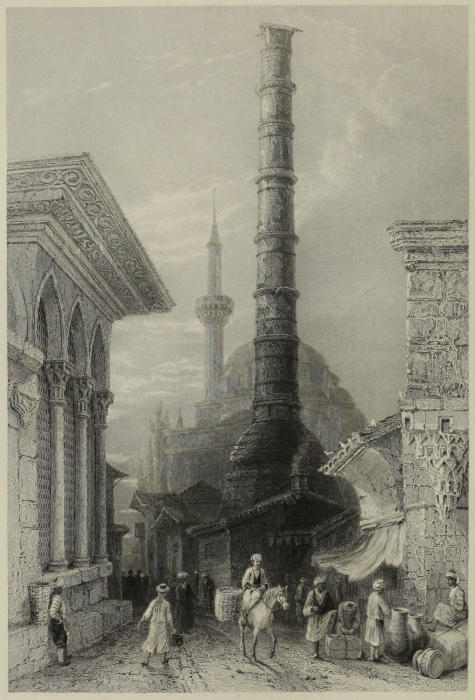
THE TCHERNBERLÈ TASH, OR BURNT PILLAR.
LE TCHERNBERLÈ TASH, OU COLONNE BRÛLÉE. DER TCHERNBERLÈ TASH ODER GEBRANNTE PFEILER.
W. H. Bartlett. J. Carter.
London. Published for the Proprietors, by Geo: Virtue, 26, Ivy Lane, 1839.
The pedestal upon which it stands measures thirty feet at its base, and is rendered interesting by the fact, that several portions of the Holy Cross were built up within it, and that the space amid which it stood consequently became a popular place of prayer, every mounted passenger reverently alighting from his horse as he passed before it; but the Moslem, not recognising the divinity of the relics enshrined within its solid masonry, nor the sanctity of the spot thus hallowed, have surrounded the pillar on every side with mean and unsightly houses; and it is only in one solitary direction that the anxious antiquary can obtain a satisfactory view of this singular monument. The pedestal bears a Greek inscription, now nearly obliterated, which has been translated thus:—
“O Christ, Master and Protector of the World, I dedicate to Thee this City, subject to Thee; and the Sceptre and the Empire of Rome. Guard the City, and protect it from all evil!”