THE BOSPHORUS.
Reading edition
The chain is forged, the web is wrought, Woven of memory and thought; And to myself each link is set Alike with fondness and regret. Oh! could I only call to view Each scene in its own fairy hue, And the same brightness that it wore For me, on Bosphor’s lovely shore, The eye, in lingering o’er my line, Would see the gilded minaret shine, Trace the stern mountain’s lofty peak. Bound onward with the swift caïque. And count the thousand glories o’er Of either palace-girdled shore; Spell-bound by thy bright witcheries, Fair city of the Triple seas! MS.
Ere I take my leave of the reader, whom I have endeavoured, in conjunction with Mr. Bartlett, to interest in one of the most glorious portions of the earth, I cannot deny myself the gratification of once more addressing him in my own proper person.
In the volume which is now nearly completed, space was not permitted to me for mention of many things on which it would have been a pleasure to expatiate; nor have I made an effort towards this self-indulgence. The work is a purely descriptive one, and I have followed the talented artist wheresoever he has led me, and have found him no inefficient guide. Together we have visited mosques, wandered in burial-places, clombe mountains, and glided over the sun-lighted Bosphorus: and there were times when such a pilgrimage would have been deemed no trifling undertaking; but Steam has now annihilated both time and space; and we can only hope that our pictorial and literary pictures may induce the traveller on his summer trip to Palmyra, Balbek, or Jerusalem, not to overlook in his haste the fair city of Byzantium.
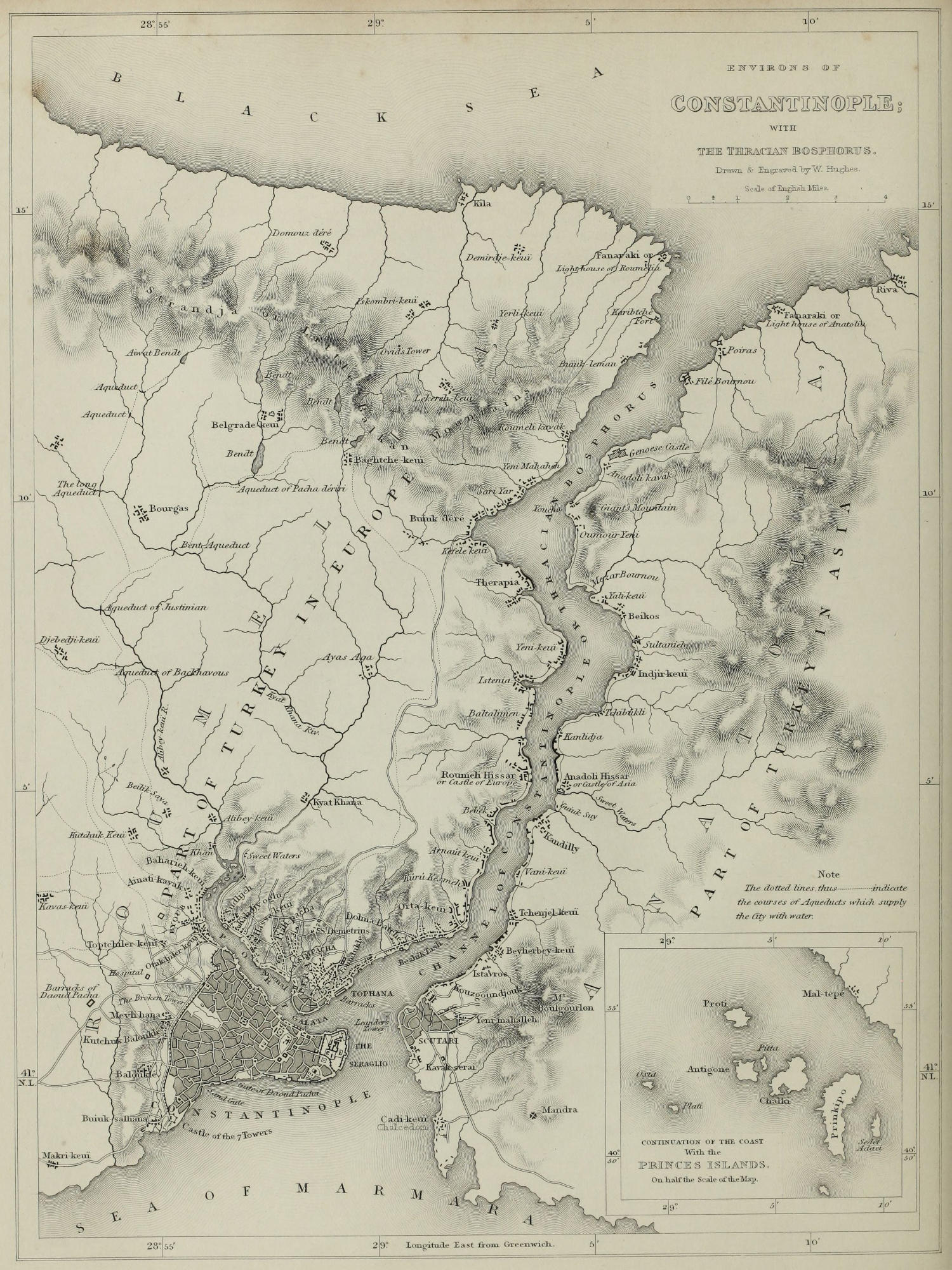
ENVIRONS OF CONSTANTINOPLE; WITH THE THRACIAN BOSPHORUS.
Drawn & Engraved by W. Hughes.
London. Published for the Proprietors, by Geo: Virtue, 26, Ivy Lane, 1839.
Snatches of exquisite poetry have frequently been written on the subject of the Bosphorus; from the days of Lady Mary Wortley Montague to our own, every pilgrim-bard has wooed the glorious “ocean-stream” in song—every traveller has freely offered to it the meed of his admiration; yet still I feel convinced that those who know it only by verse and story cannot form a correct or adequate idea of its peculiar beauties. The description of one tourist gives a balloon view of the whole channel, sweeping it from the Euxine to the Sea of Marmora, levelling mountains, prostrating forests, and making curved lines straight; while an eminent French traveller and literateur, in an eloquent and elegant burst of imaginative genius, setting fact at defiance, removes some of the windings of the Strait, and enlarges the range of vision with true poetic license, in order to present a more rich and animated tableau at a single coup-d’œil, instead of distinguishing the series of points in keeping with the original. This bold and energetic style of verbal painting may produce a powerful picture, well calculated to impress the mind of the reader, but it by no means does justice to its subject, for the surpassing beauty of the Bosphorus is its exquisite variety. History and fable go hand in hand, walking over its waters, and awakening pleasant memories of the past; but it needed not these additional incitements to admiration, for nature has woven so powerful a spell about its shores that the present scarcely asks the prestige of the past. The liveliest creations of the fancy are not likely to be disappointed on the spot; and hence there is no reason why even the most enthusiastic tourist should overcharge the colouring, or aim at additional ornament in grouping the details.
The true charm of the Bosphorus, as I have already remarked, lies in its endless variety of perspective: it is like a garland, woven by the hand of beauty, of which each blossom is brighter than the last; not a rock, not a tree, not a tower, could be displaced without injury to the whole. Rival castles, looking each upon the other from the shores of Europe and of Asia, stand on the nearest point of approach between the two coasts, and seem at one interval to close the entrance of the channel; but, as the rapid caïque starts onward, they yield to laughing groves, and painted palaces, and hamlets scattered along the lip of the water, and mirrored in the waves; and the beautiful curve is lost only to be succeeded by another, and another. At almost every boat’s length the vista changes, and presents new combinations; inlets and glens at intervals peeping out in their pleasant greenery, break the rigid outline of the rocks; valleys, such as even Rasselas might have loved to dwell in, studded with trees to the very edge of the current which their branches overhang, are sheltered by the woods on the sloping sides of the adjacent heights—the cypress and pine retaining throughout the year their deep perpetual green, and the brighter foliage ever shifting under the breeze, and wearing new shapes and hues as it sweeps over them.
A range of populous villages, composed of party-coloured houses, intermingled with trees and gardens, and handsome mansions backed by lofty hills, extends for about twelve miles on either shore; the finest sites being occupied by the palaces and kiosques of the court, either erected or embellished by the present Sultan, with their bright façades and fanciful parapets glittering in the sun-light; while numerous private villas are interspersed among them, always gaily and fancifully painted when belonging to a Turk, and in sober grey or lead colour when tenanted by an Armenian or a Greek, Christians not being permitted to use any other colours on the exterior of their dwellings; while the houses of the Jews are invariably black. These villas frequently have terraces, formed into parterres and flower-beds, cut in the face of the precipitous rocks, and leading by winding steps to the pretty kiosque, or pavilion, pitched like an eyrie on the cliff above; others have gardens laid out along the banks of the channel, whose rose-wreaths, suspended from the walls, almost drop into the current; while their fading blossoms, scattering their loosened petals on the tide, freight it as with a fleet of fairy barks!
One Imperial Kiosque, perched on the apex of a cone-like rock on the Asiatic coast, about midway of the strait, is a very conspicuous object. From below it appears as though it covered the whole summit of the height; not a tree breaks its beautiful Grecian outline as it stands out in strong relief against the intense blue of the sky, and it is very appropriately called the “Kiosque of the Sun.”
It has been said that travellers should never set foot in the city of Constantinople, in order not to dispel by unsightly contacts in its mean and narrow streets the glorious illusion of the spectacle from the waters. This assertion is hyper-fastidious, and must have emanated from a mind totally unable to appreciate the treasures to which those streets conduct. Should the Tchernberlè Tasch remain unvisited because the unsavoury lanes in its vicinity are disagreeable to traverse? Should the Palace of Belisarius be avoided because Jews burrow among the ruins? Should the Mosques, the Khans, the Tcharchi, and the Seraï, continue unexplored, because the wandering Sybarite cannot walk to them over rose-leaves? Surely some sacrifice may well be made in order to insure a pilgrimage round the old, ivy-clad, historical walls of Byzantium, or a glance into one of its stately Mosques—some annoyance undergone to obtain an opportunity of studying the national character, and judging of the national manners.
The most celebrated view in the environs is that from the Bulgurlhu Daghi, behind Scutari, overlooking the Marmora, the city, the harbour, and the whole line of coast in the direction of Asia Minor; but, by ascending some other peak a few miles from the shore, the oblique and narrow strait of the Bosphorus may be traced in all its windings, until diminished in appearance to a mere meadow rivulet; while at each extremity of the horizon, seemingly linked together by this silver chain, the Euxine and the Propontis spread their broad waters.
A ramble over the mountain-heights of the Asian coast is delicious: the pure cool wind comes lovingly to your cheek, untainted by one touch of earth; and the silence is unbroken, save by the shrill whistle of the shepherd, and the responsive bark of his trusty dog; the call of the goat-herd to his truant flock; the short keen stroke of the woodcutter; or, frequently, the rustle of a pheasant springing from the copse beside you, rather startled than alarmed, and sailing away in all his primitive glory and wildness, such as he is still found in his native woods of the Phasis.
The Bosphorus wears the most animated appearance early in June, when the trees are in full foliage, and every leaf is redolent of life, ere the heats have withered the herbage, and when a light southerly wind is wafting hundreds of vessels up the strait towards the Black Sea, the inner tiers almost touching the houses with their spars; while all the caïques are plying busily between the city and the villages on the channel, laughter is ringing out on the clear air, roses blossoming along the banks, and the waters are buoyant with life and motion, and adding to the magic of the landscape.
But to be seen in all its beauty, it should be looked upon by moonlight. Then it is that the occupants of the spacious mansions which overhang its waters enjoy to the fullest perfection the magnificence of the scene around them. The glare of noonday reveals too fully the colours of the picture, and the garish sun withers as it shines; while the deep, purple, star-encrusted sky, the pure moonlight, and the holy quiet of evening, lend to it, on the contrary, a mysterious indistinctness which doubles its attraction.
The inhabitants of the capital are conscious of this fact; and, during the summer months, when they occupy their marine villas, one of their favourite recreations is to seat themselves upon their seaward terraces to enjoy the passing music of the caïques which skim over the ripple, freighted with amateur minstrels gliding from house to house, and warbling their good-night at each, to the accompaniment of a guitar; or in listening to the evening hymns of the seamen on board the Italian and Greek vessels anchored in the strait; amused at intervals by the rolling by of a huge shoal of porpoises on their way to the harbour, (where they frequently abound,) gambolling in the moonlight, and plunging among the waves with a sound like thunder; while, in the distance, loom out the dark mountains of the Asian coast, casting their long dusky shadows far across the water; and close beside them are the quivering summits of the tall trees on the edge of the channel, sparkling like silver, and lending the last touch of loveliness to a landscape, perhaps unparalleled in the world.
The Bay of Naples—the fairest and most picturesque points of the Rhine—the approach to sea-seated Venice—the entrance of the Tagus—and the noblest portions of the Danube, have each in turn been quoted as all-excelling, and unsurpassable in natural beauty; but who that has anchored in the Golden Horn, just where beyond the shadow of the Guz-Couli, his eye could wander onward along the channel, will not at once yield the palm to the “rolling seas between the Bosphorus?” Truly, the Bay of Naples boasts its volcanic mountain, which in sublimity must stand unrivalled; but it has not the freshness, the changefulness, the never-ending variety of the Golden Horn; and it, moreover, wants the strait which renders the site of the Moslem city unique in its character. The great German streams, noble and majestic as they may be, are devoid of those lovely breaks and varied vistas which render the Bosphorus so beautiful, and divest it of all tameness and monotony; grandeur and softness vie with each other upon its banks; and it is, moreover, the swift ocean-tide which flows between them, while the shores of the Danube and the Rhine are laved only by the waters of one of its humble tributaries.
And now my pleasant task is ended. I have exhausted the artist’s portfolio, and I have nothing left to do, save to take leave of the reader, who has wandered with me in idea under the sunny skies of the fair East.
I have said little—almost nothing, of the inhabitants of the “City of the Sultan;” not because I could not have said much, very much, which might have gratified both them and myself, but because the nature of the present work did not admit of my doing so; and it is only now, at the “eleventh hour,” that I permit myself to remark, that the courtesy, kindness, and friendship, which I universally experienced from the natives of the country, and the veneration which I felt for their many virtues, tended greatly to endear to my heart “The Beauties of the Bosphorus.”