THE CASTLES OF EUROPE AND ASIA.
Reading edition
“Lo! dusky masses steal in dubious sight Along the leaguered wall and bristling bank Of the arm’d river.” Byron.
These fortresses stand on either shore of the Bosphorus, about half way up; where the channel is unusually narrow, and was once traversed by the celebrated bridge of Darius. The Anadoli Hissari, or Castle of Asia, was, during the reign of the Janissaries, the prison of the Bostangis, or body-guard of the Sultan, who were here immured or executed as the nature of their crimes dictated. It rises on the lip of a pleasant rivulet which empties itself into the Bosphorus, and washes the tree-fringed valley of the Asian Sweet Waters, called by the natives Guiuk-Suy, or Chest-water, from the extreme purity of the spring.
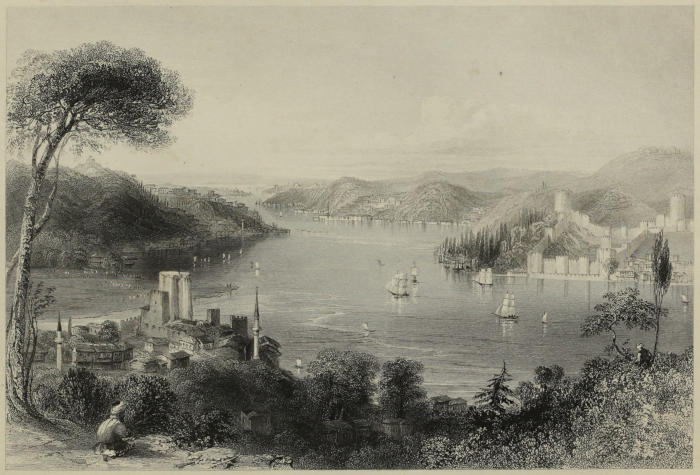
THE CASTLES OF EUROPE AND ASIA.
W. H. Bartlett. G. K. Richardson.
London. Published for the Proprietors, by Geo: Virtue, 26, Ivy Lane, 1839.
The Roumeli Hissari, or Castle of Europe, on the opposite shore, is of very singular construction, the ground-plan forming the characters of the Prophet’s name; by whom, tradition says that it was built in six days, by permission of the Greek emperor, who, with more courtesy than policy, acceded to the desire of Mahomet to possess a pied-à-terre on the European edge of the channel. This fortress was the celebrated prison of the Janissaries; and the large gun yet fills its embrasure on the lower rampart, which was fired on the execution of every criminal, to announce to the Sultan that the guilty one had expiated his crime. The strength of the Castle is much greater than its appearance from the sea would indicate; and it is well supplied with water, and the means of storing provisions. The Traitor’s Gate is the only seaward entrance to the fortress; and through its low wide arch the bodies of the strangled Janissaries were dragged by the heels, and flung into the Bosphorus. There are four principal towers, one of which occasionally served as a state-prison for persons of distinction; that immediately above it, is called the Tower of Blood, where the Agas, or chiefs of the Janissaries, were put to death privately, and their bodies conveyed to the Bosphorus through a tunnel excavated beneath the foundations of the fortress; it being considered unsafe and impolitic to dishonour their remains in the eyes of that formidable body, in the public manner in which the corses of their less distinguished comrades were mutilated and insulted.
The Janissaries’ Tower is built upon the highest point of land within the walls, and commands one of the finest views in the world; having on one hand the whole stretch of the channel to the opening of the island-studded Propontis; and on the other, the entrance of the Black Sea, with the “blue symplegades” in the dim distance, looking as if they were indeed fulfilling the ancient superstition, and wandering over the waters of the “storm-vexed Euxine.”
The instrument to which the fatal cord used in strangling the Janissaries was attached, is an old Roman bow of extraordinary strength; and the place of execution was a portion of the covered way that connects the towers throughout the fortress; and it is painful to look from this place of death upon the brightness and the beauty of nature, and to remember how many have so looked for the last time! The blue, sun-lighted sky—the sparkling water—the fantastic and changeful shadows cast by the broad leaves of the wild fig-trees upon the earth—the song of the wild-birds from the underwood beneath the ramparts—all seem to conspire in investing the world with a dearer charm, and in lending to life a value which must enchance tenfold the bitterness of death.
The few houses built within the walls of the fortress are in good repair, and are surrounded by pleasant gardens. Their tenants marry and intermarry continually, not being permitted to form any alliance with families unconnected with the Castle; and, altogether, the celebrated Roumeli Hissari, (a sealed book, save in one recent instance, to all European travellers,) possesses a great moral interest, as well as extreme picturesque beauty.