THE SLAVE-MARKET.
Reading edition
“Veritatis simplex oratio est.” School Classics.
The fables which have been both written and painted on the subject of the Yesèr Bazār, or Slave-Market of Constantinople, with a tenacity of error perfectly extraordinary, have tended to excite in Europe a feeling of horror and disgust, totally uncalled for by the aspect of the place itself. This is no arena for controversy; nor has the writer of these sketches either wish or intention to defend a traffic utterly revolting to every principle of our nature; but justice to the Turkish nation calls for a contradiction of those absurd and indelicate episodes with which the active and wonder-creating imaginations of certain writers and artists have laboured to render the name of the Yesèr Bazār odious, not only inferentially, but actually. A sentimental chapter is easily woven of the tears and terror of a fair and fainting girl, torn from her home and her kindred, and exposed to the gaze of a coarse and ribald crowd; a pretty picture may be readily produced when the formal quadrangle of the market is relieved by groups of beautiful Georgians or Circassians, habited in flowing draperies of white muslin, and unveiled by the coarse hands of the dealer to gratify the whim of every lounging passenger; but surely if the creators of these flimsy prettinesses were to reflect for a moment that they are not only violating good taste in their own persons, but moreover libelling a whole people, and distorting truth at the same time, they would consent to sacrifice a sentence, or to dispense with an effect, in order to be at once more decent, more veracious, and more just.
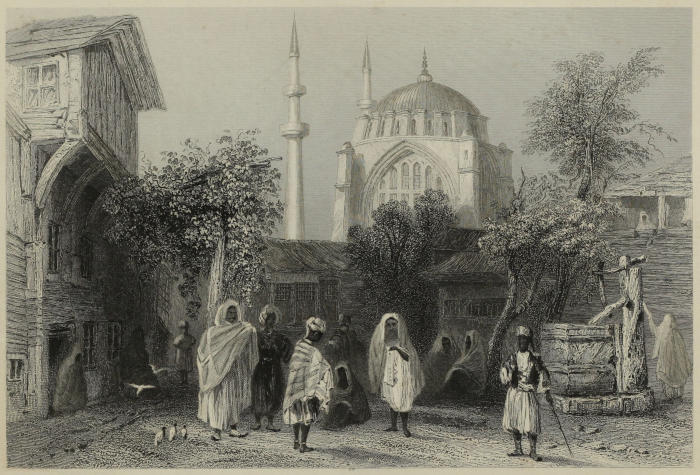
THE MOSQUE OF OSMANIÈ. (From the Slave-Market.)
MOSQUÉE D’OSMANIÈ, VUE DU MARCHÉ. DIE MOSCHEE OSMANIÈ, WIE SIE SICH ZEIGT VOM SCLAVENMARKTE.
W. H. Bartlett. H. Griffiths.
London. Published for the Proprietors, by Geo: Virtue, 26, Ivy Lane, 1839.
It is only those who look superficially at the East,—the travellers against time, who make deduction serve for experience, and inference for fact,—who fall into such gross errors as these; and Turkey is not a country to be described on inference and deduction. Not one of those who have spread the fallacy which we are now deprecating, ever witnessed the revolting spectacle born of their own fancy. How does Dr. Walsh speak of the Yesèr Bazār? And we quote him, not only because he was resident in Constantinople many years, looking deeply and earnestly into its institutions, but because the whole tone and tendency of his work must at once acquit him of any leaning to the Turkish people:—
“Here decorum is no further violated than in the act of sale. It consists of a quadrangular building, with an open court in the middle. Round this are raised platforms, on which black slaves sit; behind are latticed windows, lighting apartments where the white and more costly women are shut up till they are sold; and there is a certain decency and propriety observed in the purchase.”[44]
The wanton exposure, therefore, which has been represented as a concomitant of the sale of slaves in the Yesèr Bazār, did not originate with the Turks; to whom Dr. Walsh (certainly not their most lenient historian) thus concedes the merit of “decency and propriety.”
We have been somewhat prolix on this point, because it is one which has been deeply and painfully felt by many individuals of the calumniated nation; and also because it is an useless and cruel misrepresentation of facts, of which common justice demands the refutation. There is always a painful and a revolting association connected with the idea of slavery, and an insurmountable disgust excited by the spectacle of money given in exchange for human beings; but, beyond this, (and assuredly this is enough!) there is nothing either to distress or to disgust in the slave-market of Constantinople. No wanton cruelty, no idle insult is permitted: the slaves, in many instances, select their own purchaser from among the bidders; and they know that when once received into a Turkish family, they become members of it in every sense of the word, and are almost universally sure to rise in the world if they conduct themselves worthily. The Circassians and Georgians are generally brought there by their parents at their own request; preferring a youth of ease, and a future of probable luxury, to labour in the fields, and the life of household drudgery, which must be their lot if they continued in their own mountain-homes. These voluntary slaves occupy the closed apartments, and are only seen by such individuals as are likely to purchase them; care being taken to protect them against gratuitous annoyance, and the gaze of the idlers who throng the court. The utmost order, decency, and quiet prevail; and a military guard is stationed at the entrance to enforce them, should the necessity for interference occur, which is, however, very rarely the case.
The Negro slaves squat in groups upon their mats all over the court; some laughing, jesting, and devouring huge slices of pastek,[45] or clusters of purple grapes; others sleeping; and some again looking anxious, or sulky, or sad, according to their mood; but nothing takes place around them which can embitter their position: the Turks never make either a sport or a jest of human suffering, or human degradation; they have not yet discovered that it is witty to do so; and accordingly they drive their odious bargain seriously and quietly, and lead away the slaves whom they purchase without one act of wanton cruelty or tyrannical assumption.
The Yesèr Bazār is situated in the immediate vicinity of the Tchernberlè Tasch, or Burnt Pillar; and commands a view of the mosque of Osmaniè, or “the Light of Osman;” a splendid temple of pure white marble, beautifully covered with carpets of bright and rich colours, and having the Mihrab, or niche at its eastern extremity, guarded by a gilded railing. Like almost every mosque in the city, it is embosomed in fine maple-trees, which, springing from amid the marble pavement of the court, spread their leafy branches far and wide, and afford a sweet and refreshing resting-place for the eye, which has been pained by immediate contact with the interior of the Slave-Market.