A COFFEE-KIOSQUE.
Reading edition
’Tis the resort of public men; the haunt Of wealthy idlers; and the trysting-place Of such as have no home to indicate. A place where each may come and go at will, Think his own thoughts, pursue his own affairs, Or fling his ore of feeling and of sense Into the common crucible. MS.
Even as the English have their tavern, the French their restaurant, and the Portuguese their estralagem, so have the Turks their Coffee-Kiosque—the rendezvous alike of the idle and the exhausted—of the man of pleasure who lives only for self-indulgence, and the man of business who reluctantly snatches an hour of relaxation from the all-absorbing toils of commerce. What the public baths are to the women of Turkey, the public coffee-houses are to their lords—the head-quarters of gossipry, and news, and enjoyment—where every passing event is canvassed, and weighed, and judged; and time is suffered to slide by as carelessly as though it might one day be redeemed.
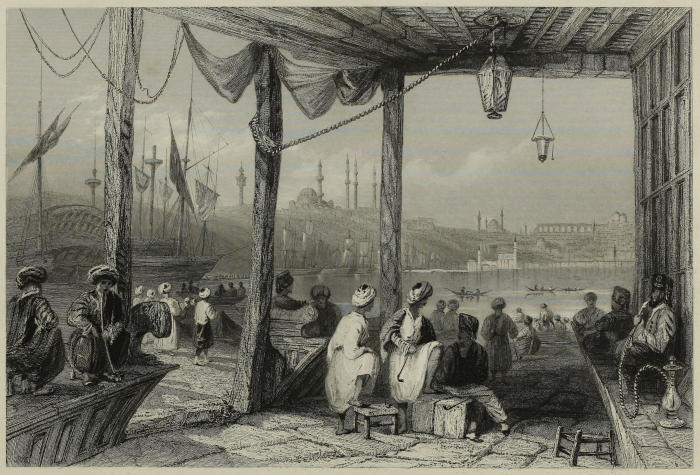
COFFEE-KIOSQUE, ON THE PORT.
CAFÉ SUR LE PORT DAS KAFFEEHAUS AM HAFEN.
W. H. Bartlett. H. Griffiths.
London. Published for the Proprietors, by Geo: Virtue, 26, Ivy Lane, 1839.
In the villages, the Coffee-Kiosques are erected in pleasant shady nooks, where the maples shed a glory and a grace over the hamlet, (for these are never wanting in a village on the Bosphorus;) and where, with the leaves above their heads, canopied by the bright blue sky which peeps in among them as if to lend them an added beauty, and the “ocean-stream” flowing at their feet, the placid and nature-loving Moslems inhale the fragrance of the chibouque, and drain their tiny cups of scented mocha. But in the city, few are the coffee-kiosques which can boast better shade than that of the deeply-projecting roof of the building, which, flung boldly forward several feet from the walls of the house itself, serves to shelter the open terrace that stretches along each side of the edifice; and this terrace, furnished with wide seats, on which the visitor can lounge at ease, forms the nearest approach to out-of-door enjoyment compatible with their situation.
The Coffee-Kiosque chosen by the artist for his sketch, is that of Pieri Pasha, near the Arsenal, and overlooking the harbour—a position eminently calculated to render it popular. The moving panorama which it commands, is a perpetual source of interest; and the breeze comes softly from the sea of Marmora, with freshness and perfume on its wing.
The amusements provided, or rather customary, at these places of resort, are numerous, but seldom commence before noon, the morning passing listlessly away in the gossipry of which mention has already been made. They consist principally of music, (the performers being usually young Jews,) improvisation, matches at tric-trac, and an exhibition somewhat resembling a magic-lantern in effect, though not in principle; the mover of the puppets occupying an angle of the apartment screened off, and presenting a front covered with muslin stretched over a frame, against which the puppets are pressed, to exhibit their grotesque antics. Their performance is accompanied by the ceaseless recitative of the exhibitor, who must be a decided humourist, if not a genuine wit, to judge by the effect of his oration. The Turks are too well-bred, and too self-possessed, to indulge in the boisterous laughter which is often elicited by a clever mime in Europe; but the low quiet chuckle, and the hand passed slowly and complacently over the beard, proclaim their thorough appreciation of the attempt to amuse them: nor is the mountebank backward in deciding on the precise moment in which the richest harvest may be reaped; for no sooner has he secured the good-will of his audience by a burst of humour, and excited their curiosity by a mystery, than forth he pops from his concealment with a little metal basin in his hand to levy contributions; and this ceremony is repeated several times during the evening.
The Improvvisatori generally accompany themselves on a rude sort of guitar, which they twang most unmercifully, as they pour forth their lays of love, or their tales of tradition, in a heavy, monotonous, sleep-inspiring drawl, never seeming themselves to become inspired by their subject; while their hearers, apparently quite insensible to the soporific medium through which the legends are conveyed, frequently betray extreme emotion as they listen, grasping the hilts of the handjars[53] in their girdles, setting their teeth firmly, clenching their fingers rigidly upon their palms, and drawing their breath hard, as though their respiration were impeded.
The Hebrew music already mentioned comprises several performers, and the instruments are commonly a small Arab drum, two or three bad guitars, and a tambourine; these are relieved by the voices of the younger boys, which are generally very thin and shrill, and they sometimes accompany their songs with a heavy languishing movement—a caricature of the graceful dance of the Harem.
That some of these establishments, however, not only emulate, but even exceed in luxury and magnificence the most costly and fashionable European “Clubs,” we have the evidence of Mr. St. John, (no mean authority on oriental subjects,) who thus describes one visited by himself during a season of high festival:—
“We now proceeded to the coffee-house of Kodjia Ben Lolo, near the great Hammams,[54] the approaches to which were so crowded, that it was with much difficulty we found our way in. This establishment, which is on a grand scale, corresponds in a great measure with our ideas of Oriental splendour. Erected, like a caravanseraï, about a spacious quadrangular court, it contains an infinite number of magnificent rooms, paved with marble, and furnished with superb divans of crimson velvet, bordered with gold fringe a foot deep. The windows are glazed, if one may so speak, with large panes of gypsum,[55] gorgeously painted in various colours; and in the midst of the principal apartment, an elegant marble fountain, constantly playing, maintains an agreeable freshness in the air. None but opulent Turks frequent this establishment, the expense of the entertainment being considerable....
“Small brazen censers, placed on the summit of pyramidal flower-stands, and constantly burning, filled the apartment with the perfume of sandal-wood, benzoin, and wood of aloes, intermingled with the rich odours of Indian myrtle, jasmine, and other rare or sweet plants.”[56]
In establishments, such as the one here described, the most rare and costly coffee and tobacco is served to the guests, by the owner of the house; but in the common run of Coffee-kiosques, each individual brings his own tobacco in a small bag, which he carries amid the folds of the shawl that he wears about his waist, or, should he have adopted the new costume, in his bosom. A brazier, full of heated charcoal, stands in the apartment, and the stranger is no sooner seated, and has filled his chibouque, (two almost simultaneous operations,) than the cafèjhe seizes a small live coal in a pair of iron pincers, and deposits it on the summit of the tobacco. When the customer has smoked a few long whiffs, he calls for coffee, which is made over another and larger brazier, and handed to him in its minute cup of porcelain, standing in a metal zarf;[57] and the few paras which, on departing, are paid for the coffee, are considered a sufficient compensation to the attentive cafèjhe for his house-room, his goblets of clear cool water, and his exhausted charcoal, as well as for the article for which they profess to pay.
There is a marked difference in the method of smoking pursued by the upper class of Turks and that practised by the poorer orders. The wealthy and fastidious Effendi fills the boudaka[58] of his chibouque with the mild and costly tobacco of Salonica, which he inhales, until round the edges of the bowl a circle of white ash is formed, which rises buoyantly from the superincumbent morsel of heated charcoal, when he immediately empties the boudaka, and flings the exhausted weed away, for its aroma has then perished, and the tobacco, to a connoisseur, has become worthless; while the boatmen and mechanics smoke the strong, coarse produce of Latakia, even to the last fragment. There are other varieties of the “scented weed” imported from the Crimea, Ormus, Circassia, and different parts of the East, but the two already quoted are by far the most popular, and the most extensively consumed.
There were, formerly, establishments at Constantinople, called Teriarki Tcharchi, or opium-houses, but these exist no longer; they were conducted on the same principle as the Coffee-Kiosques; but in the Teriarki Tcharchi, the comparatively innoxious use of tobacco was accompanied by that of opium, which was handed from guest to guest, made up into pills. One of them, no longer appropriated to its original purpose, but rapidly mouldering to decay, may still be seen in the neighbourhood of the Mosque of Solimaniè. It differs in nothing from a common coffee-house, save in its extent, which is considerable; and the miserable victims to this singular vice, so painfully described by the Baron de Tott, nearly a hundred years ago, are fortunately no longer to be seen, as the use of opium is now considered disgraceful by the Turks; and an individual addicted to its use, is regarded as that almost obsolete animal, a sot, would be among ourselves.
The motive of such of the population as still adhere to this disgraceful practice in private—a practice reprobated by the respectable portion of the community, and formally forbidden by the government, is, as they express it, to make kef; a phrase perfectly untranslatable, but which would seem to mean the creation of a species of unnatural but pleasurable excitement, unconnected with any physical exertion, as kef may be made where the person under the operation of the drug lies quietly on his cushions, wrapped in a sort of drowsiness indicative of no emotion whatever to the lookers-on; although it is asserted that there are frequent cases where the effects of the kef would be well worthy the attention of any oriental police-office.
The habit of opium-eating, is, however, rapidly declining among the Turks. Denounced by the government, despised by the bulk of the population, and only practised by the dissipated and the depraved, it will probably soon cease to exist altogether; while the legitimate Coffee-Kiosque, quiet, orderly, and moderate, is as essential a feature of the country as the Mosque, the Khan, or the Tcharchi.