PALACE OF BESHIK-TASH.
Reading edition
“The European with the Asian shore Sprinkled with palaces: the ocean-stream Here and there studded with a seventy-four; Sophia’s cupola with golden gleam: The cypress groves: Olympus high and hoar.” Byron.
The new palace of Beshik-Tash, erected by the present Sultan, commands a noble view of the Propontis; sweeps the Bosphorus through nearly its whole length; looks towards Scutari, (the Asian jewel seated at the foot of the dark mountain-chain of Bulgurlhu-Dagi;) affords a glimpse of the ancient Chalcedon; and includes within the range of its magnificent prospect the snow-crowned summit of Mount Olympus, flashing out in the distance through the clear blue of the horizon like a huge pearl set in sapphires; the Seraï Bournou, whose imperial walls enclose what was once a city; and the “Seven Hills” of glorious Stamboul. The world can probably produce no similar panorama; and as the traveller stands on the height above the palace gardens, and looks down upon the heavy inelegant wooden edifice, protected on the seaward side by a stately colonnade of white marble, he may well be pardoned should he indulge a regret that this imperial residence should be so unworthy of its admirable and unequalled site.
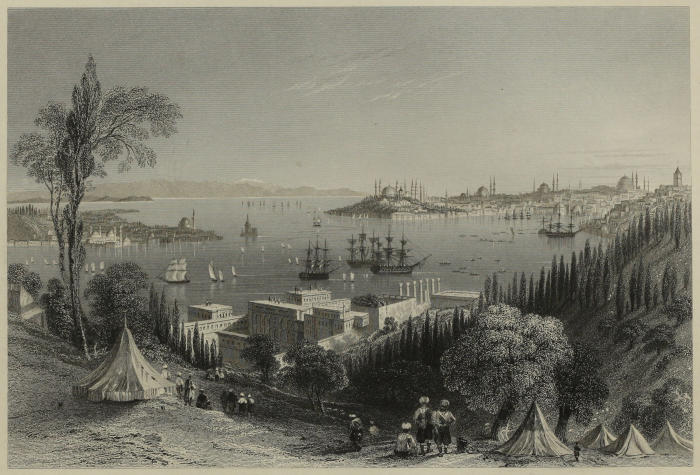
SCENE FROM ABOVE THE NEW PALACE OF BESHIK-TASH.
W. H. Bartlett. R. Wallis.
London. Published for the Proprietors, by Geo: Virtue, 26, Ivy Lane, 1839.
During the youth of Sultan Mahmoud, he was induced to consult a celebrated astrologer, who, among other predictions, foretold, that while he continued to build palaces, he should be successful in all his undertakings. And it would appear that he put the most perfect faith in the prophecy, for every pretty bay in the Bosphorus has its kiosque; and the number of his residences in the immediate vicinity of the capital, amounts to fifty-seven. The palace of Beshik-Tash is the last and most extensive of the whole, but decidedly the least picturesque and elegant. Its Armenian architect was not, however, selected without due consideration on the part of the Sultan, who was won to decide on the present plan by the assurance that it was thoroughly European; a fact which could not be disputed, were the glittering and well-proportioned columns that support the open peristyle swept away, when this huge pile, which has cost upwards of a million sterling, would present precisely the appearance of a manufactory.
There is an anecdote connected with the palace which is extremely characteristic of its regal builder, and which may appropriately be introduced here. While yet undecided unto whom he should confide the great work of its erection, an architect (also an Armenian) was introduced to the Sultan by one of his favourites, and was desired to be upon the spot destined for its site at a particular hour, in order to judge of its capabilities, and to explain them to his imperial master. Ere they entered upon the actual subject of their meeting, Mahmoud stretched forth his arm towards the Seraï Bournou,[10] of which nothing could be seen above the surrounding walls but the gleaming roofs, with here and there a tall white minaret, or a stately dome, standing out from amid a forest of cypress and maple-trees; and drily inquired what the stranger thought of the palace of Amurath? The Armenian cautiously replied, that never having been enabled to examine the nature of the building, he was totally inadequate to form any judgment. “Let him have the opportunity;” said the Sultan to the Bey by whom he had been introduced, “and to-morrow I will hear the result.”
The astonished raïah,[11] consequently, found himself in a few moments darting over the ripple in the caïque of his patron; and, ere long, actually passing the sacred threshold which it had hitherto been death to any infidel to tread. Bewildered and, perhaps, misled by his astonishment, and dazzled by the gilding and glitter of the celebrated Seraï—or, it may be, fearful of undervaluing by a word an edifice which had so long been a world’s wonder—or, again, tutored by his friend, the courtier—he declared, when he next stood in the presence of the Sultan, that, in as far as his poor judgment served, earth held nothing to compare with the palace of Amurath.
“Would you tell me that Europe boasts not its equal?” asked the Sultan calmly.
“I have visited many of the cities of the west;” said the obsequious raïah, “and I have seen nothing from the rising of the sun to its going down, so perfect as the Seraï Bournou.”
“Chok chay—that is much!” smiled the Sultan; “then the Franks are liars when they send me things like these, and tell me that they represent the palaces of their Padishahs;”[12] and as he spoke he drew out a roll of paper which he held in his hand, and displayed to the discomfited Armenian views of the different imperial and royal edifices of Europe. “Have you ever seen any of these Seraïs? and do they really not resemble the drawings now before me?”
“They do, may it please your highness; I have looked on many of them.”
“Then,” said the Sultan, “you are unsuited to the undertaking which I contemplate; for none, save a rogue or a fool, could class that place, fitted only for deeds of blood and mystery”—and he pointed once more towards the Seraï Bournou; “that place, hidden beneath high walls, and amid dark trees, as though it could not brave the light of day; with these light, laughing palaces, open to the free air, and the pure sunshine of heaven. Such would I have my own; and such it shall be:—we have therefore met for the last time.”
And the Armenian, having prostrated himself before the “Lord of the Three Seas,” withdrew from the presence of his master to comfort himself as he might under his disappointment and disgrace.
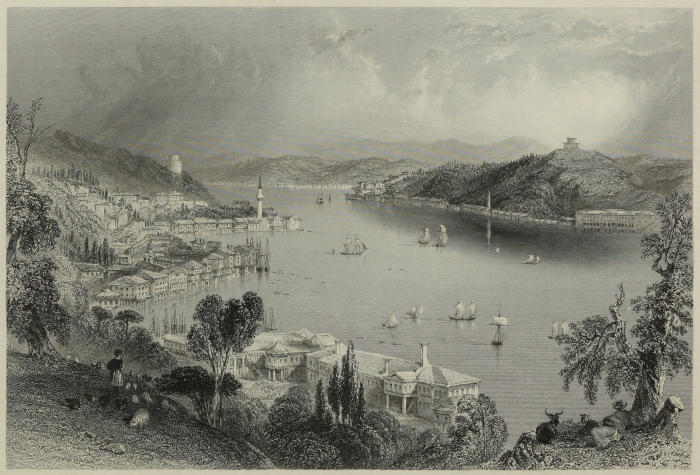
THE BOSPHORUS, FROM ABOVE BESHIK-TASH. (Looking North.)
LE BOSPHORE (NORD) VU DU HAUT DE BESHIK-TASH. DER BOSPHORUS NACH NORDEN HIN, GESEHN VON BESHIK-TASH HER.
W. H. Bartlett. J. Cousen.
London. Published for the Proprietors, by Geo: Virtue, 26, Ivy Lane, 1839.
The ground upon which the palace stands was formerly occupied by an elegant kiosque, built by Sultan Selim—a glittering gaily-tinted pavilion, looking like a huge tulip amid the cluster of cypresses in the centre of which it rose; and a Tekiè or chapel of Turning Dervishes; whose community, undaunted by the displeasure of the Sultan, persisted in the occupation of their dwelling, although the walls of the new palace grew higher from day to day, until they fairly overtopped the more modest roof of the holy building. To the frequent orders which they received to vacate their Tekiè, they replied only that they were not free to depart, as they guarded the ashes of a saint; whose tomb, surrounded by a lattice-work of bright green, about half way up the height above the channel, was indeed a conspicuous object from their windows. In this dilemma, the Sultan applied to the Chèïk-Islam, or High Priest, to enforce their removal; but he was again met by a steady refusal, the Chèïk-Islam pleading the danger of such a precedent, and declining all interference. Sultan Mahmoud heard him in silence, and did not again agitate the question until the chapel was fairly built in, when he simply informed the chief Dervish of the precise day on which he was to vacate the premises; or, in default of his so doing, the roof would be pulled about the ears of his community. The holy man stood aghast, but there was no alternative; and the brotherhood in a few hours took quiet possession of a handsome house on the edge of the water, which had been made over to them by the Sultan, on the death of the court jester, to whom it had previously belonged.
The magnificent Turkish line-of-battle ships, when in harbour, are anchored about mid-stream, in the immediate vicinity of Beshik-Tash; and nothing can be finer than the effect of their stupendous brass guns when firing a salute. The peal rattles along the hills, flung back at intervals by the walls of the Seraglio, until it finally dies away in the distance, throwing a long musical sound, like the hollow rumbling of a coming storm along the billows of the Black Sea.
The gardens of the palace are extensive, but will require time to make them worthy of description; at present, a great portion of the hill-side behind the building is left in its original state, boasting for all ornament sweeps of fine cypresses, and here and there a tuft of almond trees, a group of acacias, or a majestic maple; while the white tents of the Bulgarian workmen employed upon the walls, give to the scene the picturesque and cheerful appearance of a summer encampment.