THE COLUMN OF MARCIAN.
Reading edition
There Rome’s proud eagle, carved in living stone, Is lifted to the skies, and forms the base Of a still prouder statue, now unknown— Which, when first raised to its imperial place, Had thought to make futurity its own. MS. Poem.
The Column of Marcian stands near the gate of Adrianople, in the garden of a Turkish house; and is a fine remain of Roman splendour. The pedestal of the pillar is ornamented with wreaths of oak-leaves; the shaft is eighty feet in height; and on the richly carved Corinthian capital rests a block of marble supporting a second capital, formed by four gigantic eagles, sustaining upon their extended wings the base of a statue now entirely destroyed. The name of the column would infer that the missing effigy was that of the Emperor Marcian; but many of the Greeks cling to the tradition that it was erected in honour of one of the heathen divinities, by whose statue it was surmounted: and they ascribe it indifferently to Apollo, Mercury, and Mars. By the Turks it is called Kestachi, and valued only as a stately feature in the landscape; although the worthy Moslem in whose garden it stands, is evidently much gratified by the admiration it elicits from strangers. A venerable olive-tree, whose rude and knotted trunk is in a state of picturesque decay, leans against the slender shaft; flowers bloom at its base; a cluster of dark cypresses, looking, despite their great height, like mere pigmies beside this lofty monument of human art, are in its immediate vicinity; while a small mosque, and a modest mausoleum, peep out in the distance from among the leafy trees of the enclosure.
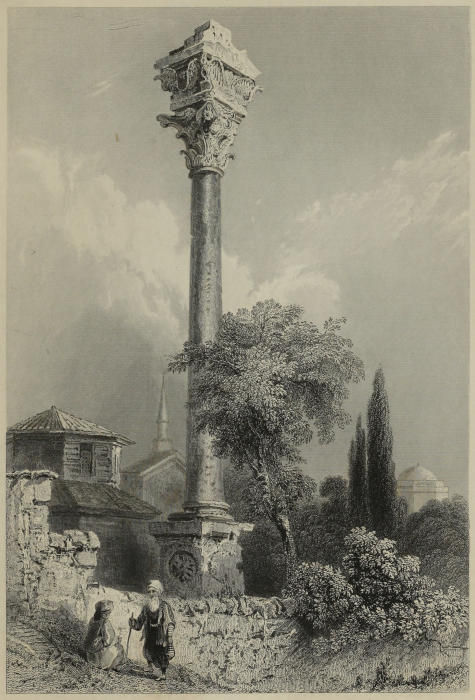
COLUMN OF MARCIAN.
W. H. Bartlett. H. Adlard.
London. Published for the Proprietors, by Geo: Virtue, 26, Ivy Lane, 1838.
Occasionally, as the tourist meditates beside it, or the artist, seated near the mouldering wall which separates it from the road, transfers its noble proportions to his canvass or his sketch-book, the cheerful voices of women come on his ear from the latticed casement of the dwelling by which it is immediately overlooked: nor can he fail to feel that he is himself the subject of their harmless mirth; his foreign and tasteless garb, his unturbaned head, his beardless chin—even the very nature of his occupation, is food for laughter and for jest; while the certainty of a present to old Akif, which is never refused by those who visit his classic garden, adds, in no inconsiderable degree, to the gratification of his harem, when the apparition of a wandering giaour comes to relieve the tedium of their existence.
Old Akif himself is also a worthy subject for the easel of the artist; he seems to have grown grey with the column, and to have withered with the olive-tree. The innovations of late years have wrought no reform in the garb or manner of Akif; he looks like an Asiatic Turk who had never gazed on the glories of the “Golden City.” His turban is large and loosely folded; his tchalvar[21] are of the widest dimensions; his open sleeves of the extremest length; his waist-shawl is freighted with an ample tobacco-purse; and he leans upon his chibouque with an air of sturdy and majestic independence finely demonstrative of his proud and self-centered disposition. He does the honours of the monument like one who is conscious that he is conferring a favour. He neither murmurs at the heartless haste, nor at the tedious delay of his visitors; and he ultimately receives the gratuity of his departing guests with all the quiet and unmoved composure of a creditor tendering his hand for the payment of a well-won debt. The venerable Akif is no antiquarian in spirit; to him stones are stones, and inscriptions which do not treat of the Korān a mere waste of words; and as the smoke from his chibouque curls slowly over his long white beard, many a thought probably passes through his placid brain, not altogether flattering to the earnest Frank who scrambles about the ruin, seeking for traces of a time and people now passed away for ever.