THE SERAGLIO POINT.
Reading edition
“Claudius:—Look forth—What see you? “Benedict:—Every thing, and nothing! Bright skies, clear waters, sunshine, snow, and flowers; Islands, that seem as if in sport they laved Their bosoms in the tide; and shores that smile At their own beauty, mirrored in the glass Of a blue, waveless sea; dwellings that rise Upon the eye like party-coloured flowers; And a warm sunshine, wantoning in sport With the white veil of winter, cast about A foot-defying mountain, round whose brow The amorous clouds cling like a bridal garland. And ever and anon there flits a sail Over the surface of the waters, swift, And graceful as the passage of a spirit, Bound on some pure behest.” Old Play.
The Seraglio Point has been so often described in this volume, that it is merely necessary to introduce the present beautiful sketch, by explaining that it is taken from a height, and, consequently, compresses and embraces a greater number of objects than have yet been introduced into one view of this celebrated spot. The Seraï Bournou is more fully revealed, with its clustering domes and kiosques; St. Sophia lords it more majestically over the Seven Hills; and the glimpse of the harbour is shut in by a portion of one of the quaintly-fashioned houses so peculiar to the locality. In the distance rises Mount Olympus, pale with its eternal snows; with one fantastic rock looming out of the blue waters immediately beneath it, like a huge marine monster sleeping under the still sunshine. To the left, still stretching along the same line of coast, cluster the nest of islets, once known as the “Demon Islands,” and said to have been haunted by a foul spirit; who, however, it may be presumed—
“Visits no more the glimpses of the moon, Making night hideous;”
as three holy houses have been erected within their limits, and a royal lady sheltered there safely for many days to elude a hated and infidel suitor; whence these pleasant retreats have since been more invitingly christened the “Princess’ Islands;” and they are now a place of great resort with the holiday-loving Greeks, during the summer months. On the extreme left lies Scutari, with its noble and palace-like barrack and mosque, over which the rock-seated Guz-couli, rising up amid the waters, seems to be standing sentinel; while the narrow stretch of land, running in a direct line into the sea, is occupied by the poor dingy little Greek town of Cadi Küi, which is built upon the site of the ancient Chalcedon—called, in derision, the “City of the Blind,” in contempt for the wretched taste and narrow policy of the Greeks, who founded it several years before they took possession of the superior position occupied by the present capital.
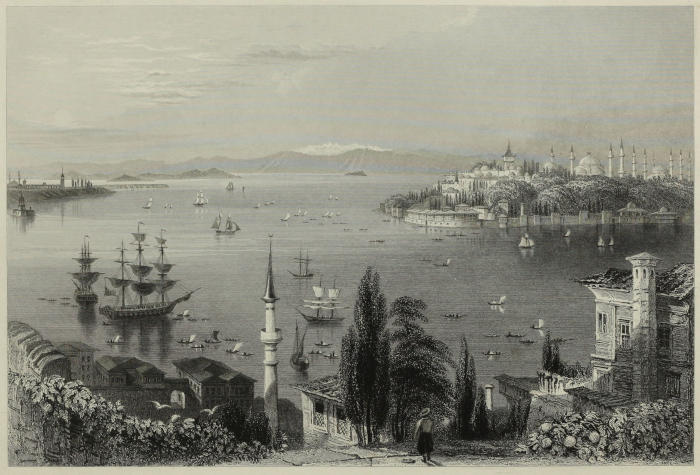
THE SERAGLIO POINT.
POINTE DU SERAIL. DAS ENDE DER SERAGLIO STRASSE.
W. H. Bartlett. R. Wallis.
London. Published for the Proprietors, by Geo: Virtue, 26, Ivy Lane, 1838.
Add to these several and enduring features of the scene, the constant passage of hundreds of swift and arrow-like caïques, of fleets of merchantmen of all lands, of the high-prowed and classical Arabian barks, and, occasionally, the stately ships of war, with their blood-red flag glittering with a silver crescent, gracefully making their way to their moorings off the palace of Beshik-Tash—and the artist will readily be forgiven, though he should have multiplied his memories of so glorious a spectacle.