PETIT CHAMPS DES MORTS, PERA.
Reading edition
“Come, wander with me in the place of graves— The tall trees wave a welcome, and the wind Sighs like soft music through the clustered tombs. Come, wander with me there, where thousands rest; We shall not waken them—theirs is the sleep Which, dreamless, knows no waking.”
There is certainly nothing which more impresses the mind or fills the imagination of the traveller in Turkey, than the appearance and situation of the burial-places. The sunniest spots, where all is gaiety and gladness, yet find room for a grave, without being saddened by the partial occupancy of death. The gardens of the great are open to the remains of those who have been dear to them in life, and the lovely Acacia Gul-ibrasim, or “silk rose,” is often gathered from the tomb of a dead beauty to adorn the hair of a living one; nor does the soft wind which sighs through the branches of the pensile willow by which it is overshadowed seem more sad, nor its cool shade less welcome to the survivor, because they are the accessories to a grave.
In the grounds of the Sultan’s “Palace of the Sweet Waters” there is a tomb of fair white marble, erected immediately beneath the windows of his own private apartments, to the memory of one whom he had loved and lost—a beautiful Odalisque, who died in the first bloom of her youth and favour—whom the Imperial Poet immortalized in song—whom the man wept in the solitude of his chamber—and whose head was laid low where he could at least see the fresh turf spring about her tomb.
The Reis Effendi, an old gray man, in whom it might have been thought that the weight of years and the cares of office must have worn out the sensibilities which lead us to yearn after the departed, and to cling morbidly to the poor remnant which is shrouded in the grave;—even he, surrounded by state intrigues, each of which might have cost him both place and power; hastening to the termination of his earthly pilgrimage, and accustomed to the sight of death for long and weary years;—even he, when in the winter of his days he lost one whom he deeply loved, suffered not the body to be borne away from him, but raised the tomb in his garden, where, beneath the long shadows of the over-arching trees, he could sit on the cold marble of the gilded sepulchre, and weep. And yet it was but upon the grave of a young child that he shed these bitter and frequent tears—the little son of a dead daughter, who had not yet seen seven summers: but the boy had clung to him, had never learnt to bow before his greatness, but had sat upon his knee, and made a plaything of his gray beard, as he prattled to him in the language of the heart in which there is no guile: and the hoary statesman loved the child—and lost him; and he felt bitterly that he had not time enough left on earth to learn so to love another!
And there stood the little tomb in that shady garden, with its gilded turban, and its fond record, where the grandsire could look upon it unobserved.
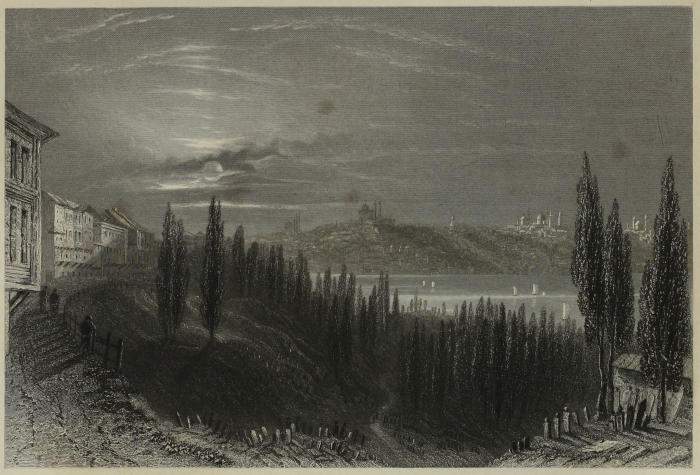
THE PETIT CHAMP-DES-MORTS, PERA.
LE PETIT CHAMP-DES-MORTS, VU DESSUS DE PÉRA. DER KLEINE TODTENACKER, OBERHALB PERA.
W. H. Bartlett. J. T. Willmore.
London. Published for the Proprietors, by Geo: Virtue, 26, Ivy Lane, 1839.
Is there a narrow nook at the corner of a street in the most crowded thoroughfares of the city,—there you will find a head-stone and a grave. Like the ancient Romans, from whom they probably imbibed the custom, the Turks form burial-places by the way side; and, like them, they also inscribe upon their tombs the most beautiful lessons of resignation and philosophy.
The Petit Champs, or lesser Necropolis of Pera, offers a singular spectacle: it is entirely sacred to the Musselmauns, (who never suffer the ashes of their dead to mingle with Infidel clay,) and fringes with its dark cypresses the crest and a portion of the declivity of the hill which dominates the post: it is hemmed in with houses, overlooked by a hundred casements, grazed by cattle, loud with greetings and gossipry; and commands from its higher points extensive and noble views of the harbour and the opposite shore. The ground is very undulating, forming deep dells where the sunshine never penetrates, and then suddenly and abruptly rising, as though to fling its funereal grove in contact with the blue sky above it. There are footpaths among the trees, sunny glades gleaming out from among the dark shadows, head-stones clustered against the grassy slopes, and guard-houses with their portals thronged with lounging soldiers, arousing the echoes of the death-forest by the clash of steel.
In the bottom of the valley, in the very midst of the cemetery, stands a small octagonal building, from whose solitary chimney a dense white cloud of smoke may generally be seen to emerge, wreathe itself for an instant about the nearest cypresses, and finally lose itself in the atmosphere. This is the dead-house, to which the body of every deceased Moslem destined for interment in this burial-place is brought, in order that the last worldly duties may be performed—the corse carefully washed, the beard shorn, the nails cut, and the limbs decently composed; and this is a ceremony never omitted, ere what was so lately a True Believer is laid to rest in the narrow grave.
On the verge of the cemetery, where it touches on the faubourg of Pera, the rocky ground rises precipitately, forming a natural division between the habitations of the dead and the living; but not a hand’s space has been left waste by either. A narrow road along the side of the descent alone separates the houses of the Perotes from the graves of the Moslem, which lean against the base of the ridge. These houses have many of them terraces overlooking the cemetery,—gay with flowers, loud with laughter, and bright with smiles: trees have been planted before them; cafés, where the young and the idle congregate during the summer evenings to enjoy their ices and cigars, awaken with their light revelry the echoes of the death-place; and many a fond couple wander away amid the graves, and sit hand in hand upon some lettered stone, to exchange their vows, and to lay plans for the future on the very threshold of the past!
Some of the Turkish tombs are very elaborate and beautiful, particularly in the solemn Necropolis of Scutari: there are none of the prettinesses of Père-la-Chaise to be found amid its wide solitudes; and it is equally free from colossal statues of statesmen, looking as though they had been transplanted from a council-chamber or a cathedral, and appalling representations of grinning skeletons and eyeless sculls; no fanciful calembourgs on roses and reine-marguerites are graven into the eternal stone, which had been better enshrined in some gilded volume:—all is stern, and still, and solemn: the fatuities of life have no place in that city of the dead; its very atmosphere is unlike that which is breathed elsewhere, for the clustering together of the cypresses diffuses a strong aroma of resin, purifying the air, and counteracting the pernicious effects of such a mass of perishing mortality as that which lies below; while its deep shadows, and its occasional gleams of light falling upon the myriad head-stones scattered around, are like glimpses of an unknown world.
Those head-stones themselves form a striking and peculiar feature of the scene; they are extremely picturesque and various in design; and as the Musselmauns never disturb the ashes of the dead, and never bury and re-bury on the same spot, as is too commonly the case in the more narrow and confined grave-yards of Europe, the time-worn, weather-stained, and leaning column, beneath which the clammy human soil has failed, is seen in juxta-position with the brightly-gilded, fresh-lettered pillar of yesterday, against which time has yet had no power, and over which no storm-cloud has yet burst, standing turban-crowned and erect, telling its tale of recent bereavement. At the base of many of these columns a small reservoir for water is hollowed in the stone that marks the dimensions of the grave, to slake the thirst of the wandering dogs and birds which may chance to pass through the cemetery; while the sex of the dead may be at once distinguished by the turban (varying in form according to the rank of the deceased, and faithfully serving as the index to his social position) which marks the grave of the man, and the sculptured rose-branch that indicates the resting-place of the female.
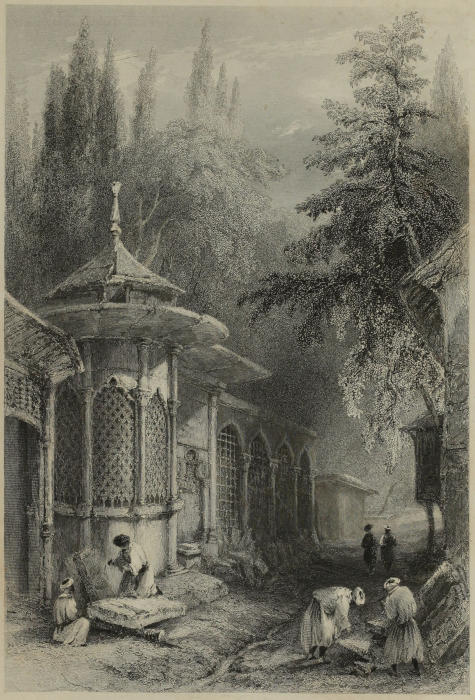
TOMB IN THE CEMETERY OF SCUTARI.
TOMBE DANS LA CIMETIÈRE DE SCUTARI. EIN GRABMAL AUF DEM KIRCHHOFE ZU SCUTARI.
W. H. Bartlett. W. F. Topham.
London. Published for the Proprietors, by Geo: Virtue, 26, Ivy Lane, 1839.
Nothing can be more marked than the contrast between the Turkish and the Christian burial-grounds. The Greek cemetery at Pera is slovenly and ill kept; the slabs covering the bodies are mutilated and defaced by wanton violence; the trees, scantily distributed among them, are hacked and ragged; and were it not that it is on three of its sides overlooked by houses, it would present the very embodyment of desolation.
The Frank grave-yard is as obnoxious to good taste as that of the Greeks to good feeling. There are Latin inscriptions, signifying nothing which can awaken either sympathy or devotion; flourishes of French sentiment in prose and rhyme; injunctions to pray for the souls of the departed, coupled with Italian elaborations of eulogy and despair; concise English records of births, ages, deaths, and diseases; and all the common-places of an ordinary grave-yard, without a single object which can tend to deepen a solemn or a pious thought.
But the Armenian necropolis is well worthy the attention of the stranger. It is a thickly-peopled spot, where the acacia-trees blossom in their scented beauty, and shed their withered flowers, like a sweet pall dropped by the hand of nature on the quiet graves. The Armenian tombs are peculiarly inscribed, giving you a lesson, and reading you a homily as you wander among them. The noble Armenian character is graven deeply into the stone; name and date are duly set forth; but that which renders these slabs (for there is not an upright head-stone in any Eastern cemetery, save those of the Turks and Jews) peculiarly distinctive, is the singular custom observed by this people, of graving upon the tomb an emblem of the profession or trade of the deceased.
Thus the priest is distinguished even beyond the grave by the mitre that surmounts his name; the diamond-merchant by a group of ornaments; the money-changer by a pair of scales; the florist by a knot of flowers: besides many more ignoble hieroglyphics, such as the razor and basin of the barber, the shears of the tailor, and so on; and when the calling is one which may have been followed by either sex, a book, placed immediately above the appropriate emblem, distinguishes the grave of the man.
Nor is this all; for the victims of a violent death have also their distinctive mark; and more than one tomb in this extraordinary burial-place presents the rude representation of a headless trunk, from whose severed throat the gushing blood is spirting upwards like a fountain, while the head itself is pillowed on the clasped hands!
Many of the more ancient of the tombs are very richly and intricately wrought; and the shapes of several of these sarcophagi are eminently classical; but nearly all the modern ones are mere oblong slabs, mounted in some cases upon circular pedestals three or four inches in height, and perfectly simple in design. The situation of the Armenian burial-place is superb; and it is generally occupied by groups of people of that nation, seated upon the grave-stones, beneath the cool shadows of the acacia-trees, talking and smoking, as though no symbol of the dead were near.
Death has no gloom for the philosophical Orientals!