A PUBLIC KHAN.
Reading edition
A place where merchants congregate—where wealth Takes many forms—is bartered, bought, and sold; Is earned by labour, flung away on chance, Exchanged, computed, watched with eager eyes, Weighed, balanced, won, and scattered o’er the globe. MS.
The Khans, or Caravanseraïs of the East, are as purely oriental in their character as the Mosques in whose immediate neighbourhood they are generally situated, or the Bazārs which they supply with merchandise.
The Caravanseraï, or lodging of the caravan, is a large quadrangular court, surrounded by stone buildings, solidly massed, and presenting much the appearance of the inner cloisters of a monastery. The apartments on the basement serve as counting-houses for the merchants, one only being reserved as a coffee-kiosque, for the accommodation of the tenants of the Khan, which always has a fine fountain in the centre of its paved court, and is closed two hours before midnight by a pair of massive gates; beside one of which is the little hut of the Khanjhi, who is answerable for all comers and goers after that time, until day-break; a precaution rendered highly necessary by the immense value of the merchandise which is frequently contained in these establishments.
The upper story of the building is faced by an open gallery, supported on arches, which stretches round the entire square, and is reached by exterior flights of stone steps, situated at two of its angles; and from this gallery open the store-rooms of the merchants, which are generally filled with bags of raw silk, European cottons, bales of rich stuffs, tobaccos, spices, arms—and, in short, all the most precious articles of Eastern traffic.
It must not, however, be imagined that the articles here described are to be found promiscuously in every Khan; on the contrary, the silk-merchants have their own peculiar rendezvous; the hyperbolical Persians pile their gold and silver stuffs apart; and the gebeli-dealers sort their various tobaccos in a caravanseraï of their own; while the mere traveller, pilgrim, and dervish, take up their abode in common in very inferior Khans, where heat, vermin, and filth are their certain companions; and where the acquaintanceless European, driven to this resource in towns where no hotels exist, is initiated into a thousand personal miseries, of which he could previously have formed no idea.
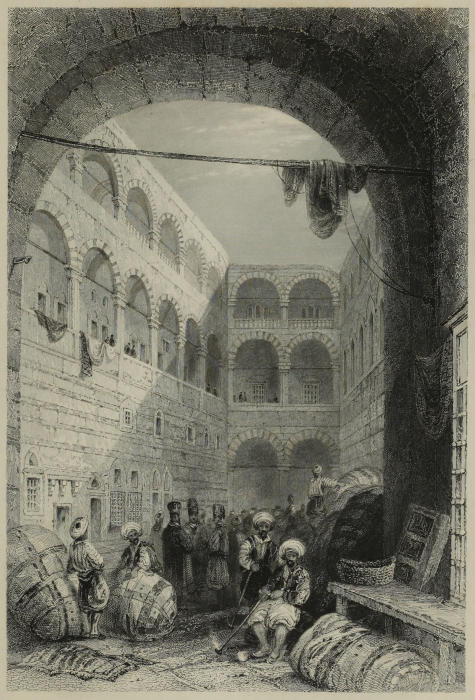
A PUBLIC KHAN.
KHAN PUBLIC. EINE UNENTGELTLICHE HERBERGE.
W. H. Bartlett. J. C. Bentley.
London. Published for the Proprietors, by Geo: Virtue, 26, Ivy Lane, 1840.
The Khan of the silk-merchants at Broussa in Asia Minor is a very beautiful establishment, with a noble gate-way, opening from the bazār of the city, finely set in a frame-work of mosaiced porcelain; while its Caravanseraï for pilgrims is wretched in the extreme. And the same distinction is visible in those of Constantinople itself, where dervishes, santons, and other wayfarers, who can afford to pay for their scanty lodging, and yet more scanty fare, leave behind them traces of disorder and want of cleanliness, which are, indeed, almost enough to challenge the skill of all the khanjhis of the city to obliterate.
Dr. Walsh, in the first volume of his “Residence in Constantinople,” gives an account of his arrival in a Turkish hamlet, situated in a magnificent valley, surrounded by the distant branches of Mount Rhodope, when on his way overland to Stamboul from the Dardanelles—which, as it not only gives an admirable picture of one of the inferior village Caravanseraïs of the East, but also illustrates a virtue universally practised in Turkey, we shall extract entire:—
“The villages scattered about these mountains are inhabited by Turks, Greeks, or Armenians; if by the former, a traveller is never admitted into a house, but must lie in the stable with his horse, at a place called a Khan. This is generally a very large edifice, like one of the great cow-houses in England, filled with cattle of all kinds. At one end is a little enclosure, separated by a low partition, just sufficiently high to prevent the cattle from walking over him, but in other respects a continuation of the stable. That in which I now found myself had the luxury of a bit of rugged straw mat, just large enough for me to sit on; and I found myself lodged with about fifty buffaloes and camels. A traveller gets nothing to eat but what he brings with him, and my stock of provisions consisted of a grain of coffee in a paper in one waistcoat pocket, and a little zacchari, or brown sugar, in the other. Hasan had a bag of tobacco. I had eaten nothing from the first light in the morning, and I was as hungry as tired, after a long day’s ride; but there I sat solitary, between three mud walls, on a bit of dirty straw mat, with the more fortunate cattle crunching their provender about me. Occasionally, a camel, or a buffalo, would put his neck across the partition, and having looked at me with considerable curiosity, would then begin to move his jaws just close to my face, as if to mock my hunger. Meantime, Hasan sat cross-legged before me, smoking his pipe with the most imperturbable gravity, quite reconciled to the state of inanity in which we were doomed to pass the night. I several times gave him an imploring look, and put my finger in my mouth, closing my teeth on it, that even a Turk might comprehend what I wanted. Hasan slowly moved his head, and said, ‘Yoke,’ the first word I had heard him utter. I hoped that yoke might have something to say to eggs, but I was mistaken; yoke, I found, was Turkish for ‘nothing.’ I now made myself about a thimbleful of coffee, in a little tin measure, which I found among some embers in an earthen pot in the corner, and stretching myself out for the night, I took Hasan’s pipe, and smoked myself into a doze.
“I know not how long I remained in this state, but when I opened my eyes, I found by the light of a lamp stuck in the wall, the place crowded with Turks, sitting round me cross-legged, three or four deep, all smoking and silently gazing on me, waiting, apparently, until I should awake. I asked for Hasan, whom I could not see; and one of them, rather a truculent-looking man, drew his hand across his throat, and with a solemn countenance, motioned me to hold my peace. ‘Here then,’ said I to myself, ‘I am about to suffer the penalty of travelling with a false firman;[48] my janissary has been punished in the summary way of a Turk, and I must submit to whatever they please to do to myself; the Elchi Bey[49] can’t protect a British subject in this remote place.’ While engaged in these pleasant reflections, a joint-stool was brought in and set before me, and a large metal tray laid on it, with a number of broad horn spoons, like shovels. I had some vague notions of barbarian nations feeding people before they kill them; and here was my last meal.
“The first course was a basin, the size of a cauldron, of pease-porridge, which was soon dispatched by the company; the next was a seasoned substance, like macaroni; and the last was a bowl of an acidulated liquor, the most grateful I ever tasted. During the whole of the entertainment, not a sound was uttered, nor was I ever asked to eat. But a man in a green turban, to mark his being a descendant of Mahomet, and who seemed the master of the feast, had his eye on me. When he saw me relaxing with my spoon, he said not a word; but he nudged the man next him with his elbow, and he his neighbour, till it came round to me; and in this way I was pressed to eat more. A large bunch of grapes was fished up from the bottom of the last bowl, and held for a moment by the Turk in the green turban; it was then passed on to me, without any one helping himself, and laid on the tray before me; and it seemed a part of the ceremonial of the entertainment. When every thing was removed, I was presented with a cup of coffee, and a pipe; but having declined them, one of the company laid the side of his head on his hand, intimating that I should go to sleep; I drew my cloak over me as I was bid, and when I awoke in the morning, I found the company still sitting round me, smoking as before I fell asleep. The horses were now brought to the door, and my hosts departed as silently as they entered, without asking remuneration, or seeming to expect even thanks. I afterwards found that my friendly Turks were the voivode and principal men of the village, who, being informed that I was a stranger and a Frank with a firman, had given me an entertainment; and the man who drew his hand across his throat, had intimated that Hasan had gone to get himself shaved and dressed for dinner. There was something singular in their taciturn hospitality, but the kindness of a Turk is divested of all pretension; it is rude, but cordial, whenever it is offered.”
At the town of Rodosto, the same writer says:—
“The Khans for travellers here are of a most enormous size, some of them, apparently, as large as Westminster Hall, and resembling it in appearance; an open edifice, with a high roof, supported on naked walls, unbroken by any object. Some of them contain two or three hundred horses, or camels, which appear like mice ranged round the floor below.”
But the khanjhis, or keepers of the Khan, must not themselves be passed over without a word of mention. They are usually keen-witted, crafty, intelligent men—the very focus of all the news and gossip of the city; chartered rascals, moreover, who will cheat every one to his face who has any thing to lose, and against whom every one is consequently on his guard; but who are at the same time so true to the trust reposed in them, that the goods of the merchants, however valuable, are never violated when once placed in the charge of the khanjhi, who will die at his post rather than suffer even a suspicious eye to rest upon them.
There is a certain foppery about the khanjhi of a first-rate Caravanseraï; he wears his turban with an air, carries his chibouque between the second and third fingers of his right hand, and flourishes a tusbee in his left, as though it had never any other employment than that of coquetting with the beads of the chaplet; although his well-worn slippers, and the weather-stained folds of his dress, tell a tale of more active and useful occupations.
The khanjhis are universally patient and good-humoured, and from living constantly among strangers, are much less prejudiced in favour of their own habits and manners than most of their countrymen; though they evidently consider the mere visitors to the establishment as decided intruders, interfering with the comfort and seclusion of their tenants, and trammelling them in their business; and consequently receive the parting backschish[50] of the stranger with a grim satisfaction wondrously amusing.
Altogether, could the wandering European make the acquaintance of a khanjhi in every Eastern city that he visits, without being compelled to make that of the Khan itself, he would enjoy a novel and interesting phase of society, totally distinct from all that he had left behind him in the far west.