MOSQUE OF SULTAN BAJAZET.
Reading edition
——“This enchanted ground, And all its thousand turns disclose Some fresher beauty varying round: The haughtiest breast its wish might bound Through life to dwell delighted here.” Byron.
The Mosque of Sultan Bajazet is situated in the angle of a large open area, known as the “Square of the Seraskier,” from the circumstance that his palace, or rather its extensive court, forms another side of the enclosure; its large and lofty projecting gate, elaborately wrought and fretted with gold, and surmounted by a dome crowned with an immense gilded star, being, perhaps, the most oriental feature of the scene.
The Mosque of Bajazet is built in the immediate neighbourhood of the great Tcharchi, or Bazār, and hence the square is constantly thronged with merchants, traders, and strangers, passing to and from this vast commercial mart; while groups of khamals, or street-porters, lounge on every side with their baskets, waiting to be hired by such visitors to the Tcharchi as chance to make purchases. Numbers of Greek and Armenian mahalibè[39] and yahourt[40] merchants are also perpetually to be seen; the first with their dainty fare temptingly set forth upon fine linen cloths, and protected from the sun by huge white umbrellas, looking like gigantic mushrooms; and the others, wandering from side to side, balancing the large wooden scales on which the small basins of red clay, containing the yahourt, are arranged with extreme care and cleanliness; while, at intervals, the water-venders cross the path, with their classically-moulded earthen pitchers on their shoulders, and their capacious goblets of crystal, carried on a narrow tray attached to the leathern girdle about their waists; giving out, as they move along, the low, plaintive, and by no means unmusical cry peculiar to their calling; and exerting a very successful rivalry with the sherbetjhes, who plant their portable fountains under the cool shadows of some lofty wall, and invite customers by the fairy chime of the metal bells which the flow of the beverage keeps in perpetual play.
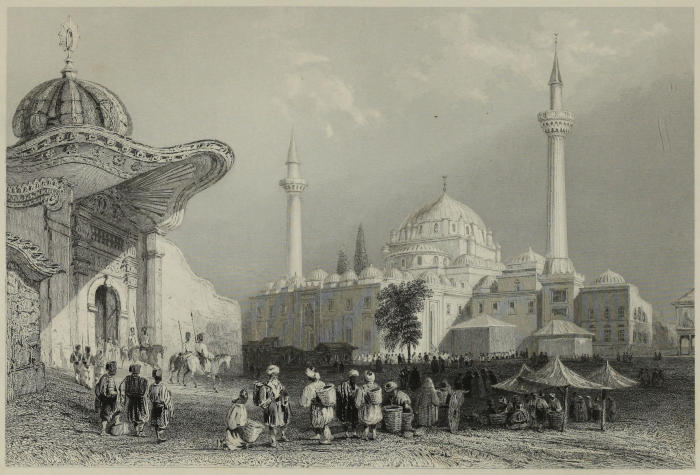
MOSQUE OF BAJAZET, WITH THE SERASKIER’S GATE.
MOSQUÉE DE BAJAZET AVEC LA PORTE DU SÉRASKIER. DIE MOSCHEE DES BAJAZET UND DER EINGANG ZUM SCHLOSS DES SERASKIERS.
W. H. Bartlett. H. Griffiths.
London. Published for the Proprietors, by Geo: Virtue, 26, Ivy Lane, 1839.
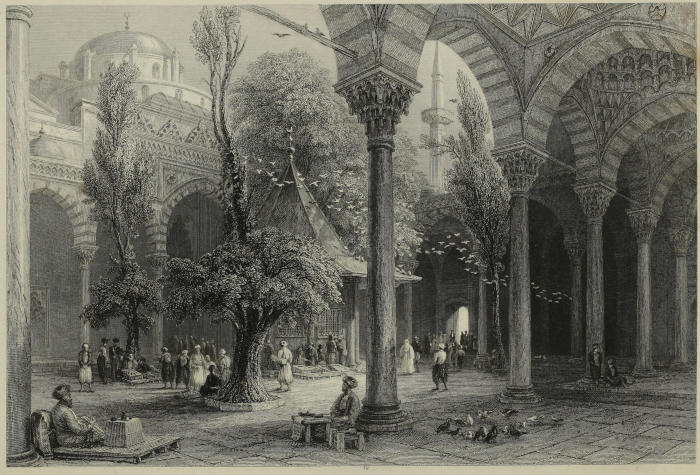
COURT OF THE MOSQUE OF BAJAZET.
COUR DE LA MOSQUÉE DE BAJAZET. DER HOF DER MOSCHEE BAJAZET.
W. H. Bartlett. T. Higham.
London. Published for the Proprietors, by Geo: Virtue, 26, Ivy Lane, 1840.
Occasionally, a detachment of the Seraskier’s guard pass into the square, and after having demurely walked their horses from beneath the august kapousi, or gate, suddenly break into a brisker pace as they speed on their errand, scattering the lounging populace to the right and left, as their eager horses bound from the stroke of the iron stirrup. And well may they hasten on their way, for those errands frequently involve a question of life and death; all criminals taken in flagrante delicto within the precincts of the city being first committed to the prisons of the Seraskier, whence the tidings of their crime and capture are transmitted to the Porte.
The portal of the Mosque is very beautiful, being elaborately wrought in the Saracenic taste, with those receding dentated arches which look as though they were formed by stalactites; and the battans of the gate itself being skilfully inlaid with mother-of-pearl, in arabesques. Its exterior galleries are also very gracefully designed, and the form and fashion of its two slender minarets singularly pleasing.
The court of the Mosque is a favourite rendezvous with the merchants trading in the Tcharchi, who frequently retire for a time from their shops to smoke a chibouque beside the fountain, under the shadow of the maple-trees; or to complete there a bargain more legitimately commenced in the great mart itself; all commercial transactions of any extent being uniformly concluded over a pipe, or broken off with the same ceremony. Nor may it be uninteresting to remark, that, whenever a Turkish trader decides on retiring for an hour’s relaxation from the labours of his calling, he does not trouble himself to place his merchandise under lock and key, even in this extensive thoroughfare; but simply letting fall a tapestry curtain above the platform on which he is accustomed to sit and to display his wares, as a signal that he is away, he goes quietly to the coffee-kiosque without one misgiving as to the safety of his property, which is sacred during his absence; a trust in the public integrity which was never in any instance known to be violated.
But the most remarkable object in the vicinity, is decidedly the Yanguen Kiosque, or Fire-Tower, which occupies a portion of the palace court. It is of immense height, of a circular form, and entirely surrounded almost at its summit by windows, which command a view of every quarter of the city; the apartment from which they open being the head-quarters of the fire-guard, six of whom are constantly on duty day and night, relieving each other every second hour like military sentinels. At sunset, in order to counteract the feeling of weariness which grows upon the watchers as the darkness gathers about them, the individual on duty wears a pair of wooden slippers, with double heels, the lower of which beats against the floor by a spring at every step of the wearer, keeping up a perpetual noise quite sufficient to assist his efforts against sleep, although, when he resigns his watch, he throws himself down upon his mat, and slumbers in happy heedlessness of the dissonance.
On the first appearance of a fire, the sentinel gives the alarm to a second division of the guard, occupying the lower portion of the Tower; and having indicated the quarter of the city in which the conflagration has burst forth, he returns to his post, and leaves them to do their duty. This consists in summoning the firemen, who are a bold and hardy band (less judiciously trained, perhaps, than those of England, but yielding nothing to them in courage and perseverance)—in informing the authorities of the misfortune, when every Pasha within reach is compelled to repair to the spot, and to assist, by his counsels and exertions, in repairing or subduing the evil—and in warning the inhabitants of the city and suburbs of the impending catastrophe. This latter ceremony is performed by traversing the streets, armed with a long staff shod with iron, which is perpetually and violently struck against the rude pavement by the fireman, who having thus “murdered sleep,” next shouts at the pitch of his voice, “Yanguen var—There is a fire!” adding, an instant afterwards, “Scutari-a—Galata-a—Stamboul-da”—as the case may be; thus indicating to his anxious listeners the scene of terror, in order to enable those who have friends or property in that neighbourhood to speed to their rescue.
In a city of wood like Constantinople, where, save only the Mosques, the Khans, and the Tcharchi, there are very few buildings of stone, conflagrations are of frequent and almost continual occurrence, and scarcely a night passes in which the trembling Frank is not awakened by the hoarse cry of Yanguen var beneath his window; casements are hastily flung up; heads are anxiously protruded; and then there is a hurried tramp along the streets, as with swift step and labouring breath those hurry by who fear to be involved in the catastrophe; while others quietly return to court a renewal of the rest which has been so rudely broken, thanking Allah, or the Panagia,[41] according to their several creeds, that their turn is not yet come!
Such is the use of the Fire-Tower, which, moreover, affords to the lover of nature an enjoyment probably unrivalled in the world, as from its immense height it commands a series of views, so varied and so magnificent, as almost to defy competition. Immediately beneath it lies the court of the Palace, with the noble dwelling of the Seraskier, the long range of grated prisons, and the green tents of the guard, forming a pigmy encampment; the dome and minarets of the Mosque of Bajazet appear beyond the walls, beside the clustering and far-reaching roofs of the Tcharchi; and this is, perhaps, the only point from which the traveller can form a just estimate of the immense extent of the far-famed Bazārs of Constantinople. But it is the distance—the stretch of sea and shore, of isle and mountain, of lake and forest, of light and shadow—the infinite variety, the surpassing majesty of nature in her brightest and most beautiful of garbs, which make the pulses bound, and the brow burn, as the traveller looks down and around him; awe-struck, spell-bound, and silent, drinking in deep draughts of loveliness, and seeming to revel in a new existence!
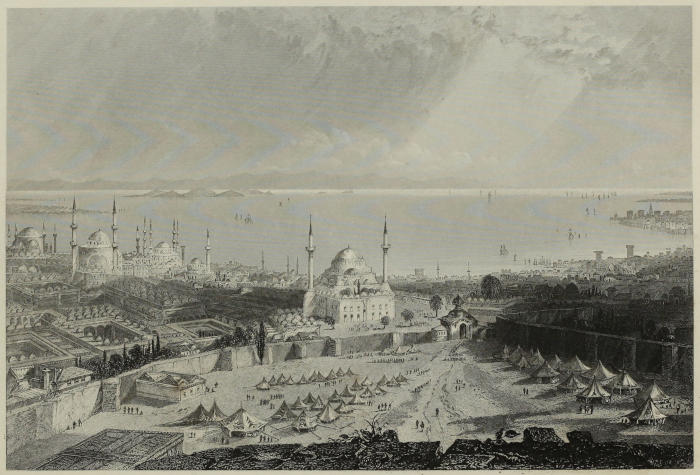
THE SEA OF MARMORA. (From the Seraskiers Tower.)
MER DE MARMORA, VUE DE LA TOUR DU SÉRASKIER. DAS MARMOR-MEER, (VOM SCHLOSS DES SERASKIER.)
W. H. Bartlett. R. Brandard.
London. Published for the Proprietors, by Geo: Virtue, 26, Ivy Lane, 1839.
On one side, the city of Constantinople is spread out beneath him like a map; and he gazes on its thousand domes, and its five thousand minarets; its majestic maples dwindled into bushes; and its dark cypresses seeming like finger-posts indicating the scattered resting-places of the dead—upon its busy khans, its crowded Tcharchi, its luxurious palaces, and its gloomy prisons. The hand and mind of man are visible throughout, and human pride swells high during the contemplation of human power; but let the gazer move a few paces onward—only to the next window—and he will be instantly rebuked. There stretches away the sea of Marmora—the sunny Propontis—with its rocky islets, and its glittering waves, dancing beneath the bright blue sky; Mount Olympus, stately with its crown of snow and its mantle of vapour, perceptible on the verge of the horizon; and the glorious Bosphorus, winding between its rich and peopled shores, guiding his vision onward to the Sea of Storms. Another move, and the Golden Horn is before him; a thousand barks safely moored within its land-locked limits, pouring forth the riches of other lands, or lading with the treasures of this; the flag of many nations flying proudly at their masts, and the voices of many lands swelling upon the breeze. When his eye is sated, and his mind is satisfied with this spirit-stirring scene, a few feet onward he will find a spot whence he may repose his excited vision on the dark and arid rocks which enclose the lovely “Valley of the Sweet Waters;” the most delicious spot of earth that ever was cinctured by a mountain-girdle; and lose himself in fancy amid its woods and waters, the golden-latticed chambers of its summer-palace, and the veiled beauties who inhabit them.
Such is a faint outline of the majestic and varied scenes to be enjoyed at the expense of the fatigue attendant on mounting the three hundred and thirty steps of the Yanguen Kiosque—a physical exertion which is forgotten at the first glance from its dizzy height upon the fairy wonders of the surrounding objects; the busy breathing city—the sweet still valley—the ocean-channel, linking two quarters of the globe as with a silver string—and the wide sea, the unfathomable, trackless, mysterious sea, bounding the vision, where it blends in one deep, rich, purple tint, with the far horizon.