THE WALLS OF CONSTANTINOPLE.
Reading edition
Girdling a peopled world they stretch along— A mighty grasp about a mightier space; Where heroes strove in vain, and poet’s song Hath shed around a glory and a grace. Here the proud Crescent braved the holy Cross, And reared its symbol on each saintly shrine; And here, triumphant ’mid an Empire’s loss, Thy proud heart ceased to beat—Imperial Constantine! MS. Poem.
The walls of Constantinople are fraught with interesting memories. To the historian they tell of the varying fortunes of a mighty empire; to the antiquary, of the noblest days of Roman art; and to the soldier, of the bold and heroic deeds of a race long gone, but living still in the page of tradition; while, to the traveller and the man of taste, they offer scenes of picturesque beauty, varying at every point of his pilgrimage; and presenting a succession of landscape-views which defy alike the description of the tourist, and the pencil of the painter.
The city of Constantinople occupies a triangular promontory above the Propontis, and it has been strongly fortified on all sides, as well those which are washed by the sea, as on that which is the base of the triangle, and connects it with the main land. The walls extend twelve miles, sweeping from sea to sea, running along the whole length of the harbour, restraining the billows of the sea of Marmora, and terminating in the celebrated fortress of the Seven Towers. They are every where ruinous, and in several places so utterly dilapidated as to be wholly useless for the purposes of defence; their reparation being a herculean project at present unmeditated by the Turks, and probably never to be accomplished. At some points the foundation of the walls is formed by huge masses of rock, a species of architecture still to be traced in a few of the most ancient Grecian structures, and formerly termed Cyclopæan; and fabulously asserted to be the work of giants, owing to the enormous size and weight of the stones employed. In other spots, particularly on the side of Marmora, the masonry commences regularly from the very edge of the water; and where the action of the waves has displaced the original material, piles of broken shafts of the most beautiful proportions, hewn into fragments, have, in endless instances, been substituted to prevent the ingress of the water to the gardens and kiosques by which the shore is fringed. The antiquarian treasures thus recklessly lavished where baser material would have sufficed, are said to be beyond price; and many a sculptured capital and graven stone may be detected as the caïques slowly glide along over the glittering ripple, which render the traveller willing to believe and to mourn over the fact. Permission has in several instances been sought by strangers to remove some of these tempting reliques, but it has always been coldly and resolutely denied.
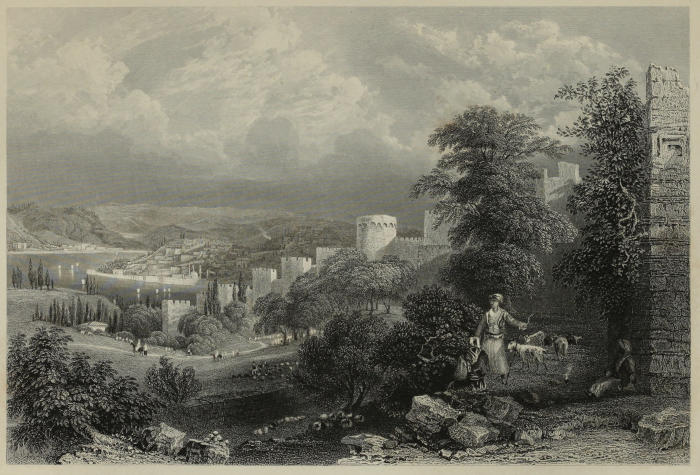
THE CITY WALLS. (Descending to the Port.)
MURS DE LA VILLE. DIE FESTUNGSWERKE DER STADT.
W. H. Bartlett. J. C. Varrall.
London. Published for the Proprietors, by Geo: Virtue, 26, Ivy Lane, 1839.
The most ancient portion of the walls is necessarily that which enclosed the ancient Byzantium, now known as the Seraglio Point, where the apex of the triangle divides the Propontis from the port, and instead of being peopled by the busy multitude of a city, is silent in the stateliness of its gilded palace and overhanging groves. Portions of the original walls are still standing, and separate the seraglio gardens from the adjacent streets; and even in their ruin they retain traces of the strength and massiveness which have enabled them to exist from the year 660 A.C.—at which period they were erected by the hands of the Lacedæmonian colony who first peopled this magnificent spot—even to the nineteenth century, as if in scorn of the frail and unstable works of later and less laborious architects.
The wall which encircles the present city was built nine hundred and seventy-eight years subsequently, by the Emperor Constantine, and frequently repaired by Theodosius, and other sovereigns, who have each in succession left commemorative inscriptions upon the masonry. Thus, on one spot is graven “Theodosius, King, by the grace of Christ;” on another, “The illustrious Theodosius, the great King, by the grace of Christ;” while numberless crosses, and the remains of half-obliterated sentences, now beyond solution, are to be found in various places.
Perhaps the most picturesque portion of the walls is that which stretches from the cemetery of Eyoub along the road leading to Balouclé, or the “Church of Fishes.” A dilapidated palace, known as the “Palace of Constantine,” (and supposed to have belonged to the first of that name,) is among the most striking objects in this quarter of the city; it appears to be coeval with the wall, and to have mouldered under the same influences. The view which it commands is extensive and magnificent; and its ruin has a regality about it which speaks of Rome in her best days of pride and power. The walls are, in this direction, unusually well preserved, and of great height, and no breach is perceptible for a considerable distance, as this side of the city offered fewer facilities to an invading army than many other points, and the defences have consequently been subjected to no violence beyond that of the ever-gnawing and corroding tooth of time. A dense coating of ivy clothes the whole hoary mass of masonry; octagonal towers, draperied with the same rich parasite, rise at intervals like a succession of feudal castles; and the moat at their base is rife with vegetation, amid which the wild fig-tree with its broad fan-like leaf, the acacia with its peach-like blossoms, and the weeping birch, waving its flexile branches to the wind like the hair of a young beauty, are the most conspicuous.
Two of these octagonal towers flank the more lofty portion of the wall, and several breaches are shortly afterwards discernible. Here the defences are tripled; and a double moat, commencing at the Rodosto Gate, terminates only at the entrance of the Seven Towers, on the Sea of Marmora. This triple wall is considerably lower than that which stretches along from Eyoub; and as it follows the undulations of the hills upon which the city is built, it necessarily permits a great portion of the enclosure to be visible from without; and to this circumstance may possibly be attributed the fact, that it was on this side that Mahomet, encouraged by a sight of the fair capital which he coveted, was induced to attempt its capture. The Top-Kapousi, or Gate of the Cannon, remains as a memorial of his success; and it derives its name from the fact of its being surmounted by several immense balls of marble, such as are used by the Turks for the supply of their most ponderous pieces of ordnance, and which were placed there by the triumphant Moslems to perpetuate the capture of the devoted Christian city.
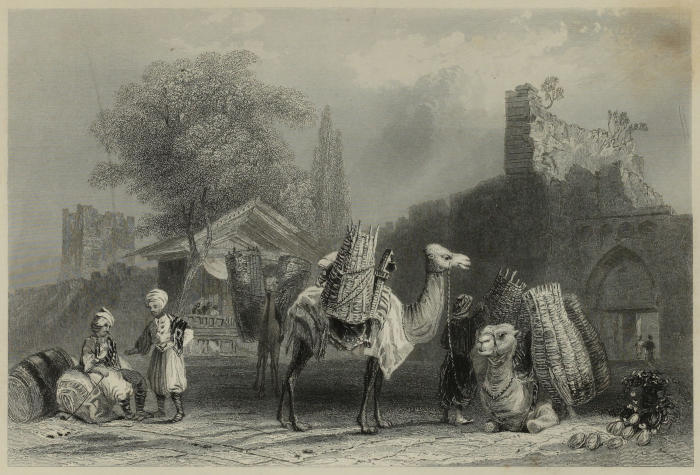
TOP-KAPOUSI, OR THE CANNONGATE.
TOP-KAPOUSI, VU LE CANNONGATE. TOP-KAPOUSI ODER DAS KANONEN THOR.
W. H. Bartlett. H. Griffiths.
London. Published for the Proprietors, by Geo: Virtue, 26, Ivy Lane, 1839.
Immediately in front of the Cannon Gate, but at a short distance from the moat, rises an artificial mount called by the Turks, Maltèpè, on whose summit the invading Prophet planted his standard, and whence he directed the attack. The view from this height is magnificent, as the eye sweeps the whole of the city, commands a vast extent of country, and loses itself among the far-stretching waves of the sea of Marmora, glancing over the islands by which it is studded, and the mountain-belt which partially hems it in. Here it was, near this stately gate, and in one of the numerous breaches made in the city wall during this unequal war, where more than two hundred thousand Turks besieged, both by sea and land, a town defended only by eight thousand men at arms, and those depressed by long sufferings, and pent up in this their last stronghold, without a hope beyond their own arms and hearts, that the last Greek Emperor, the immortal Constantine Paleologus, proved to the world the power and pride of individual genius and heroism. Here it was that he fought, that he struggled—and that, spurning an existence which would have outlived his cause, he nobly fell, offering himself up as the last and proudest victim to his religion and his country. The body of the brave Paleologus was found in a breach near the Top-Kapousi; he had bought his freedom from Moslem thrall with his heart’s blood, and with him perished a long line of Grecian Emperors. A dense vegetation now chokes up the moat; and forest-trees, nourished by the rich soil, flourish on the very spot; but while one Greek heart beats in a noble breast, and one Greek hand can wield a worthy pen, the memory of the last of the Paleologi can need no graven epitaph, nor can the heart of man devise for him a more fitting mausoleum!
The next point of interest is the fortress known as that of the Seven Towers. What a spell is in the very name, to all those who are either interested in, or conversant with, Eastern history! What volumes of human power and of human suffering does it not involve! Captives have sickened with despair—ambassadors have sighed at delay within those walls of darkness and of crime—monarchs have made a jest of foreign vengeance, and nobles have felt the weight of native displeasure!
This extensive fortress originally consisted, as its name implies, of seven principal towers, dominating a series of dungeons, courts, and guard-rooms, whose secrets seldom transpired beyond the walls. A strong garrison, lofty outworks, and jealously-barred cells, insured the safety (in so far as escape was concerned) of the captives whom state policy or private hate consigned to this formidable prison. Hecatombs of heads, sacrificed to one or the other of these impulses, gave their name to a small enclosure now called the “Place of Heads,” where they are said to have been piled upon each other until the mound was of sufficient height to enable the executioners to command from its summit a wide view of the sun-lighted Propontis; while a dark vault is shown, upon whose brink the stranger stands with quailing heart, and looks down upon the “Well of Blood,” whose ensanguined stream once overflowed its margin, and ran reeking under the broad daylight over the marble pavement of the court beyond, to pollute the pure waters of the sea of Marmora. Stone tunnels, into which the writhing wretches who were doomed to this merciless death were forced by the sharp scimitars and handjars[31] of their jailors, and there left to expire of famine; and oubliettes, whose gnawing jaws opened to receive their victims only to deliver them back mutilated and bleeding to the depths of the ocean-grave, where their sufferings were destined to end for ever, are to be seen on all sides; while the promenades provided for the prisoners within the guarded precincts are overshadowed by the funereal cypress, as though fresher and brighter foliage would there have been a mockery.
Not the least remarkable object pointed out to the stranger within the walls of the Seven Towers is a dry well, celebrated as that into which Mustapha III., on some misunderstanding between the courts of the Sultan and the Czarina Catherine, very unceremoniously caused her representative, the Count Obrescoff, to be lowered, and left during several days, ere he entered upon his more legitimate period of a captivity which endured three weary years; while racks, and wheels, and other complicated instruments of torture, are scattered through the fortress, as if to prove the ingenuity of mankind in inventions of pain and horror!
Four of the towers to which the stronghold is indebted for its appellation, are now partially in ruin; and the gloomy walls no longer give back the stifled echoes of moral suffering. From a state-prison for attainted Turks, the fortress became the compulsatory abode of the Moscovite Ambassadors on all outbreakings of discord between the Autocrats of Russia and Turkey; and still more recently it has served as a plague-hospital for the Greeks, and thus exchanged its experience of human torture for one which, although equally bitter, is Heaven-inflicted, and not born of the malice or the tyranny of man. But, although the record of blood is now filled up, and the dark volume of violence sealed—it may be hoped, for ever—the entrance-gate of the Seven Towers is still an object of dread and terror to the Turks; and it is difficult even for the traveller to pass it by without a quickening pulse!