SULEIMANIÈ.
Reading edition
“——Solyman, the glory of their line.” Byron.
The Mosque of Solyman “the Magnificent,” called by the Turks Suleimaniè, is esteemed the most elegant religious edifice in Constantinople. The splendid windows of painted glass, which are said to be unequalled throughout the world, were a spoil from the Persians, from whom they were wrested by Solyman to decorate the temple of which he was the founder; and the effect of their elaborately-blended rays on the marble walls of the mosque is strikingly fine and impressive. The dome is supported by four slight and well-proportioned pillars, and rests upon their delicate capitals so lightly, as to give a character to the interior of this beautiful building quite distinct from that of every other mosque in the city. But the four columns of porphyry which occupy the angles of the edifice, are the boast of Suleimaniè. The rare relics of a pagan temple, they are of the most exquisite symmetry and finish, and are supposed to have originally served as pedestals to as many antique statues. Hanging arches of that delicate Arabian architecture so little known in Europe, and so justly prized by the Turks, relieve the base of the dome; and the cornice of the platform on which the meuzzin performs his prostrations, and regulates the devotions of the faithful during the service, is finely chiselled to represent a wreath of lotus leaves. The pulpit is shaped like the blossom of the arum, and being composed of fine white marble, has the effect of a gigantic flower petrified into stone. The great entrance-gates of the edifice are very costly, being thickly inlaid with devices of mother-of-pearl; and the marble floor is over-strown with rich carpets.
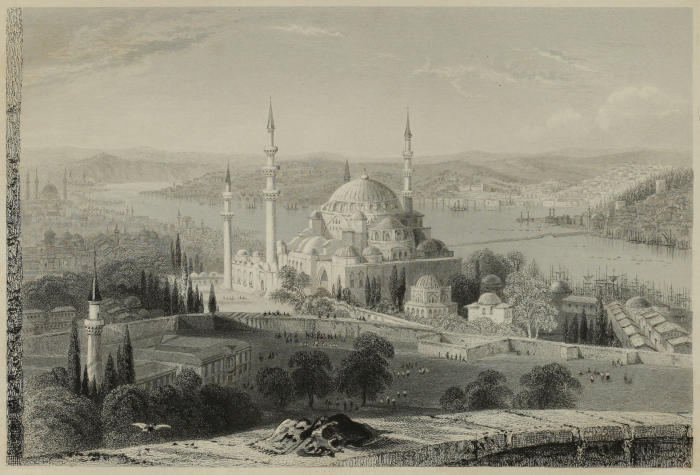
MOSQUE OF SULEIMANIÈ FROM THE SERASKIER’S TOWER.
MOSQUÉE DE SULEIMANIÈ VUE DE LA TOUR DU SÉRASKIER. DIE MOSCHEE VON SULEIMANIÈ, VOM SCHLOSS DES SERASKIERS GESEHN.
W. H. Bartlett. H. Adlard.
London. Published for the Proprietors, by Geo: Virtue, 26, Ivy Lane, 1839.
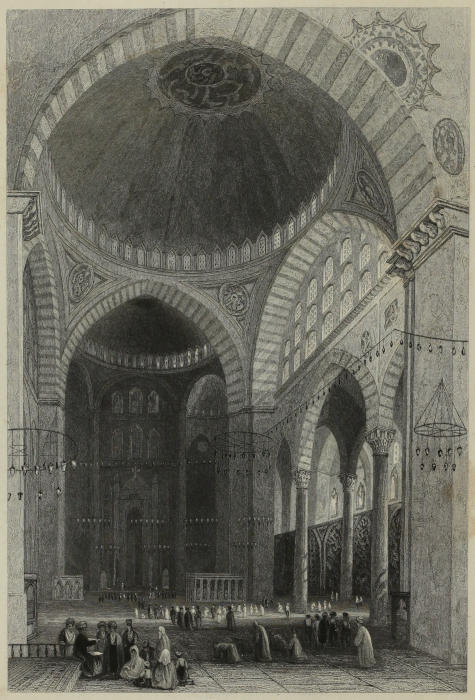
INTERIOR OF THE MOSQUE SULEIMANIÈ.
INTERIEUR DE LA MOSQUÉE DE SULEIMANIÈ. DAS INNERE DER MOSCHEE ZU SULEIMANIÈ.
W. H. Bartlett. W. Radclyffe.
London. Published for the Proprietors, by Geo: Virtue, 26, Ivy Lane, 1839.
The entire roof of the building is highly ornamented, and sentences from the Korān, beautifully written in the oriental character, are scattered over the walls. The mihrab, or niche at the eastern extremity of the edifice, occupying the position which, when the ground-plan of the Mahommedan temples was borrowed from St. Sophia, was filled by the Christian altar, is also inscribed with the names of the Deity and the Prophets. The immense wax candles that flank the mihrab are lighted every night during the reading of the Korān by the officiating Kiatib.[32] Those at the mosque of St. Sophia are eighteen inches in circumference, and last for twelve months; and the waxen giants of Suleimaniè, although considerably smaller, are still of enormous size; but as these are merely supposed to light the holy page of the priest, the body of the building is illuminated by thousands of small coloured lamps, suspended from the roof in various devices, by slight rods of iron, and producing to an European eye, a festal effect strangely incompatible with the sacred uses of the place.
But Suleimaniè possesses one peculiar feature, to which it is indebted for an interest beyond all the other mosques of Constantinople, and one of so high and honourable a character, that it is even more worthy of record than its pillars of porphyry, or its “cunning work” in glass and marble; and it is of so distinctive a nature that it must not be passed over in silence.
A richly-wrought gallery, extending along the whole northern face of the edifice, is heaped with chests of sundry sizes, and of all descriptions, from the rude trunk of cypress-wood, painted a dull green, and decorated with huge groups of flowers, tawdrily and clumsily executed—the treasure-hoard of the petty trader, or the roving tatar[33]—to the heavy iron-clamped strong box of the exiled noble, or the wandering merchant: these are piled one on the other to the very roof of the building, and each is carefully marked with some hieroglyphic known only to its absent owner, and to its temporary guardians. Each package, when received by the authorities at Suleimaniè, is described and registered with the most scrupulous exactness; and when once it has been deposited within the holy precincts of the mosque, it remains intact and inviolate, whatever time may elapse, or whatever changes may ensue ere it is reclaimed by its proper owner, either in the government, or the institutions of the Empire. The sacredness of the trust is felt, acknowledged, and respected; and men of every nation, and professors of every creed, are free to deposit their property within the walls of Suleimaniè, secure of its restoration whenever they may see fit to reclaim it.
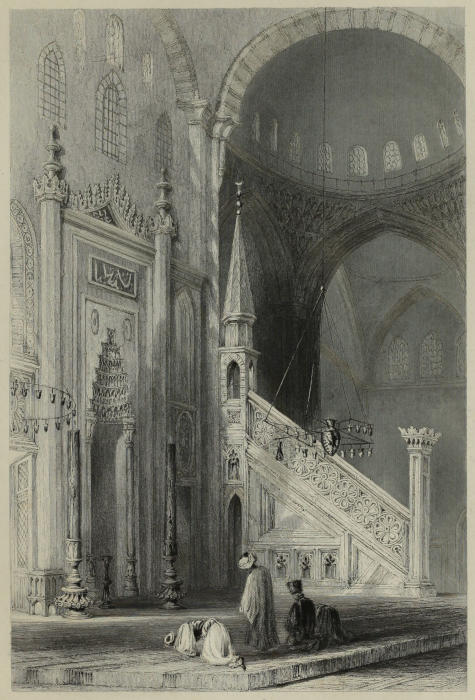
THE MIHRAB OF THE MOSQUE OF SULEIMANIÈ.
LE MIHRAB, VU NICHE, DANS LA MOSQUÉE DE SULEIMANIÈ. DER MIHRAB DER MOSCHEE SULEIMANIÈ.
W. H. Bartlett. J. H. Le Keux.
London. Published for the Proprietors, by Geo: Virtue, 26, Ivy Lane, 1839.
It is said that the amount of treasure in gold, silver, jewels, and rich stuffs, thus collected together, is immense; and that many of the chests have occupied their place in the gallery for a century. But this fact does not operate against their security—no seal is ever forced at Suleimaniè; and this great national bank, for such it truly is, remains untouched and sacred throughout every popular convulsion, and every intestine change. Here the Turkish government exercises no despotism, exacts no avaniah,[34] levies no tax; and amid all its reverses, and all its necessities, preserves an admirable integrity which is less generally known than it deserves to be.