FOUNTAIN OF THE ASIAN SWEET WATERS.
Reading edition
“A glowing scene of water, leaves, and light, And white-veil’d dames, and turban’d men are there; And all around the earth and sea are bright And beautiful in the sunshiny air; Soft ripples dance upon the channel’s breast, Light breezes sweep along the mountain’s crest, And woman’s voice, and childhood’s laugh of glee, Come blended on the ear harmoniously.” MS. Poem.
The Valley of Guiuk-Suy, charmingly situated about midway of the Bosphorus, and called by Europeans the Asian Sweet Waters, owes its charm and its popularity (like the glen of Kyat-Khana, already described,) to the circumstance of its being intersected by a pretty stream of fresh water, which, after flowing along under the shadows of tall and leafy trees, finally mingles its pigmy ripples with the swifter waves of the channel. The Anadoli Hissari, or Castle of Asia, stands upon its margin, and painfully recalls the mind to the darker and sterner realities of life; or the visitor to Guiuk-Suy might fancy himself in Arcadia, so lovely is the locality.
On Fridays, (the Mahommedan Sabbath,) the valley is thronged with holiday-keeping idlers; and here the Frank traveller may see more of the habits and morale of the Turkish women than he can hope to do elsewhere; for here, being on Asiatic ground, they appear to feel more at home, and less trammelled by the restrictions of their creed than in any other environ of the capital; their yashmacs are less scrupulously arranged, they are more accessible to strangers, and they do the honours of their lovely valley with a gentle courtesy extremely pleasing.
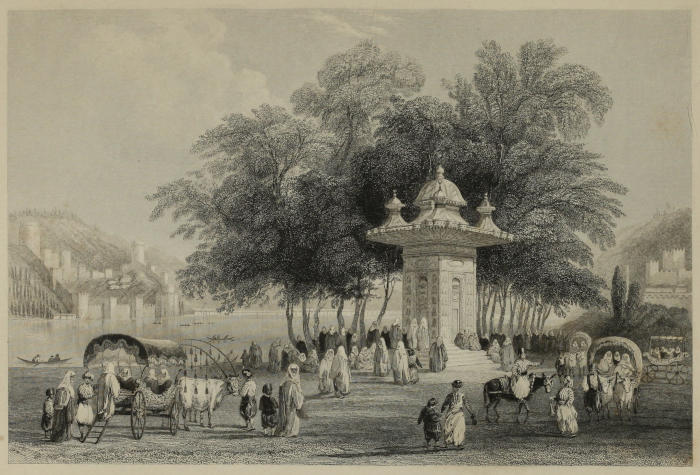
FOUNTAIN NEAR THE ASIAN VALLEY OF SWEET WATERS, ON THE BOSPHORUS.
W. H. Bartlett. H. Griffiths.
London. Published for the Proprietors, by Geo: Virtue, 26, Ivy Lane, 1839.
All ranks alike frequent this sweet and balmy spot. The Sultanas move along in quiet stateliness over the greensward in their gilded arabas, drawn by oxen glittering with foil, and covered with awnings of velvet, heavy with gold embroidery and fringes; the light carriages of the Pashas’ harems roll rapidly past, decorated with flashing draperies, the horses gaily caparisoned, and the young beauties within pillowed on satins and velvets, and frequently screened by shawls of immense value; while the wives of many of the Beys, the Effendis, and the Emirs, leave their arabas, and seated on Persian carpets under the leafy canopy of the superb maple-trees which abound in the valley, amuse themselves for hours, the elder ladies with their pipes, and the younger ones with their hand-mirrors; greetings innumerable take place on all sides; and the itinerant confectioners and water-venders reap a rich harvest.
The Fountain of Guiuk-Suy stands in the midst of a double avenue of trees, which fringe the border of the Bosphorus. It is built of delicate white marble, is extremely elegant in design, and elaborately ornamented with arabesques. The spot which it adorns is a point of reunion for the fair idlers of the valley, when the evening breeze upon the channel renders this portion of the glen more cool and delicious than that in which they pass the earlier hours of the day; and is only separated from it by the stream already named, which is traversed by a heavy wooden bridge.
The whole coup-d’œil is charming; slaves hurry hither and thither, carrying water from the fountain to their respective mistresses, in covered crystal goblets, or vases of wrought silver. Fruit-merchants pass and repass with amber-coloured grapes and golden melons; Sclavonian musicians collect a crowd about them, which disperses the next moment to throng round a gang of Bedouin tumblers; serudjhes gallop over the soft grass in pursuit of their employers; carriages come and go noiselessly along the turf at the beck of their fair occupants; a fleet of caïques dance upon the ripple, ready to convey a portion of the revellers to their homes on the European shore; and the beams of the bright sun fall full on the turretted towers of the Castle of Europe, on the opposite side of the channel, touching them with gold, and contrasting yet more powerfully their long and graceful shadows upon the water.