A BENDT IN THE FOREST OF BELGRADE.
Reading edition
“A lovely spot, half sunshine, and half shade, Where flickering boughs a shifting picture made; And tranquil waters, ’mid the general hush, Gazed on the sun until they stole his blush!”
The village of Belgrade, formerly called Beil-Gorod, (a word signifying, in the Sclavonian language, White Fortress,) is situated at the termination of the Great Bendt, or Reservoir, which forms the subject of the accompanying sketch. Nothing can exceed in beauty the situation of this mountain-hamlet, nestled in a green valley bright with turf and flowers, and traversed by a sparkling stream, which, after winding gracefully for two or three miles through the plain, finally empties itself into the Bendt.
The heights by which the valley is encompassed are a portion of the chain of the Lower Balcan, and are, in this immediate neighbourhood, richly clothed with stately forests of chestnut, maple, oak, and other noble timber; while the glen itself is studded with groups of beech-trees, whose soft and fantastic outlines cut gracefully against the sunny sky, and whose flexile and leafy branches throw their long and refreshing shadows across the grass, and the dancing ripple of the pigmy river.
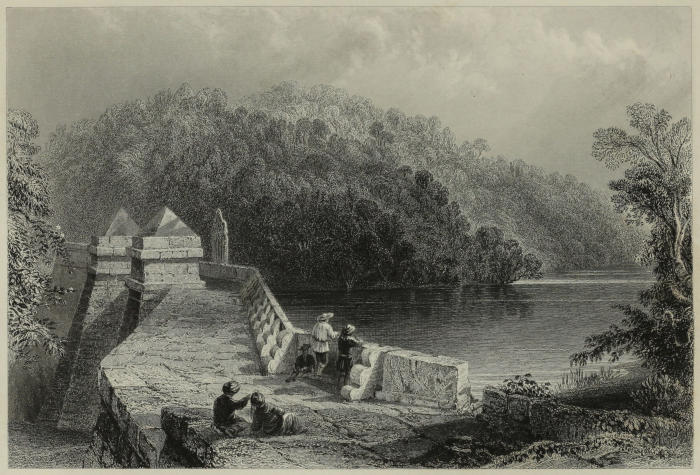
A BENDT, in the Forest above Belgrade.
UN BENDT, DANS LA FORÉT PRÈS DU BELGRADE. EINE BIEGUNG IM WALDE OBERHALB BELGRAD.
W. H. Bartlett. R. Wallis.
London. Published for the Proprietors, by Geo: Virtue, 26, Ivy Lane, 1839.
But Belgrade, beautiful as it undoubtedly is, is nevertheless much changed since the year 1717, when the talented Lady Mary Wortley Montagu, courting its shades in the sultry month of June, thus wrote to the immortal bard of Twickenham.
“The heats of Constantinople have driven me to this place, which perfectly answers the description of the Elysian fields. I am in the middle of a wood, consisting chiefly of fruit-trees, watered by a vast number of fountains famous for the excellency of their water, and divided into many shady walks, upon short grass, that seems to me artificial, but, I am assured, is the pure work of nature, and within view of the Black Sea, from whence we perpetually enjoy the refreshment of cool breezes, that make us insensible of the heat of the summer. The village is only inhabited by the richest amongst the Christians, who meet every night at a fountain, forty paces from my house, to sing and dance. The beauty and dress of the women exactly resemble the ideas of the ancient nymphs, as they are given us by the representations of the poets and painters.”[36]
When the fair and gifted Ambassadress sketched this beautiful picture of the spot, she must have been, as she herself expresses it, “in the middle of a wood;” for, until the summer of 1823, the Valley of Belgrade was rich in chestnut, beech, oak, walnut, lime-trees, plantains, and every description of forest timber; but, unfortunately for the lover of “the gay green wood,” the recesses of Belgrade became at that period the retreat of parties of the scattered Janissaries, who had escaped during the massacre; and who, carrying along with them all the surviving rabble of the city who had espoused their cause, and sided with them during the carnage, divided themselves between the forest of Belgrade and the heights of Moudania; the more active passing over into Asia Minor, and infesting the mountains as far as Broussa; and the less far-seeing, concealing themselves in the dense woods bordering the Black Sea. Here the wretched men subsisted for a time on fruits and herbs; but, despairing of brighter fortune, they soon became desperate, and sallying forth upon every chance traveller, in parties of eight or ten, as they had associated themselves, they constantly robbed, and occasionally murdered, until the roads were considered to be impassable. Various, and even strenuous efforts were made by the government to capture or disperse them, but as they amounted to some hundreds, they set at defiance both the soldiery and the police; and although an occasional straggler was captured by the troops, summarily strangled, and his body flung by the wayside for the purpose of terrifying his comrades into submission, no effect was produced; until the Sultan, irritated and wearied by their prolonged enormities, decided on setting fire to the forest, and thus destroying their stronghold. This expedient was accordingly adopted; the woods were ignited in several directions, and a military cordon established on the heights, with strict orders to fire upon every individual who attempted to escape. Could the mind have been freed from the consciousness that the fierce flames were serving as the ministers of a painful and relentless death, the scene would have been surpassingly magnificent!
The primeval forest which had stood tall and dark upon the earth in solemn grandeur for centuries, challenging the antiquity of the hoary heights beyond, and excluding from its mysterious depths the brightness of the stars; defying the glorious day-beam which failed to penetrate its wild recesses, and concealing amid its trackless wilderness a thousand things of life, became suddenly girdled with fire—the tall trees shivered, crackled, swayed, leant towards each other as the tongues of flame bound them in one apparently solid mass—stood out for an instant, charred and leafless against the sky, as the scared ocean-wind struggled for a brief interval with its rival element—and then fell with a crash that woke the caverned echoes of Asia, while the leaping waves that chafed against the bleak Symplegades, caught, the deep tint, and turned the sea to gold; and the majestic aqueduct of Baghtchè-Keuï, above the valley, lost for a time its snowy tint, and seemed to be formed of sculptured ore.
The ruin wrought bravely. Belgrade was girt with fire; the flames extended for several square miles, and ere many hours elapsed, all was desolation; while, (meet accompaniment for such a scene!) the constant report of musquetry was blent with the shrieks of human agony, and the deep groan of human suffering filled up the horrid diapason. Of all who had been sheltered by the forest of Belgrade, it was believed that not one escaped with life. Most of the fugitives fell beneath the bullets of the soldiery; while a few, strong and stern even in extremity, disdained to fly merely to exchange a death of suffering for a prompter end at the hands of their exulting victors; and thus they perished in their silent fortitude, with the forest-trees amid which they had been so long hidden.
The Bendts, or Tanks, are of classic origin, having been formed by the Greek Emperors when Byzantium became a second Rome, and the necessities of an increasing population rendered it imperative on their rulers to secure to the growing city a sure and sufficient supply of water. They were constructed with considerable ingenuity, extreme care, and great cost; and their preservation was anxiously insured by repeated edicts, several of which are still in the Imperial Library of the Eski-Seraï, insisting strongly upon their immense utility, regulating the planting of the trees by which they were to be surrounded, and prohibiting, under pain of the Imperial displeasure, and a heavy fine, the abstraction of water by any individual whomsoever; every such offender being compelled, upon detection, to pay a pound of gold for each ounce weight of water!
All the rills which trickle through the valley have been directed to one point, and now unite in a stream of considerable volume, which flows between two hills, and finally empties itself into the Great Bendt; while, in every instance where a similar arrangement is feasible in this region of springs and moisture, another of these mountain-reservoirs, smaller in size, but equally perfect in construction, will repay the search of the traveller.
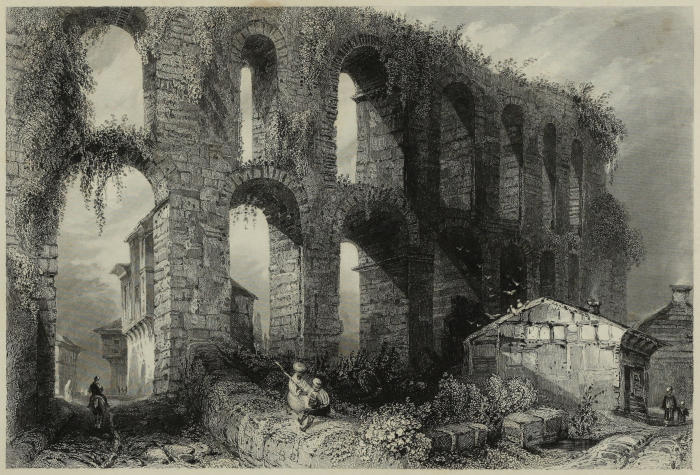
AQUEDUCT OF VALENS. (In the City.)
AQUEDUC DE VALENS. WASSERLEITUNG DES K. VALENS.
W. H. Bartlett. J. C. Bentley.
London. Published for the Proprietors, by Geo: Virtue, 26, Ivy Lane, 1839.
The Suy-Terrasi, by whose means the water is now conveyed on a summit level, were described earlier in the work; and their effect, scattered for miles over the face of the country, from the Black Sea to Pera, is extremely singular, setting all the conjectures of the uninitiated at defiance. These were invented at a later period by the Turks themselves, in order to avoid the enormous outlay necessary to the erection of Aqueducts; but they were not allowed, nevertheless, to supersede them altogether—a fact which must gratify every lover of the picturesque, as he gazes on the majestic Aqueduct of Validè, which is flung across the fair valley of Buyukdèrè, terminating the vista as seen from the Bosphorus, and linking the heights with a range of snowy arches.
Another, of more vast, but, perhaps, less graceful proportions, and certainly less happily situated, is that of Solyman, near Pyrgo, of which a sketch has been already given. It dominates a valley one thousand six hundred feet in width, is formed by a double range of fifty arches, and is of very imposing appearance, and constructed with great solidity.
The Aqueduct of Valens is one of the most striking objects that meets the eye of the stranger, as he gazes enraptured on the far-famed city of the Bosphorus. Dark, and hoar, and massy, it links two of the seven hills, and spans the peopled valley with a giant grasp; in strong contrast to the gaiety and glitter of the marble mosques, and party-coloured houses. Festoons of the graceful wild-vine, and the scented honeysuckle, drapery its mouldering masonry; masses of the caper-plant, with its beautiful blossoms, conceal the ravages of time; lichens trail among its arches; and a variety of stone plants, fed by the moisture which is continually oozing through the interstices of the building, flourish in picturesque luxuriance, and lend a glory to its decay. Historians allude to several other Aqueducts, which they assert to have had existence in Constantinople, but no trace now remains within the walls of the city of any, save this; and its origin is thus curiously accounted for by a modern traveller.
“The Emperor, incensed at the conduct of the people of Chalcedon, who had favoured the party of Procopius, ordered their walls to be pulled down. Among the stones was found one with an oracular inscription, implying that ‘the walls of Chalcedon would bring a great supply of water to the city;’ and, to complete the prophecy, Valens erected his Aqueduct with the materials.”[37]
It is impossible to calculate how often this venerable ruin must have overlooked a scene of flame and terror; in 1836, the streets by which it is surrounded were levelled by an extensive conflagration, that lit up the sky of midnight with a wild and lurid gleam, and turned the ripple of the channel into liquid metal. Every object within the harbour was as visible as at noonday, but wore a spectral brightness never to be forgotten by those who witnessed the grand and imposing spectacle; the dark hulls of the shipping seemed to float upon a sea of molten lead, while the delicate tracery of the cordage appeared to be hanging in links of gold from mast to mast. The dome of St. Sophia glowed like a huge carbuncle; and the slender minarets stood out like silver wands from an atmosphere of brass; while the rigid cypresses, whose dense foliage flung back the unnatural brightness as if in mockery, loomed darkly on the eye like the presiding forms of destroying demons overlooking their work of devastation.
Amid all this ruin, the Aqueduct of Valens remained unscathed. Some portions of its leafy coronal, parched by the intense heat, hung on the morrow, scorched and blighted; but the hoary remnant of by-gone centuries still soared proudly above the prostrate city at its feet, and received as incense the smoke of its destruction.
No single inscription can now be traced on any portion of the work; not a lettered stone has ever repaid the search of the curious, or rewarded the labour of the antiquary; and the tradition cited by Dr. Walsh is said to be the only record of its date, or of its founder. To the picturesque traveller, the Aqueduct of Valens will, however, require no historical interest to lend it value; as of all the antiquities of Constantinople, none form so prominent a feature in the landscape, or tend so greatly to contrast their classic and graceful shadowing with the broad lights and vivid colouring of the remainder of the picture.
Many others exist without the city, but all more or less in a state of decay; the Turks, by an unaccountable fatality, neglecting their aqueducts and cisterns, while they are rigorously strict on the subject of the Bendts; planting the embankments; and condemning to severe penalties, not only the “drawers of water,” but also the “hewers of wood,” who may be rash enough to exercise their vocation within the guarded precincts.
The cisterns of the city are, in many instances, merely immense tanks, or wells, excavated beneath the houses, and intended to act as reservoirs for rainwater; but these are far from being the most important; four vast subterraneans being yet in existence, which were the work of the Greek Emperors, and which were formerly supplied by aqueducts from the waters of the Bendts. One of them, called by the Turks Ben-Veber-Direg, is supported by three hundred and thirty-six pillars of rough marble; and is known as the “Thousand and One,” because the separate blocks employed in forming the columns are said to amount to that mystic number; but in the time of the Romans this cistern enjoyed the appellation of the “Stranger’s Friend,” being a public reservoir, of which every comer might claim his share. The tank was computed to contain one million two hundred and thirty-seven thousand, nine hundred and thirty-nine cubic feet of water, and to suffice for the consumption of the whole city more than fifty days. It is now, however, perfectly dry, and filled with earth to one-third the height of the columns; and is the damp and unwholesome resort of a score or two of silk-twisters, who ply their rapid wheels beneath its hoary and time-tinted arches. Tradition says that the water-courses were diverted from this reservoir by order of the Emperor, who, when digging the foundations of Saint Sophia, caused all the soil to be flung into the cistern, rather than submit to the delay necessary to its transport beyond the walls of the city. The channel worn in the stone by the water that once flowed into it, is distinguishable on three different sides of the reservoir, which is lighted by narrow grated windows, level with the street; and the loud clamours of the silk-twisters, as they besiege the visitor for backschish, (Anglicè money,) prolonged by the dull and distant echoes of the vaulted recesses, die away with a sound so hollow and supernatural as to induce a momentary belief that no human being could have given them utterance.
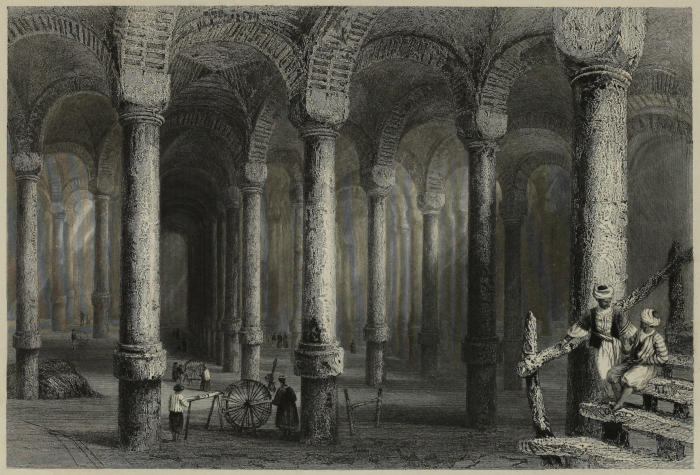
CISTERN OF BIN-VEBER-DIREG. (Or the Thousand and One.)
CITERNE DE BIN-VEBER-DIREG, OU LES MILLE ET UNE. DIE CISTERNE BIN-VEBER-DIREG, ODER DIE TAUSENDSTE UND EINE.
W. H. Bartlett. J. Carter.
London. Published for the Proprietors, by Geo: Virtue, 26, Ivy Lane, 1839.
A second and smaller tank, known only as the Boudroum, or Subterranean, is situated in the same quarter of the city, not ten minutes’ walk from Bin-Veber-Direg; and, although of lesser dimensions, is infinitely handsomer; the columns being at least three times the circumference of those in the other cisterns, uncovered to their base, and composed of a single block. Two only of the pillars are imperfect, and the coup-d’œil from midway of the stone stair which leads into the vault is most imposing. Here, not a sound breaks the deep and dreary silence; for, although this reservoir is tenanted during the day like the other, the squalid and miserable objects who frequent it, and who earn a scanty and painful subsistence by spinning cotton, are too much enervated by the clammy and unwholesome atmosphere of the place to have any strength to lavish upon supplication; nor, indeed, to the humane traveller who may chance to visit their gloomy work-room would supplication be necessary, for one glance at their pallid and livid faces, and their bent and attenuated bodies, must be more effective than any words, whatever were the tale of wretchedness those words might tell.
But there yet remains one subterranean beneath the city streets which has not been entirely diverted from its original purpose; the most vast and impressive, the most dim and mysterious of all; and one which has defied alike the power of time, and the curiosity of a newer and less glorious generation—the far-spreading and extraordinary Hall of Waters, known by the Turks as the Yèrè-Batan-Seraï, or Swallowed-up Palace. The roof of this immense cistern is supported, like that of Bin-Veber-Direg, by marble columns, distant about ten feet from each other, each formed from a single block, with elaborately wrought capitals, and, in some instances, entirely covered throughout the whole length of the shaft with sculptured ornaments in high relief to the level of the water, which varies in depth according to the season, from five to fifteen feet.
The spot whence the traveller looks through the gloomy arches of the Yèrè-Batan-Seraï, is not a regularly constructed entrance to the vault, (nor is it known if such an one really exists,) but an opening, formed by the failure of several of the pillars, which, yielding to the superincumbent weight, have caused the roof to fall in, and thus revealed the watery waste beneath. Nor does any boat now offer the means of penetrating the wilderness of columns: so many accidents having occurred through the rashness of strangers who could not be prevailed upon to forego the gratification of their perilous curiosity, and their desire of ascertaining the size of the subterranean—a fact hitherto undetermined—that the little bark was removed; and the traveller is, consequently, fain to rest satisfied with the view of this extraordinary structure which he commands from the ruined aperture.
The artist has embodied in his drawing a melancholy incident, which took place only a few years back, in this singular spot. He has shadowed forth the adventure of a young, spirited, high-hearted Englishman, who, on his visit to the vault, was so excited by the wild mystery of the place—its undefined limits, its deep silence, its dim majesty, and the desire of being the first to discover its extent, that he resolved to put forth alone in a small boat, which at that period was moored beside one of the columns.
Vain were all the expostulations of the worthy old Effendi, in the garden of whose house the accidental revelation of the Yèrè-Batan-Seraï had taken place; vain were the examples of previous failure repeated to the reckless adventurer by his anxious dragoman;[38] equally vain the threats of foul air, imaginary Afrits, and visionary dangers, marshalled in long array before him;—when did an Englishman ever yield to such arguments? He laughed at the terrors of his companions, and declared his determination to explore the subterranean. What was it but a cistern—the work of men’s hands? and would they weakly endeavour to persuade him that he could not achieve his purpose? Opposition did but render him the more resolved; and such was the power of his excited eloquence, that he almost persuaded his hearers of the certainty of his success; he did all, indeed, save engage them to become his partners in the attempt: and when they had furnished him with the torches of bitumen which were to light him on his way, and that he had gaily pushed off his little bark, laughing at the pusillanimity of those who stood to witness his departure, until the echoes of his reckless mirth rang through the dim arches, and died away in hollow mutterings deep in the distance; they flung themselves down upon the earth on their soft mats, and prepared their chibouques, with a strong faith in the success of his hardy adventure.
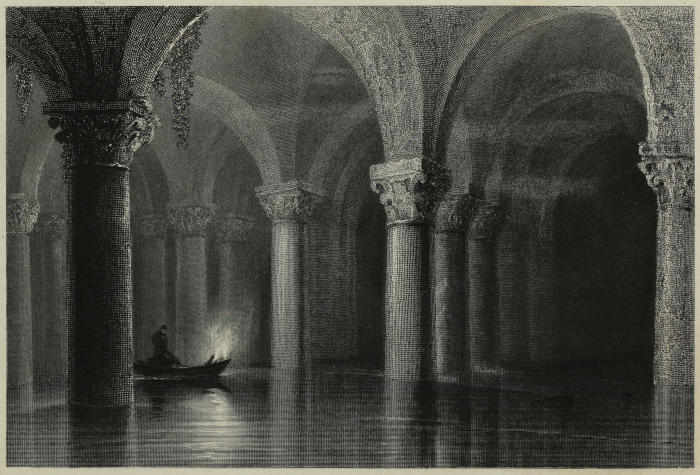
YÈRÈ BATAN SERAÏ.
W. H. Bartlett. J. T. Willmore.
London. Published for the Proprietors, by Geo: Virtue, 26, Ivy Lane, 1839.
Gradually a crowd, to whom the bold attempt of the young Frank had been whispered, stole one by one into the garden of the Effendi, and clustered about the cistern. At times they fancied that they distinguished strange sounds sweeping through the subterranean, and mingling with the fall of the large drops which gathered on the vaulted roofs, grew into size and weight, and then plashed heavily on the broad sheet of water beneath; at others, some one among them, deceived by a sun-glint shimmering through the leaves of the noble trees of the garden, and reflected in the still basin, proclaimed the return of the boat, and the flashing of the torch; but the boat came not. Hours passed away, and the watchers wearied at their post; expectation became weakened; hope waxed fainter and fainter; the brief twilight softened for a short interval the face of nature; and then down fell the darkness, glooming athwart the net-work of the silvery stars that were woven over the deep blue of the tranquil heavens.
A low whisper grew audible among the awe-struck group: their watch had endured long; it was now almost unavailing—the reckless Infidel had met his fate! Each went to his home, and told the tale in his harem; and many a fair cheek paled, and many a bright eye grew dim with tears that night, in the city of the Moslem.
Morning came—bright, rosy, laughing morning—and all was fair, and gay, and sunny, in that happy clime; and as the watchers resumed their station upon the brink of the subterranean, each turned a long searching gaze into its depths: but they looked in vain—the boat and its doomed freight never appeared again!
The brain grows dizzy as it attempts to follow in idea the mysterious progress of the fated wanderer over those mysterious waters! Rapid was the splash of his oar as the little bark bounded away; the torch-light flashed broadly upon the gleaming columns of the vault, and were cast back from the marble far over the rippleless sheet beneath; his reckless laughter made wild music until it was lost in the distance, and that he could no longer distinguish the anxious group whom he had left behind; and then—then—all was still, and dark, and solitary about him! Above, dome succeeded dome; around, column rose beside column; beneath, far as the eye could penetrate the gloom, the still, waveless water spread itself out, to the right and to the left, before and behind—the same wild, stern, chilling monotony reigned throughout the subterranean!
For a time, perchance, he rowed on in a straight line—his watery path could thus be easily retraced—and still the vista lengthened as he went. Hours crept slowly by, and his vigorous arm relaxed somewhat of its strength; and the atmosphere grew dense, and engendered strange vapours, which pressed upon his brain, and induced a languor that caused him to draw in his oars, and ruminate for a while upon the scene around him. The torch had grown more feeble in its effects, and the shadowy darkness of the vaulted aisles by which he was encompassed on all sides pressed more closely upon him, and he strained his eye-balls to look deeper into their black depths! His breathing, too, became impeded; and the hand was less firm than its wont, which loosened the kerchief about his neck: while in the act of doing so, he suffered the little boat to swing round, and at once became conscious that he no longer recognised the avenue by which he had entered the vault.
As the frightful truth flashed upon him, he again seized the oars with the impulse of despair, and laboured until big drops of moisture rolled down his clammy brow, and every nerve quivered; but what availed his toil? He knew not in what direction he was advancing—whether he were indeed returning to his friends, and to that world which he had so rashly abandoned; or only plunging further into the mysterious subterranean.
Meanwhile, who can doubt that the fœtid and unwholesome atmosphere was slowly and surely doing its work, and that the high heart sank gradually, sickening beneath the horrors of this living death—the victim sitting motionless for a time to ascertain whether the slightest under-current from some hidden spring might not give a faint impetus to the boat, and thus afford a hope of escape; and learning, as the still caïque lay like a log upon the water, that there was no hope! And then the doomed one laughed—laughed long and loudly, until the echoes of that unnatural mirth were cast back in mockery upon the idiot who had given it voice; and ten thousand gibbering fiends seemed to be coining it into foul and bitter words, and bandying them to and fro with fierce and wanton industry! Then came clouds of dusky and unnatural forms, woven out of the darkness, pressing upon each other to board the little boat, and to overset it—and then he shrieked as the icy waters rose to his chin, and he gasped for breath—when suddenly he was saved, he knew not how; and he lay on the fresh greensward of a sweet meadow near his old ancestral home, with his head on his mother’s lap, and a fair girl bending over him, and singing in a low soft voice, to which his ear had been long familiar, a simple ballad, which he had loved from his boyhood; and he listened long, until at length he dropped asleep to that fond familiar music.
He awoke once more—awoke to madness and despair! He remembered all—all! and his brain failed beneath the horrors of the retrospect! He was again a maniac; and in his first fierce paroxysm, he dashed the still burning torch into the hissing waters, and the darkness fell upon him—crushed him—pressed upon his heart, and upon his throat—and who shall say how that wild tragedy was terminated?
Other, but more prudent attempts have since been made, but, as yet, no determined limits have been assigned to the Yèrè-Batan-Seraï; in three other directions the roof has failed, but these have occurred in such distant quarters of the city, that far from resolving to the curious the question of its extent, they have only been enabled to arrive at the fact, that it stretches under a great portion of Constantinople, and even beyond its walls; and that the same apparently endless avenues of arches, multiplied, ad infinitum, on the right and left, stretch in dim, mysterious, monotonous, and chilling silence beneath the crowded streets of a busy capital—canopied by darkness, while all is light above—and yawning like a vast sepulchre to receive the load of human life and human treasure, which time must ultimately hurl in one huge ruin into its greedy depths!
The Yèrè-Batan-Seraï is, without any exception, the noblest remain of Roman intellect and industry in Constantinople.