BEGLIER-BEY.
Reading edition
——“The coast Lay at this period quiet as the sky, The sands untumbled, the blue waves untoss’d, And all was stillness, save the sea-bird’s cry, And dolphin’s leap, and little billow cross’d By some low rock or shelve that made it fret, Against the boundary it scarcely wet.” ... “Mother-of-pearl, and porphyry, and marble, Vied with each other on this costly spot; And singing birds without were heard to warble; And the stain’d glass which lighted this fair grot Varied each ray.” Byron.
The Sultan’s summer-palace of Beglier-Bey, on the Asiatic shore, is the most elegant object on the Bosphorus. It is an irregularly fronted and extensive edifice, stretching along the lip of the channel, whose waves wash its long and stately terraces of glittering marble, and sometimes penetrate into their latticed and mysterious recesses. The building is of wood; and the harem presents a line of gables perforated with long ranges of windows secured by most minute screens of gilded wood: the Salemliek, containing the State apartments, the private saloons of the Sultan, and the rooms occupied by the Imperial household, is an octagonal pile, of which the pointed roof is surmounted by a crescent supporting a star, whose richly gilded points flash in the sunshine like lambent fire. The entire building is painted in white and pale gold; and it has rather the appearance of a fairy-palace, called into existence by enchantment, than the mere every-day work of human hands.
A marble gate, terminating the terrace in the direction of the city, admits the visitor into a garden bright with flowers, and redolent of perfume; where fountains for ever fling their delicate jets of water against the sky, with a soft and soothing music well suited to the spot; and where birds of gorgeous plumage wander at will, as rainbow-tinted as the blossoms amid which they sport. A line of gilt lattices veils the seaward boundary of this delicious retreat; and, passing beside these, an inlaid door of stately proportions gives admittance to the Hall of Entrance.
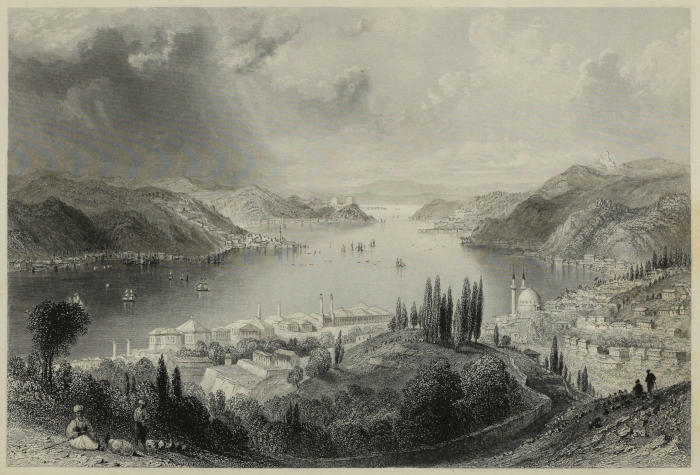
THE SUMMER PALACE AT BEGLIER-BEY.
W. H. Bartlett. J. Cousen.
London. Published for the Proprietors, by Geo: Virtue, 26, Ivy Lane, 1838.
“The first glance of the interior is not imposing. The double staircase, sweeping crescent-wise through the centre of the entrance, contracts its extent so much as to give it the appearance of being insignificant in its proportions; an effect which is, moreover, considerably heightened by the elaborated ornaments of the carved and gilded balustrades and pillars. But such is far from being the case in reality; as, from this outer apartment, with its flooring of curious woods, arabesqued ceiling, and numerous casements, open no less than eight spacious saloons, appropriated to the Imperial household.
“Above this suite are situated the State Apartments, which are gorgeous with gilding, and richly furnished with every luxury peculiar alike to the East and to the West. The Turkish divans of brocade and embroidered velvet are relieved by sofas and lounges of European fashion—bijouterie from Geneva—porcelain from Sèvres—marbles from Italy—gems from Pompeii—Persian carpets—English hangings; and, in the principal saloons, six of the most magnificent, if not actually the six most magnificent pier-glasses in the world: a present to the Sultan from the Emperor of Russia, after the Treaty of Unkiar Skelessi. Enclosed within a deep frame of silver gilt, bearing the united arms of the two Empires, these costly glasses reflect in every direction the ornaments of the apartment, and produce an effect almost magical; while the highly-ornamented ceiling, richly wrought with delicate wreaths of flowers, and the bright-coloured carpets covering the floor, combine to fling over the saloon an atmosphere of light and gladness, which is increased by the dazzling glories of the parterre spread out beneath the windows, with its flashing fountains, golden orangery, and long line of gleaming lattices.
“The Reception-room is small, and remarkable only for the comfortably-cushioned divan on which the Sultan receives his visitors; and the noble view that it commands of the channel, from the Seraglio point to the Castle of Mahomet.
“The Banquetting Hall is entirely lined with inlaid woods of rare and beautiful kinds, finely mosaiced; the ceiling and the floor being alike enriched with a deep garland of grapes and vine leaves, flung over groups of pine-apples of exquisite workmanship.
“Hence, a long gallery conducts to the private apartments of the Sultan; and on every side are graceful fountains of white marble, whose flashing waters fall with a musical monotony into their sculptured basins. In one, the stream trickles from a plume of feathers, so delicately worked in alabaster that they almost appear to bend beneath the weight of the sparkling drops that gem them: in another, the water gushes forth, overflowing a lotus-flower, upon whose lip sports a group of Cupids. The private apartments, which separate the harem from the state wing of the palace, are the very embodiment of comfort: two of them are lined with wicker-work, painted cream-colour—the prettiest possible idea, executed in the best possible style.
“The harem is, of course, a sealed book; for, as the ladies of the Sultan’s household have never been allowed to indulge their curiosity by a survey of that portion of the palace appropriated to Mahmoud himself, it can scarcely be expected that any intruder should be admitted beyond the jealously-barred door forming their own boundary.”[25]
The Bath of this imperial residence has already been described in an earlier portion of our work; and we have now only to notice the extensive and princely gardens, which rise, terrace above terrace, to the very summit of the mountain which overhangs the palace. Each terrace is under the charge of a foreign gardener, and arranged according to the fashion of his own land; but the finest portion of the grounds contains a noble sheet of water, called the Lake of the Swans, whose entire surface is frequently thickly covered with these graceful birds, of which the Sultan is so fond, that he sometimes passes hours in contemplating them as they glide over the Stillwater; and, in the words of Wordsworth,
“Swim double—swan and shadow.”
Boats, gaily gilded and painted, are moored under the shadows of the magnolias, willows, and other beautiful trees which form the frame-work of the lake; and about fifty yards from the bank stands a pretty, fanciful edifice, called the Air Bath,—an elegant retreat from the oppressive heats of summer; whose roof, and walls, and floor, are alike formed of marble, wrought in marine devices; and whose fountains, trickling down the walls, pour their waters over a succession of ocean-shells, marine divinities, sea-weeds, and coral reefs; and keep up a constant current of cool air, and murmur of sweet sound, perfectly charming. Inferior apartments branch off on either side from this beautiful saloon, and altogether it is as pretty a toy as ever exhausted fancy in its invention.
A gilded kiosque glitters amid the group of cypresses and plane-trees by which the last height is crowned; and the artist has ably portrayed the magic beauty of the scene which is mapped out beneath him as he stands beside the boundary-wall of the palace garden. The undulating shores, belted with houses, and sheltered by richly-wooded hills,—the castle-crowned rocks,—the gleaming sails of the passing vessels upon the channel,—and, far away, the “storm-tossed Euxine,” lashing its billows as if in scorn against the fortress-barriers that bristle its shores—all combine to form a picture well calculated to arrest the eye of the painter and the admiration of the tourist.