THE MOSQUE OF CHAZADE.
Reading edition
“And as the smoke condensed itself into a vapoury outline, and I saw a giant form rise into the air, I found words, and spoke. ‘In the name of the Prophet,’ I faultered out, ‘what art thou?’ And the shape answered in a shrill whistle, like the east wind through the storm-stripped branches of the forest, and said, ‘Pass on thy way, and impede me not: I guard the graves of the mighty.’ And I looked, and lo! the vapour rested on the tombs of two of earth’s proudest; so I veiled my eyes, and departed thence in trembling.”—The Gnome King.
The Mosque of Chazade (or Choabbas) is beautifully situated near the Aqueduct of Valens, which spans the valley upon whose edge it stands. Like all the other religious edifices of Constantinople, it is built in the form of a Greek cross, and is ornamented throughout its interior with arabesques, and sculptured marble. The trees which surround its court are ancient, and of majestic growth; but its principal beauty exists in the very elegant fountain, and the noble tombs which are attached to it. These buildings fringe the street in which it stands, and form an architectural group unequalled for its perfect orientalism throughout the city. The gilded lattices of the fountain, its domed and graceful roof, and the shifting crowd ever collected about its marble steps, contrast finely with the silent stateliness of the mosque itself, upon whose white and glittering surface no trace of mere perishable ornament can be detected. A cluster of domes, rising from amid a mass of foliage, where the broad-leafed and far-stretching maple mingles its fresh bright greenness with the dark, rigid, and eternal gloom of the cypress, marks the site of the mosque, and of the four tombs by whose vicinage it is distinguished; the larger and taller cupola being that of the temple, which, however, does not so greatly dominate the others as to injure the harmony of their effect.
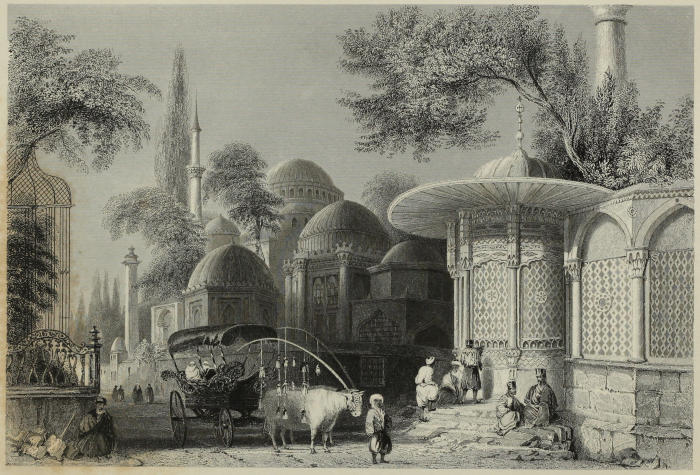
FOUNTAIN MOSQUE OF CHAZADE.
FONTAINE ET MOSQUÉE DE CHAZADE. DIE FONTAINE UND MOSCHEE.
W. H. Bartlett. R. Sands.
London. Published for the Proprietors, by Geo: Virtue, 26, Ivy Lane, 1839.
The most richly ornamented Mausoleum is that of the Sultana Chazade—which name is supposed to be a corruption of Sheherazade, an appellation bringing at once to memory the fair and wily Princess of tale-telling notoriety, so dear to our youth; and admitting the possibility that the Imperial founder of the mosque, and occupant of the mausoleum, were indeed the namesake of the indefatigable bride of the fable-loving Sultan, the eye which rests upon her tomb does not disturb the illusion which old associations have woven about the fancy; for even had its tenant been the renowned daughter of the Vèzir herself, she could not have found a fitter resting-place. The elegant tomb-house is hexagonal, and the fluted dome is supported on eight light and graceful columns, whose Saracenic capitals form a portion of the sculptured cornice which surrounds the base of the cupola. The windows are of richly stained glass; and the sarcophagus rests on a low platform in the centre of the marble floor, in solitary state.
The other three tombs attached to the Mosque of Chazade, are those of three Vèzirs; and, in two instances, their wives and sons lie beside them. A few scattered graves, almost overgrown with the dense vegetation common to the country, have been niched here and there in the recesses formed by the angles of the buildings; and clouds of blue doves inhabit the eaves of the temple, and fill the air with their low monotonous note, giving a solemnity to the spot congenial to its use. They call to each other from the roofs of the tombs sadly and soothingly, like sentinels passing the watchword of peace over the ashes of the dead, and seem, in their earnest melancholy, to echo the answer of the Gnome King to the pilgrim Hamet—“Pass on thy way, and impede me not: I guard the graves of the mighty.”