SAINT SOPHIA.
Reading edition
“Sophia’s cupola, with golden gleam.” Byron.
The great object of every lion-hunting traveller in Turkey is to obtain ingress to the mosques; and as this privilege is only accorded to great personages, and to each European Ambassador once during his residence in Constantinople, many are necessarily fated to disappointment. No golden key will unlock the mysterious gates, nor lift aside the veil of the temple; and it is with a disgust and a reluctance which they scarcely care to conceal, that the officiating priests condescend to do the honours of the shrine, even when the Imperial firman leaves them no alternative.
The court of St. Sophia, like that of every other mosque in the city, is paved with marble, and shaded by magnificent plane-trees, whose far-spreading branches and luxuriant foliage chequer the vast space with alternate patches of light and shadow, which produce a fine effect; and collect in the vicinity of the holy edifice groups of quiet-looking Moslems, who spread their carpets, and seat themselves to smoke their chibouques, and watch the pious who pass into the temple from sunrise to sunset.
An elegant fountain, with a projecting octagonal roof, whose marble basin is screened by a covering of iron net-work from the pollution of the birds which swarm upon the roof and amid the intricacies of the building, affords to the Faithful the necessary opportunity of performing their preliminary ablutions ere they enter the mosque; while in its immediate vicinity, amulet and scent merchants, generally hadjis or pilgrims, with their green turbans and flowing beards, spread their mats, and expose for sale all descriptions of chaplets, perfumes, relics from Mecca, charms against the Evil Eye, amber and ivory mouth-pieces for the chibouque, and dyes and toys for the harem.
As these pilgrim-merchants are generally gifted with a quiet facetiousness of manner which never fails to amuse a Turk, they collect about them numbers of idlers, whose picturesque costume and graceful attitudes form at every moment studies for the painter: the tall Effendi, with his turban of cachemire and his furred pelisse, stands beside the red-capped and blue-coated soldier; while, squatted at their feet, pipe in hand, and passing the beads of his tusbee[26] listlessly through his fingers as he intently follows the discourse which is going on around him, may be seen the Emir in his green robe, proud of his descent from the Prophet; and near him the Dervish, with his conical hat of grey felt; the Santon, or saint, all filth and holiness; and occasionally a closely-muffled female, her dark eyes flashing out between the folds of her snowy veil, her feet covered with boots and slippers of yellow morocco, and her form shrouded in a heavy cloak of dark-coloured cloth.
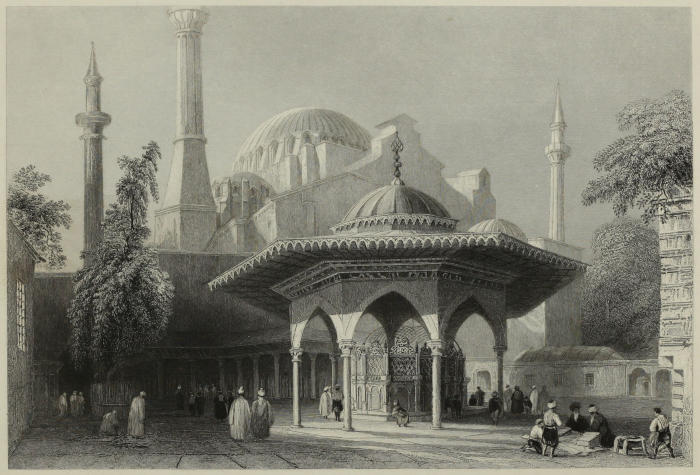
COURT AND FOUNTAIN OF ST. SOPHIA.
COUR ET FONTAINE DE STE SOPHIE. DER HOF UND DIE FONTAINE ZU ST. SOPHIE.
W. H. Bartlett. J. Redaway.
London. Published for the Proprietors, by Geo: Virtue, 26, Ivy Lane, 1839.
If a stranger approach to examine the wares of the hadji, it is curious to witness the interest which every individual takes in the success of his trade. The lookers-on will seize a chaplet of Arabian wood, rub it rapidly in their hands, and hold it towards him, that he may inhale its perfume, expatiating all the time on its extreme sweetness; while exclamations of “Guzel! peh guzel!—good! very good!” form a perfect chorus: or they will smear their beards with dye to convince him of its efficacy, if by these means they can induce the sale of any of the scattered articles about them. Nor are they fastidious in their commercial notions, for they stand quietly and encouragingly by, while the wily hadji cheats the unclean giaour, without evincing any inclination to rescue the victim; and as he bears away some treasure, for which he has probably paid about five times its value, the worthy Moslems see him depart with an ejaculation of “Allah buyûk der—God is great!” and then calmly resume the chibouque and the narration where each had been interrupted.
From the court, a stately covered peristyle, similar to that of St. Peter’s at Rome, whose ponderous granite columns are imbedded in the walls, conducts to the body of the mosque; and here the visitor casts off his shoes, and puts on the slippers of yellow morocco, which are alone permitted to press the floor of the temple. This done, the great gates (which close upon a block of porphyry) are thrown back, the curtain of tapestry is drawn aside, and in a moment the eye is bewildered amid the space which is suddenly spread out before it.
The richly mosaiced floor of jasper, porphyry, verd-antique, and marble, is covered with bright-coloured carpets; thousands of stained glass lamps are suspended in complicated designs from transverse rods of iron which traverse the body of the building in every direction; the Imperial closet, facing the pulpit, is of finely and intricately-wrought marble, with a cornice that looks like petrified point-lace; but it is the vastness of St. Sophia which for a time fills the imagination and satisfies the fancy of the traveller; and it requires time to divest him of the feeling of involuntary awe by which he is at first overwhelmed, ere he can compel himself to any analysis of the detail around him. Gigantic pillars encircle the dome, which is of a magnitude strikingly majestic; and a host of antique treasures are collected together, each a gem in itself; but they are forced into most incongruous contact. Columns of various proportions and architectural orders,—some of Egyptian granite, others of porphyry, or scagliola, or precious and rare marbles,—are to be seen on all sides; but the mind is confused by their extraordinary juxta-position; and they lose half their beauty from their want of arrangement. Eight majestic porphyry pillars from the Temple of Heliopolis are contrasted with columns of verd-antique from that of Ephesus; the walls are incrusted with marble, jasper, porphyry, and verd-antique, to about mid-height, where a gallery, entirely surrounding the mosque, supported by plain pillars, and floored with marble, affords accommodation for several hundred persons; but the dome, which was formerly adorned with minute mosaics, was whitewashed when the conquering Mahommedans converted the Christian church of St. Sophia into a temple of Islamism; and the original richness of the design is now only to be distinguished in spots where the plaister has fallen away; while, as if to render the ruin more complete, the inferior Imaums attached to the mosque make a trade of the fragments of mosaic, which they tear away and dispose of to travellers, who thus thoughtlessly contribute towards the destruction of a noble work of industry and art.
St. Sophia also boasts of two miraculous objects, which must not be passed over in silence—the “Sweating Stone,” and the “Bishop’s Door.” The first is a column, partially cased with iron, and having a deep cavity worn away beneath the metal in one particular spot, where the visitor is directed to insert his finger, and to test the humidity of the marble, which is said thus to have resisted the contact of any merely human touch since the hand of the Prophet rested upon it. It is, however, certain that the miracle sometimes fails.
The “Bishop’s Door” is situated on the northern side of the gallery, and is veiled by a mass of masonry, on which are many traces of violence, the cement being of so powerful a nature as to have resisted all attempts at its destruction. The door-frame is of fine white marble, and quite perfect; and the legend runs, that the united efforts of all the masons in Stamboul, are insufficient to force a passage to the apartment, in which, protected by a powerful talisman, a Greek Bishop, who was officiating at the altar when the Turks poured into the city after the defeat of Constantine, sits in his full canonicals, perusing an open volume of so holy a nature that Moslem eye must never look upon it; and this same Bishop will, as both the Turks and Greeks firmly believe, on the day when St. Sophia becomes again a Christian shrine, walk forth from his walled-up chamber, and chaunt a solemn high mass at the great altar!
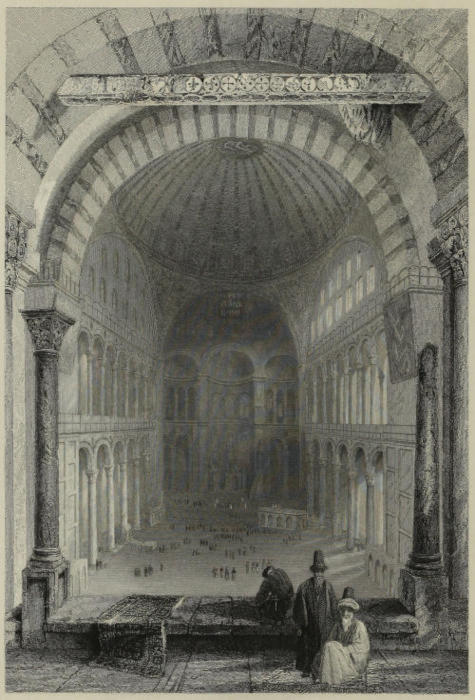
INTERIOR OF ST. SOPHIA’S.
W. H. Bartlett. J. Carter.
London. Published for the Proprietors, by Geo: Virtue, 26, Ivy Lane, 1839.
From this gallery the best view of the whole interior of the edifice is obtained; as that which encircles the dome is at such an immense height from the ground, that it reduces the dimensions of the building almost to insignificance, while the eye takes in the vast proportions of the dome itself, and the mind is absorbed by that single contemplation.[27] Clouds of blue doves occasionally wing their way across the body of the mosque; and it is a singular and beautiful fact, that they are the unmolested descendants of the birds which were found there by the Turks when they first became the masters of St. Sophia; and so holy are they in their eyes, that the destruction of one of them would be attended with great danger to the aggressor.
From the lower gallery the whole extent of the mosque may be contemplated in its silent and solemn grandeur. In the centre of the wide and uncumbered space, the mighty dome rests on the capitals of a circle of gigantic and rudely-fashioned columns; immediately beneath you are the pillars that support the far-stretching gallery in which you stand; on one hand rises the marble pulpit, with its noble flight of steps shut in by an elaborately sculptured door; and on the other, the Imperial closet, with its delicate tracery and gilded lattices. Two huge wax candles flank the mihrab, or arched recess at the eastern end of the building, which are lighted every night, and last exactly twelve months; they are about eighteen inches in circumference, and throw their light over the Korān of the Chèïk-Islam, or High Priest, who occupies the mihrab during the hours of worship. No private shrines, as in the Catholic churches—no stalls or pews, as in our own places of worship—contract and cumber the body of the building; and the effect of its extent is, consequently, much heightened. Altogether, St. Sophia, despite all its incongruities, is decidedly an architectural wonder, and well worthy of the admiration which has been lavished upon it for centuries.