TURKISH BATHS.
Reading edition
Here Beauty on her ’broidered cushion lies With languid brow, and dreaming downcast eyes— A rose o’ercharg’d with rain: beside the fair A kneeling slave binds up the glossy hair; Pours perfumed water o’er the drooping face, And lends to loveliness another grace. MS. Poem.
There is, perhaps, no luxury throughout the luxurious East more perfect, or more complete, than the Baths. Those of the great and the wealthy in Constantinople embody the idea of a scene in the “Thousand and One Nights”—they are so bright and fairy-like in their magnificence—so light and gay with painted glass, white marble, brocade, and embroidery.
Every bath, however small may be its dimensions, consists of three apartments; the outer hall, in which the bathing-dress is arranged; the cooling-room, a well-cushioned and comfortable space, moderately heated, and intended for the temporary reception of the bathers before they venture to encounter the pure free air of the exterior apartment; and the bath itself, where the atmosphere is so laden with sulphuric vapour, that, for some seconds, the breath is impeded, and the suffocating sensation which ensues is positively painful.
The Imperial Bath at the summer-palace of Beglier-Bey, is one of the most elegant and costly in the city or its environs: and as it can only be seen by the express permission of the Sultan himself, is well worthy of description. Passing a crimson door, surmounted by a crescent-shaped cornice of rich gilding, the visitor enters a small hall, in which stands a basin of fine white marble, occupied by two swans, wrought in the same material, and appearing to sport in the limpid water; which, escaping from this charming fountain, falls through concealed pipes into the basins destined to supply the bathers. The cooling-room, opening from this dim apartment, (where the light only penetrates after struggling through stars and crescents of painted glass, inlaid in the marble roof like clusters of jewels,) is hung with draperies of silk, richly embroidered; and the large mirror which occupies the wall at the lower end of the divan, is set in a frame-work of gold and enamel, surmounted by the Ottoman arms, skilfully executed; while the divan itself, formed of gay-coloured satin, is wrought in silks until it resembles a flower-bed; and the cushions which are scattered over it are of the same beautiful and costly description. The bath is a vast hall, of the most elegant proportions, lined, and roofed, and paved with marble. It is lighted like the cooling-room, and surmounted by exquisitely-imagined fountains; and gives back a long and subdued echo at every footfall which disturbs its deep and dreamy silence.
This description will serve to convey an idea of the baths of the great, and will give no exaggerated impression of their magnificence; the establishments of the Pashas and Beys being all precisely similar in their arrangement, and only varying in splendour with the resources of their owners. Here the fair Zibas and Heyminès of the different palaces pass whole hours, folded in long scarfs of muslin, worked and fringed with gold, their dark hair streaming over their ivory shoulders; inhaling the sulphuric atmosphere, and enjoying the luxurious languor which it creates; sipping sherbets made of the most delicate conserves, or the finest fruits; and, not unfrequently, enjoying a slumber which is nowhere deeper than amid the dense vapours of the bath-room.
But the public Hammām is altogether a different scene. No dreamy silence, no thoughtful abstraction can be indulged in the far-stretching hall, where hundreds congregate, and where the echoes of the many-domed roof heighten and prolong every harsh sound into tenfold discordance. These establishments are numerous in Constantinople, and fortunes, really colossal for that country, are said to be made by them, although they pay a heavy tax to the government. From eight in the morning they are open until sunset, men and women frequenting them on alternate days; and the ladies seldom fail to avail themselves of the whole of the time allowed, by spending it almost entirely in the Hammām.
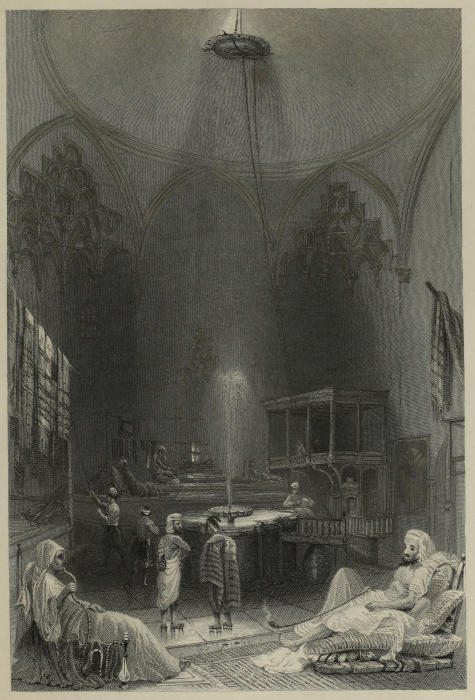
COOLING ROOM OF A HAMMĀM.
W. H. Bartlett. J. T. Willmore.
London. Published for the Proprietors, by Geo: Virtue, 26, Ivy Lane, 1839.
The bath is the very paradise of Eastern women. Here they assemble to discuss every subject of interest and amusement, whether politics, scandal, or news; to arrange marriages, and to prevent them; to ask and to offer advice; to display their domestic supremacy, and to impart their domestic grievances; but, above all, to enjoy the noise, the hurry, and the excitement, which form so great a contrast to the calm and monotony of the harem.
On leaving the outer hall, the bather is supplied with a pair of wooden pattens, raised several inches from the floor, which is so much heated in the inner apartments, that, until the vapour has had time to operate upon the frame, it is impossible to touch it with the naked foot. Thus provided—and among the higher classes these pattens are objects of great cost and luxury, the band by which they are secured across the instep being frequently inlaid with jewels—the bather passes into the cooling-room, where a number of little channels, filled with warm water, traverse the floor in every direction; which, while they add to the heat, serve to diminish the oppression of the vapour that escapes at each opening of the door of the bath itself; an extensive octagon hall, containing eight fountains, and surrounded by small cabinets for those who do not choose to avail themselves of the more public apartment.
We cannot, perhaps, do better than take a description of the extraordinary scene presented by this locality from the pages of an eye-witness.
“For the first few moments I was bewildered; the heavy, dense, sulphureous vapour that filled the place, and almost suffocated me—the wild shrill cries of the slaves pealing through the reverberating domes of the bathing-halls, enough to awaken the very marble with which they were lined—the subdued laughter and whispered conversations of their mistresses, murmuring along in an under-current of sound—the sight of nearly three hundred women, only partially dressed, and that in fine linen so perfectly saturated with vapour that it revealed the whole outline of the figure—the busy slaves passing and repassing, naked from the waist upwards, and with their arms folded upon their bosoms, balancing on their heads piles of fringed or embroidered napkins—groups of lovely girls, laughing, chatting, and refreshing themselves with sweetmeats, sherbet, and lemonade—parties of playful children, apparently quite indifferent to the dense atmosphere which made me struggle for breath—and, to crown all, the sudden bursting forth of a chorus of voices into one of the wildest and shrillest of Turkish melodies, that was caught up and flung back by the echoes of the vast hall, making a din worthy of a saturnalia of demons, all combined to form a picture like the illusory semblance of a phantasmagoria, almost leaving me in doubt whether that on which I looked were indeed reality, or the mere creation of a distempered brain.”[7]
In this hall, amid the noise and hurry here described, those who frequent it collect round the fountains, which are plentifully supplied with both hot and cold water, each lady attended by one or more slaves; her hair is then combed and saturated with water, poured over it from a basin of metal; and her limbs are gently rubbed by a hand covered with a small glove, or rather bag, woven of camel’s hair; after which, she changes her dripping garments for others that await her near the door of the hall, and passes into the cooling-room. Here, reclining on mats and carpets, the bathers sometimes lie for hours, with their hair concealed beneath heavy napkins, and their whole persons wrapped closely in long white scarfs, like winding-sheets. Were it not that they are flushed by the action of the vapour, and for the ceaseless conversation which they maintain, they would look like a party of corses prepared for burial.
When at length they venture into the outer hall, they at once spring upon their sofas, where the attentive slaves fold them in warm cloths, and pour essence upon their hair, which they twist loosely without attempting to dislodge the wet, and then cover with handsome head-kerchiefs of embroidered muslin; perfumed water is scattered over the face and hands, and the exhausted bather sinks into a luxurious slumber beneath a coverlet of satin or of eider-down.
The centre of the floor, meanwhile, is like a fair; sweetmeat, sherbet, and fruit-merchants, (old crones, who frequently have as many billet-doux as bowls of yahourt[8] in their baskets,) parade up and down, hawking their wares. Negresses pass to and fro with the dinners, or chibouques,[9] of their several mistresses; secrets are whispered—confidences are made; and, altogether, the scene is so strange, so new, and withal so attractive, that no European can fail to be both interested and amused by a visit to a Turkish Hammām.