ISTENIA.
Reading edition
“——in famed Attica such lovely dales Are rarely seen; nor can fair Tempè boast A charm they know not; loved Parnassus fails, Though classic ground and consecrated most, To match some spots that lurk within this lowering coast.” Byron.
The beautiful little village of Istenia, called by the Greeks Mirgheun, and principally inhabited by that nation, is situated in one of the prettiest spots on the Bosphorus; although the opposite shore is rocky, sterile, and fantastically flung together; the edge of the water at the base of the dusky chain of hills, being, however, fringed with houses, and gay with trees.
The Moorish fountain, which forms the subject of the accompanying sketch, is of an extremely graceful character, and built of a marble whose whiteness is almost dazzling. It occupies the termination of the main street of the village, where it touches upon the channel; and is entirely overshadowed by the far-stretching branches of a glorious maple-tree, which after spreading its gay green canopy over the dome and richly-wrought roof of the fountain, finally mingles its leafy honours with those of two other trees of the same description, beneath whose shelter the cool wooden terraces of a couple of coffee-kiosques have been erected.
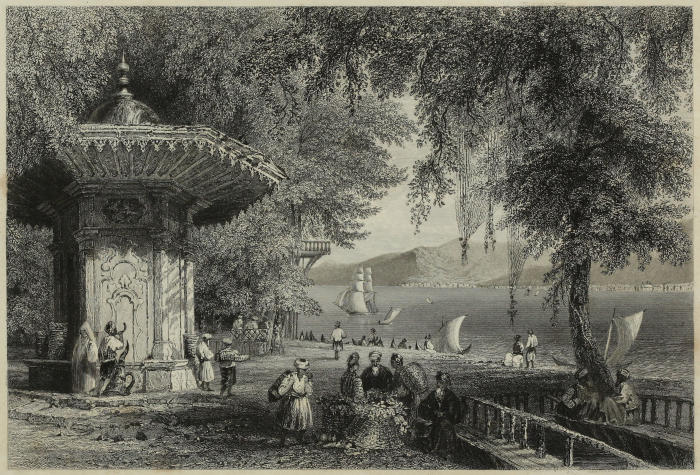
ISTENIA, NEAR THERAPIA.
ISTENIA PRÈS DE THÉRAPIA. ISTENIA BEI THERAPIA.
W. H. Bartlett. J. Cousen.
London. Published for the Proprietors, by Geo: Virtue, 26, Ivy Lane, 1839.
Crowds of caïques dance on the heaving current within twenty paces of the fountain; the transparent nets of the fishermen hang in festoons from the branches; veiled women come and go with their earthen vessels in quest of the pure water of the village spring; the gay sounds of the zebec ring out from the coffee-kiosques; the channel-wind, as it sweeps along the ripple, awakens the mysterious music of the leaves which overhang it; the white sails of the passing vessels glimmer in the sun-light—the fruit-merchants heap up their luscious stores in tempting profusion, ready to be conveyed in boats to the markets of the city—and the whole scene is so cool, so shady, and so still, that it is not wonderful that the nature-loving Orientals should have selected it as a village site, even in a land abounding with pleasant glens, and nooks teeming with loveliness.
The broad street, opening from the shore, climbs the hill behind it; its irregularly-gabled and many-coloured houses finally terminating in vineyards and olive-groves; while a mountain-stream, feeding the wheels of a mill, goes dancing in the light, now fully visible, and now buried beneath the dense vegetation upon its banks, until it throws itself into the Bosphorus. A very pretty, well-kept, and rather extensive garden, belonging to Achmet Pasha, occupies a portion of the height behind the village; and is succeeded by a small forest, where groups of Turkish and Greek ladies are constantly to be seen during the summer months, enjoying the dolce far niente so congenial to the climate; forming gipsy-parties under the trees, or sauntering slowly along beneath the dense shadows of the boughs, collecting the beautiful wild-flowers which abound in that pleasant place.
Many of the Greek merchants have their summer residences at Mirgheun; and there is, consequently, an air of cheerfulness imparted to the village by the freshly-painted houses of these gentlemen, which adds much to its attraction; while, in its immediate neighbourhood, the traveller will look upon the castle-fortress of Mahomet, with the peaceful little cemetery of Isari sleeping at its foot.