MUSICIANS AT THE ASIAN SWEET WATERS.
Reading edition
We’re coming, we’re coming to gladden the throng, With laughter and legend, with music and song; Dark eyes gleaming round us; light tones on the air: And the greetings of childhood to welcome us there; A sun in the sky, and a breeze on the sea, Oh! shew us the minstrels more happy than we! MS. Poem.
A description has already been given of the Asian Valley of Sweet Waters; of its majestic plane-trees, its laughing river, and its delicious greensward; of the young beauties who throng its recesses, the Sultanas who grace its drives; and the rosy children who make its echoes vocal. But its musicians are a race apart, and the artist demands for them
“A separate mention and a guarded page.”
and in truth they are well worthy of it!
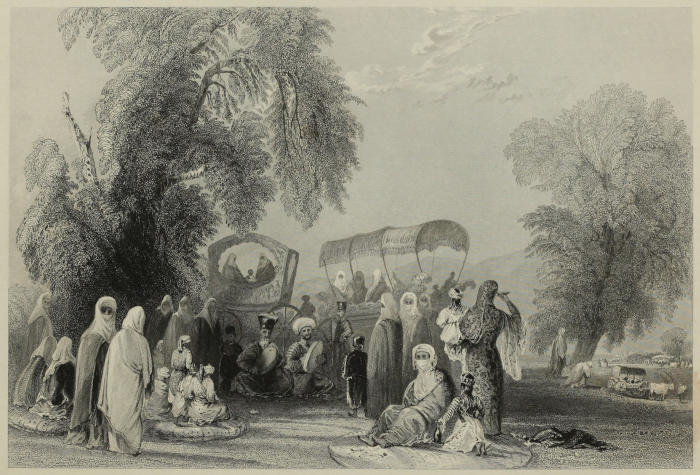
MUSICIANS AT THE ASIAN VALLEY OF SWEET WATERS.
W. H. Bartlett. R. Brandard.
London. Published for the Proprietors, by Geo: Virtue, 26, Ivy Lane, 1839.
Their minstrelsy is none of the sweetest; it requires not the ear of science to detect their discords, nor the taste of the poet to smile at their absurdities; and yet, it is impossible not to welcome them with smiles, for you know that joy and laughter follow in their train: the calpac of the one, and the turban of the other, alike covers a shrewd and a busy brain. How much may be told in a song, or hinted in a stanza! Look at the group around them! The matron is there, wary and watchful, remembering the years of her own youth, and the evils by which she was then surrounded; and yet beguiled by the “cunning minstrelsie” of the wandering bards into temporary forgetfulness of all save the charm of their ready wit and simple seeming: the young beauty is beside her, veiled and draped with jealous care, it is true, but with a heart as warm, and a fancy as buoyant, as though yashmacs and lattices were unknown in the land of her birth; her pale cheek flushes, and her pulses quicken as she listens; for to her the songs of the pilgrim-bards tell a deeper and a dearer tale than to her placid grand-dame; while the attentive children gather together in groupes, and gaze and hearken in mute and wondering admiration. Many a wild legend do the minstrels chaunt, in a slow, drawling, monotonous tone, which can add but little to the charm of the subject-matter of their song; while an occasional rasp of the grating tambourine, a rapid rattling of its silver bells, and the hollow sound emitted by the small Arab drums which are their usual accompaniment, alone serve to relieve the tedium of recitation. Pleasant, however, must be the lays which they pour forth; for many of their fair auditors will remain unweariedly for hours, listening and applauding with low-breathed “Mashallahs!” and “Ajaibs!”[24] and without a single symptom of ennui.
Wallachian and Jewish musicians are common; and the extraordinary length of time during which they will dwell upon a single note, with their heads thrown back, their mouths open, and their eyes fixed, and then follow it up with a whole sentence, rapidly and energetically uttered, is most singular. But these oriental troubadours are not without their rivals in the admiration of the veiled beauties who surround them; conjurors, improvvisatori, story-tellers, and Bulgarian dancers, are there also, to seduce away a portion of their audience; while the interruptions caused by fruit, sherbet, and water-venders, are incessant. They are, however, the most popular of all; and a musician, whose talent is known and acknowledged, seldom fails to pass a very profitable day at the Asian Sweet Waters on every occasion of festival.