EYOUB.
Reading edition
“It is a goodly sight to see What Heaven hath done for this delicious land!” Byron.
Eyoub, beautifully situated at the eastern extremity of the walls of Constantinople, and stretching down to the very lip of the harbour, is the “holy of holies” of the Turks. Its magnificent mosque and its picturesque cemetery are equally historical; while its position, overlooking the whole extent of the Golden Horn, and commanding a noble view far up the Bosphorus, is possibly unrivalled. Smoothly-rounded hills, feathered with trees varying in character, but all rich in beauty, form a background eminently scenic; the lofty maple and the leafy plane-tree, the fan-like acacia and the rigid cypress, flourish side by side, and overshadow a wilderness of graves; while the suburb itself, unusually well-built and regular, circles a portion of the harbour with stately and pleasant dwellings.
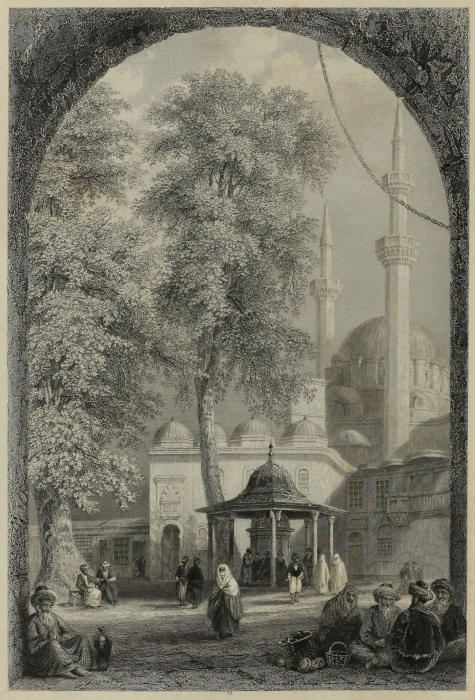
COURT OF THE MOSQUE OF EYOUB.
COUR DE LA MOSQUÉE D’EYOUB. DER HOF DER MOSCHEE ZU EYOUB.
W. H. Bartlett. J. Carter.
London. Published for the Proprietors, by Geo: Virtue, 26, Ivy Lane, 1840.
The mosque, built of the purest white marble, with a court gloriously shaded by gigantic trees, and paved with the same material of which the edifice is composed, is the most sacred of all the Constantinopolitan temples; for on this spot tradition says that Abu Eyoub, the companion-in-arms of the Prophet, was slain, during the siege of the Saracens in 668, a fact which was revealed in a vision to Mahomet II. about 800 years afterwards; who, in commemoration of the event, laid the foundation of the present mosque, which is one of the most elegant in the capital; and is rendered still more holy in the eyes of the Turks, from the circumstance that it is within these walls that every Sultan, on his accession, is invested with the sword of sovereignty. No infidel foot is permitted, under whatever pretence, to desecrate the mosque of Eyoub; and Christians are rarely, and always reluctantly, admitted even to the court.
At Eyoub, on the very verge of the water, stands one of the summer palaces built by the unfortunate Sultan Selim, and overlooking the lovely glen through which the Barbyses flows calmly onward, to lose itself in the harbour. It is now the property of the Sultana Asmè, the elder sister of the present Sultan.
“The decorations throughout are heavy, but of the greatest richness, and perfectly oriental in their character. What was formerly the reception-room of the ill-fated sovereign is entirely lined with gilding; the walls being niched and overhung with stalactited cornices similar to those which decorate many of our old cathedral tombs; and the weight of this elaborate ornament is relieved by a ceiling of faint blue, sprinkled with silver stars.”[5]
The exterior of the building is in the Moorish taste, with a convoluted and projecting roof; and the façade is of considerable extent.
Near this palace stands the great Fèz manufactory, where all the caps for the court and the army are now made. It is a modern building, erected on the site of one of the dilapidated kiosques of the Sultan, and is a very important and ornamental feature in the landscape.
There is an anecdote connected with this establishment, which is sufficiently characteristic and amusing to merit transcription; and it may be inserted here for the benefit of the many, to whom it will be entirely novel. “The manufactory was suggested and founded by Omer Lufti Effendi, in consequence of the extremely high price paid by the Sultan to the Tunisians, with whom this fabric originated, for the head-dress of his troops. Having induced a party of Arabian workmen from Tunis to accompany him to Constantinople, he established them in the old palace, which has since been replaced by the present noble building; and under their direction the knitting and shaping of the caps acquired some degree of perfection.
“But the dye was a secret beyond their art; and the Turkish government, anxious to second the views of the energetic Omer Effendi, made a second importation of Tunisians with no better success, although they were chosen from among the most efficient workmen of their country. The caps, while they were equal both in form and texture to those of Tunis, were dingy and ill-coloured; and the Arabs declared that the failure of the dye was owing to the water in and about Constantinople, which was unfavourable to the drugs employed.
“As a last hope, a trial was made at Smit, but with the same result; and the attempt to localise the manufacture was about to be abandoned, when Omer Effendi, suspecting the good faith of the Arabian workmen, disguised a clever Angorian Armenian, named Avanis Aga, as a Turk, whom he placed as a labourer in the dye-room. Being a good chemist and a shrewd observer, Avanis Aga, affecting a simplicity that removed all suspicion, soon made himself master of the secret which it so much imported his anxious patron to learn; and, abandoning the ignoble besom that he had wielded, as the attendant of the Tunisian dyers, immediately that he discovered the fraud, which, either in obedience to the secret orders of their Regent, or from an excess of patriotism, they had been practising ever since their arrival, he set himself to work in secret; and, with the water of Smit, dyed two caps, which, having dried, he presented to Omer Effendi, who was unable to distinguish them from those of Tunis.
“Delighted at the successful issue of his experiment, Omer Effendi summoned the Arabs to his presence, and showed them the Fèz; when, instantly suspecting the masquerade that had betrayed them, they simultaneously turned towards the Armenian; and throwing their turbans on the ground, and tearing their hair, they cried out, ‘Yaccoup! Yaccoup!’ (Jacob! Jacob!)
“The superintendent having dismissed them, after causing them to be liberally remunerated for the time which they had spent at Constantinople, sent them back to Tunis; while Avanis Aga, elected Head Dyer of the Imperial Manufactory of Eyoub, now enjoys the high honour of deciding on the exact tint to be worn by Mahmoud the Powerful, the ‘Light of the Sun,’ and ‘Shadow of the Universe.’”[6]
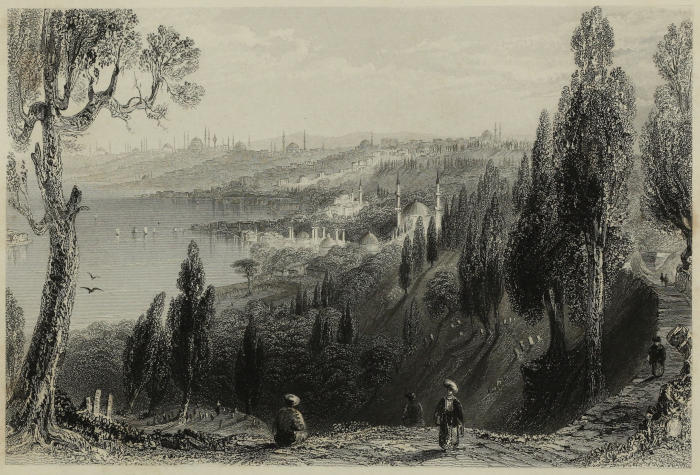
EYOUB.
W. H. Bartlett. Chas. Richardson.
London. Published for the Proprietors, by Geo: Virtue, 26, Ivy Lane, 1839.
By far the most interesting feature of Eyoub is, however, its beautifully-situated cemetery, occupying the slope of a thickly-wooded hill. After the necropolis of Scutari, that of Eyoub is the most venerated by the Turks; and to the stranger it is rendered peculiarly interesting by the fact, that it contains the tombs of the “Tiger-Pasha,” Ali of Tepeleni, whose life, revolt, and death, form a wild and thrilling romance; and those of his three sons, and his grandson; who, in accordance with Eastern ideas of expediency, shared his punishment; and whose trunkless heads now lie in the burial-ground of Eyoub, beside his own. On a parapet wall directly facing the Selyvria gate, five oblong blocks of marble of unequal height, and crowned with turbans, are ranged side by side in a conspicuous situation. That which covers the head of the traitor himself is thus inscribed:—“Here lies the head of the once celebrated Tepedelenly Ali Pasha, Governor of the Sangiac of Yanina; who for more than fifty years pretended to independence in Albania.” The others simply record the name and rank of the respective victims, and terminate the inscription very naïvely with the words, “who has been put to death by the cutting off of his head;” without attempting to perpetuate any accusation of crime or misdemeanour; their unlucky relationship to the rebel Pasha being accounted a sufficient treason.
When on a visit at the Fanar, or Greek quarter of the city, I had once a momentary glimpse of the widow of this celebrated rebel. She was the daughter of a Greek papas, or priest, of Yanina, of great beauty and some erudition, to whom the Pasha was reported to have been passionately attached; though she is accused (it is doubtful with what justice) of having stipulated to receive her “thirty pieces of silver” for betraying him to the Government. Be this as it may, it is certain that she possessed great influence over his mind; and that it was entirely by her arguments and entreaties that he was dissuaded from the desperate intention of blowing her, himself, and his treasures, up with gunpowder, to prevent their falling into the hands of the Sultan; and that it was she who negotiated the affair between Ali and Hourchid Pasha; while it is equally a fact, that let her have made what compact she might, she received neither money nor land from the Turkish Government after the execution of her husband, but was turned over in a state of positive destitution to the custody of the Patriarch, where she literally owed her daily comforts to the charity of the benevolent. She was a voluntary prisoner in her apartment, from which she seldom emerged save to attend some ceremony in the Patriarchal Church; and her time was said to be generally passed in prayer.
The view from the cemetery is strikingly fine; on the one hand the city, throned on its seven hills, with a thousand stately domes gleaming in the sunshine, and a thousand taper minarets glancing towards heaven, stretches along the edge of the harbour, until the line is lost at the abrupt and palace-cumbered point of the ancient Byzantium; beyond which may be descried the termination of the Bosphorus, and the mountain-chain of Bulgurlhu, on the Thracian shore of the channel.
On the other side of the land-locked harbour the gently-flowing Barbyses glides, like a silver thread, through the valley of Kyat-Khana, to pay its tribute to the wealth-freighted waters of the Golden Horn; and on the verge of a small hamlet not above two furlongs from this calm stream, stands a small mosque, half buried in trees, insignificant in appearance, and seldom remarked by strangers; which is, however, too historically interesting to be passed over. It is called the “Mosque of Blood,” and is painted a dull red from the base of its walls to the summit of its single minaret. It is a desecrated temple, having been forced during the last siege by a party of combatants, some of whom expired beneath its roof, and thus brought the presence of death where, on religious principles, it is never suffered to intrude; while in its immediate vicinity rises a bleak, treeless, and desolate-looking eminence, occupied by the bones of all the True Believers who perished during that memorable struggle, to the amount of some thousands: their remains have been respected, but there is neither monument nor inscription to perpetuate the memory of their good services.
Beyond this mosque, the out-buildings of the Imperial arsenal, the dry-dock for the construction of shipping, the galleys, (which are under the immediate control and authority of the High Admiral,) the powder magazines, and the ruined palace of a former Capudan Pasha, occupy the shore as high as the suburb of Kassim Pasha, where stands the Marine Barrack, a huge pile, chiefly remarkable for the wretched taste of its tawdry fresco-painting, and its air of chilling desolation; and near to it the new Tershana, or Admiralty, a bright, many-coloured, highly-ornamented edifice, in the Russian taste; occupying the side of a small creek, and overlooking a wooden pier. A wet-dock, handsomely enclosed within solid and well-made walls, and entered through a noble pair of iron gates, below Kassim Pasha, is succeeded by a height covered with cypresses, which leans downward to the water, where it terminates in a steep flight of steps, partly artificial and partly hewn in the rock, and designated the Meit-iskelli, or Ladder of the Dead. This gloomy forest is the “Little Cemetery,” or lesser burial-ground of Pera, the faubourg inhabited by the Franks; and the jetty at the foot of the stair which has just been described, is principally used for the embarkation of the bodies of deceased Turks, whom their friends are conveying for burial to the Asian necropolis of Scutari.
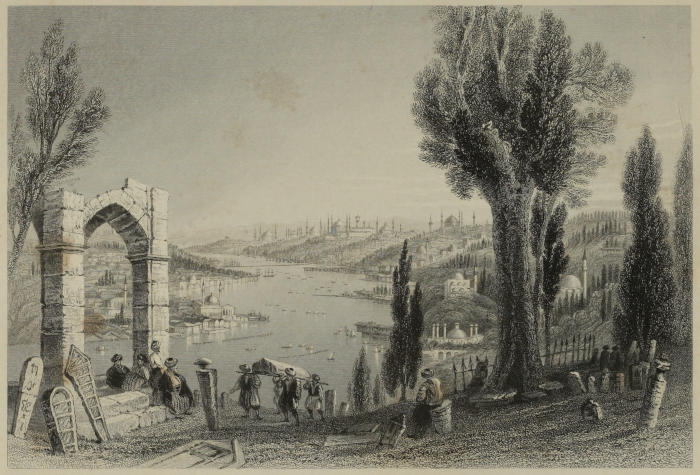
THE GOLDEN HORN, FROM THE CEMETERY OF EYOUB.
W. H. Bartlett. H. Adlard.
London. Published for the Proprietors, by Geo: Virtue, 26, Ivy Lane, 1839.
Immediately beyond this jetty, a floating bridge, stretching from the pier of Galata (the quarter of the Frank merchants, dominated by the hill on which Pera is built,) to the “Gate of the Garden,” near the Kiosque of Pearls, and immediately under the walls of the Seraglio, shuts in the harbour; while the line of shore in the distance, fringed with the houses and public buildings of Top-hannè, gently recedes, until it disappears under the stately shadow of Bulgurlhu.