THE OCMEIDAN.
Reading edition
“The tough bow yields before the sinewy arm; And, swift as lightning, through the yielding air The winged arrow whistles to the mark.”
The Ocmeidan, or Place of Arrows, is an extensive plain, situated behind the village of Tatavola, called by the Greeks who inhabit it the hamlet of St. Demetrius; and stretching along above the deep valley of this little Christian colony, and beside the cemeteries of Pera.
The view which it commands, where it touches upon the harbour, is most magnificent; the “Seven Hills” are all before it, with their galaxy of mosques and palaces: two of them linked together by the hoary aqueduct of Valens, and all gleaming in white marble, and overtopped by the dusky mountains of Asia Minor. Beneath it spreads the Golden Horn, crowded with shipping, and traversed by a light floating bridge, seeming to the eye as frail and unstable as that of El Sirat; but which is crossed by the Faithful from the Golden City only to arrive at the infidel dwellings of the Franks, instead of the houri-tenanted valleys of Paradise; forming, meanwhile, an extremely pretty feature in the landscape.
A fringe of forest-trees descends to the very edge of the plain, which is full of gentle undulations, and is rendered remarkable by being studded over at irregular distances by columns of stone or marble, bearing inscriptions, and not unfrequently lettered with gold. These columns, which have much the appearance of funereal monuments, are simply records of the skill of the Imperial Toxopholite who now sways the sceptre of the Ottoman empire, and whose dexterity in the use of the “cloth-yard shaft” is presumed to be unequalled throughout his dominions. Archery is a sport to which Sultan Mahmoud is much attached; and he is said to boast that, during the last forty years of his life, he has never suffered a week to pass in which he has not practised his well-worn bow. His proficiency in the science may therefore be inferred: though it is certain that none, save an Imperial arm, could ever have
“Sped the winged arrow”
to such a distance, as some of the columnar records, to which allusion has just been made, appear to testify.
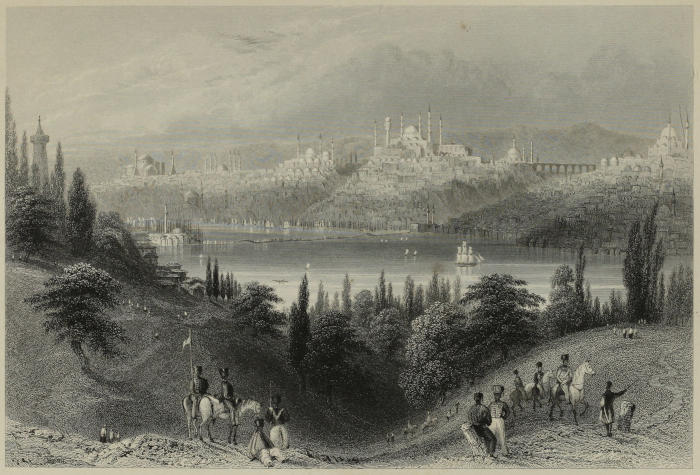
VIEW FROM THE OCMEIDAN.
W. H. Bartlett. H. Adlard.
London. Published for the Proprietors, by Geo: Virtue, 26, Ivy Lane, 1839.
Three hundred yards is, in one instance, cited as the space cleared by the feathered messenger of the Caliph: the ground was measured, and the pillar was raised, and the Sultan departed from the Ocmeidan, satisfied that no subject throughout his empire could outdo “the shooting of that day;” nor was it probable that any bowman could be found to controvert his opinion; and none, it is said, knew this better than the page who had picked up the marvellous arrow, and received two purses[28] when he restored it to his imperial master.
There is much etiquette observed in the archery parties of the Sultan. First flies the arrow of Mahmoud himself, as he stands on the right of a line of Pashas and Beys, who have been formally invited to partake of the sport; and immediately off start half a dozen of the pages of the household to recover the missive, and to mark the spot where it falls. These functionaries, who endeavour to out-speed each other, and to secure the prize which, on the occasion of a longer shot than usual, they are sure to receive from their sovereign, run with their heads close to the earth, and generally contrive to pick up the arrow without checking their speed, and to carry it on for some distance before they affect to find it, when they proclaim their success with a shrill cry; and the measurement of the ground takes place at once, where the shot is considered sufficiently remarkable to warrant the ceremony.
The very “long bow,” which we have cited to have been drawn by the Sultan on the happy occasion when the space over which his arrow had travelled was declared to be three hundred yards, is said to have been the frolic of a sportive and daring page, who, having gathered it up at a reasonable distance, ran on until he had a vision of detection, when he stopped, unquestioned if not unsuspected, and at once established the fame of his Imperial master as the first Toxopholite in Europe.
When the Sultan has ascertained his success, each of his courtly companions shoots in turn; but it is almost needless to remark, that their arrows always fall short of the mark: while, despite the diplomatic frauds of time-serving dependants, it is equally certain that there are few archers either so skilful or so graceful as the Emperor of Turkey.