THE VALLEY OF THE SWEET WATERS.
Reading edition
“From its base emerged A vital spring of water; which thence flow’d In winding rills across the flow’ry glade, At which the beasts of earth and fowl of air Refreshed their palates, after dainty feed.” Abington’s Chaos.
Kyat-Khana, called by the Franks the “Valley of the Sweet Waters,” is a lovely glen, nestled at the base of a chain of hills, and situated between Eyoub and Hassa Kuï, the quarter of the Jews. It is entirely shut in on all sides; and looks from the heights above, which are bleak and arid, like a huge emerald. Through the thick grass of the valley, and under the shadow of its magnificent trees, flows the Barbyses; a limpid, but inconsiderable stream, upon whose banks rise two of the most fairy-like edifices that ever sheltered prince or peasant! The larger building is a summer-palace, where the favourite wives of the Sultan lounge away many of the long sunshiny days of the warm season in comparative freedom; and exchange the closely-latticed apartments of the Imperial harem for the shady groves and grassy paths of the palace gardens; dreaming through the hot hours in gilded kiosques[1] on the river bank; or driving amid the tall plane-trees in arabas,[2] bright with gilding, and drawn by cream-coloured oxen.
It must not be supposed, however, that, in addition to these enjoyments, the fair Sultanas are even here permitted to look upon a world from which they are elsewhere so jealously shut out; I have already enumerated all the privileges of their summer residence. When the harem is about to remove to Kyat-Khana, a military cordon is established along the whole range of the heights overlooking the valley, and the public are entirely shut out from that portion of it which immediately surrounds the palace. Occasional glimpses of the pretty prisoners may, nevertheless, be obtained, as they glide along the Barbyses, in their magnificent caïques,[3] closely veiled, and followed by other boats, filled with a portion of the negro guard of the household.
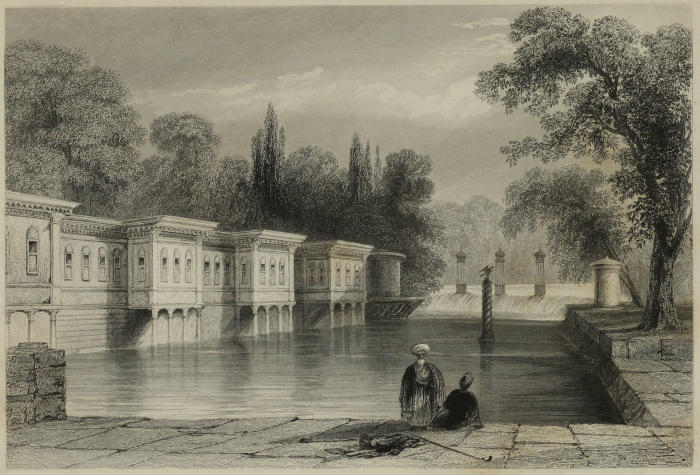
PALACE OF THE SWEET WATERS.
PALAIS DES EAUX DOUCES. DER PALAST DES SÜSSEN WASSERS.
W. H. Bartlett. After a sketch by Miss Pardoe. W. Mossman.
London. Published for the Proprietors, by Geo: Virtue, 26, Ivy Lane, 1839.
The locality owes its name of Kyat-Khana, (literally signifying the House of Paper,) to the fact that a paper manufactory was formed in the valley by a renegade, named Ibrahim, in the year 1727, during the reign of Achmed III. It was, however, abandoned, as well as a printing establishment instituted by the same individual, in consequence of a refusal from the Ulema to permit the printing of the Korān, which they declared to be too holy to be submitted to so infidel a process; and the machinery and buildings were in a state of almost equal dilapidation, when Sultan Selim, the uncle and predecessor of the present sovereign, anxious to revive so useful an art among his people, gave up the palace as a manufactory, and munificently encouraged the re-establishment of the fabric; but he was fated to see this attempt fail, like many others which he made to ameliorate the condition of his subjects, and which he ultimately expiated with his life. All traces of the undertaking have now vanished from the valley, and the palace has become once more an Imperial residence.
The smaller edifice to which allusion has been made, is a kiosque, also appertaining to the Sultan, and occasionally occupied by the high officers of the household: it stands on the very edge of the Barbyses, and the caïques glide under the windows, or shoot along beneath the thick branches of the trees on the opposite bank, with a velocity which, to the eye of a stranger, is perfectly surprising; while the inmates of the kiosque smoke their chibouques in luxurious indolence, fanned by the air of the river, and amused by the passing groupes.
The valley itself is delicious; the greensward is bright and rich, to a degree unknown in any other environ of the city. In spring it is the grazing-ground of the Imperial stud; and the beautiful Arabians are installed with great pomp, picketted after the Eastern fashion, and superintended by parties of Bulgarians, whose tents are pitched in the valley, and who never quit it under any pretence until they are released from their charge. In summer it is the resort of all ranks; who, on every Friday (the Turkish Sabbath,) resort thither, to enjoy what none know better how to appreciate than the Orientals—a bright sky, a running stream, flowers, leaves, and sunshine. Bullock-carriages, covered with gay-coloured awnings of silken shag, fringed with gold; gilded arabas, drawn by swift horses; and caïques, the number of whose elegantly-clad rowers denotes the rank or wealth of their owners, pour forth their tenants every moment; while the thick branches of the noble trees protect from the glare of the sun parties of white-veiled women, who, squatted on their mats or carpets, and attended by their slaves, sit for hours listening to the Wallachian and Bulgarian musicians, who collect paras[4] and praises at a very trifling expense of melody; purchasing the prettily and significantly arranged bouquets of the dark-eyed Bohemian flower-girls; or watching the ungainly dances of the Sclavonians, who, with their discordant bagpipes under their arms, perform evolutions which resemble the saltatory attempts of half-educated bears. Here and there, a little apart from the crowd, may be seen a party of Greeks, engaged in their graceful romaïka; while groups of lovely children, and water-venders, and sweetmeat merchants, wander up and down the greensward, and are greeted with smiles and welcome on all sides. It is, in short, a spirit-stirring scene; and the poorer classes who are unable to command a carriage, or a caïque, will cheerfully toil on foot from the city, under a scorching sun, in order to secure their portion of the festival.
A great deal of public business is occasionally transacted at Kyat-Khana; and then the sparkling Barbyses is alive with the gilded barges of the Pashas and Beys, shooting over the ripple like meteors; the grandee himself being carefully shielded from the sun by a red umbrella, held over him as he reclines on his cushions at the bottom of the boat, quietly smoking his chibouque, by an attendant, who is squatted on the raised stern of the arrow-like bark, immediately behind him.
The valley of Kyat-Khana is a very favourite resort of the present Sultan, who has expended considerable sums in beautifying the palace, and in ornamenting the fountains and kiosques which appertain to it; but only a short time since it was entirely abandoned for two years, owing to the death of a favourite Odalisque, who expired suddenly, in the very zenith of her youth and beauty, during a visit which she made here with her Imperial master; whose grief at her loss was so intense, that he could not bear to inhabit the valley until time had blunted his regret. A handsome head-stone, erected to her memory, lettered with gold, and overshadowed by a weeping willow, stands upon a square platform, beneath the windows of the saloon occupied by the Sultan; and the breeze, as it sweeps through the flexile branches of the tree, almost carries them into the apartment. Sultan Mahmoud, who is esteemed a very respectable poet for an Emperor, is said, during his season of despair, to have written a pathetic ballad in her honour; but, be that as it may, it is certain that she has been long forgotten among the bevy of beauties who now tread the gilded chambers of the palace of Kyat-Khana.