THE SERAÏ BOURNOU.
Reading edition
“A rich confusion form’d a disarray In such sort, that the eye along it cast Could hardly carry any thing away, Object on object flashed so bright and fast: A dazzling mass of gems, and gold, and glitter, Magnificently mingled in a litter.” Byron.
The celebrated Seraï Bournou, occupying the obtuse point of the triangle on which Constantinople is built, boasts, as perhaps its greatest peculiarity, that it was once in itself a city. The ancient Byzantium was founded in the year A.C. 660, by a Lacedæmonian colony; and a portion of the original walls are actually standing at this day, and still serve to separate the palace gardens from the public street. The mouldering but solid masonry which now girdles the Imperial residence of the Caliphs, once belted a city; and the groves and alleys that are to-day scantily traversed by slaves, eunuchs, and women, were in times of old thickly peopled with an active, busy, and enterprising population.
Byzantium, enriched by the first Constantine, and made the key-stone of a new Empire, and the capital of a second Rome—Byzantium, where a hundred of his august race feasted and governed in their turn, and which was ultimately lost to Christendom by the last and bravest of the line—is now a mere Moslem palace, where the echoes of the war-trumpet, and the neighing of the war-steed, have been replaced by the twanging of the lute, and the voices of women; even its ancient name is never heard, and its broad sun-lighted honours have been exchanged for silence and mystery.
It is asserted by historians that the capital of Byzantium was formerly enriched with columns and statues, and that monuments, now no longer in existence, were profusely collected within its walls: be that as it may, the only remnant of classic antiquity now remaining is a stately column of marble, formed of huge blocks piled upon each other to the height of ninety feet, and standing upon a raised square platform, or terrace, planted with trees, in an outer court of the palace; and known as the Column of Theodosius; though it is evident, in comparing this pillar with the descriptions of antiquaries, that it cannot be the original monument called by that name; nor, it is presumed, can its present position be that which it originally occupied in the city. A venerable cypress, many feet higher than the column, screens it on the seaward side, but the statue which once surmounted the capital is gone; and one deep rent, almost separating the shaft throughout its whole thickness, and evidently produced by the shock of one of those earthquakes to which Constantinople was formerly so subject, attests its ancient origin; while its graceful proportions, and the elaborately-defined acanthus of its capital, render it one of the most interesting monuments now existing in the capital.
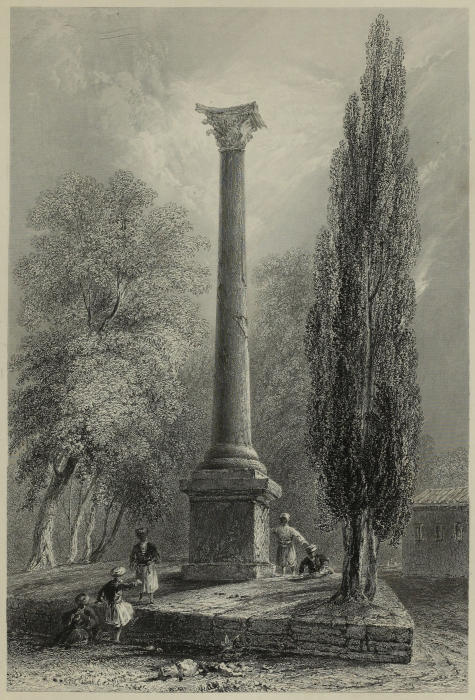
THE COLUMN OF THEODOSIUS.
COLONNE DE THÉODOSE. DIE SÄULE DES KAISERS THEODOSIUS.
W. H. Bartlett. J. Cousen.
London. Published for the Proprietors, by Geo: Virtue, 26, Ivy Lane, 1840.
The most striking feature of the Seraï Bournou in the present day is its surpassing orientalism. Fountains, palaces, streets, and market-places—all the public rendezvous of Stamboul have suffered change, save the mysterious dwelling of the Caliphs. European innovations have crept with spirit-steps across the land: tapestry hangings and jewelled toys are scattered over the summer-palace of Asia; gaudy chintzes from the looms of Britain shut out the sun-light from the gilt-latticed casements of the imperial kiosques; silks from the warehouses of Genoa and Lyons cover the sofas of the regal pile at Beshik-Tash; but in the hidden recesses of the palace of Amurath all is unchanged, as though the genius of mutability had never waved his wand over the children of the Prophet.
Its effect from the sea of Marmora is as singular as it is beautiful. The wall by which it is enclosed is separated from the water only by a narrow wharf or terrace, pierced at intervals by a close lattice-work, through which the fair tenants can look out upon the sun-lighted waves, and on to the fantastic islands of the Propontis; in some places overgrown with the most luxurious parasites, among which are conspicuous the rich dark leaves of the ivy, and the clustering verdure of the gorgeous caper-plant, with its galaxy of blossoms; and in others, surmounted by a light and graceful kiosque, now, however, tarnished by the weather, and mouldering into disuse; for since the present Sultan girded himself with the sword of sovereignty, and eschewed the mysterious exclusiveness of his predecessors, the Seraï Bournou has ceased to be a chosen residence for the Ottoman court. And even as the victorious Mahomet II. feelingly apostrophized the denuded and desecrated palace of the last Constantine, when he entered as a conqueror the august abode of his vanquished enemy, only to find it ravaged by his own soldiery, may the silent Seraï be addressed to-day in the celebrated words of a Persian poet:—“The spider has woven his web in the halls of the Cæsars, and the owl has kept her unstartled watch on the towers of Afrasiab.”
Nothing can be seen from the water save a line of gilded kiosques, gracefully clustered together on the extreme point of the land; the roofs and domes of a few scattered buildings; and here and there a slender minaret pointing heavenward from the midst of a dense forest of rich and stately trees, of which numbers overhang the boundary walls, and throw their long cool shadows over the current of the Propontis; whose depth is so great, even to the edge of the terrace, that vessels of burthen pass close beside the Golden Gate, or seaward entrance to the palace—a stately portal of marble, so richly overlaid with arabesques of burnished gold, that it is scarcely possible to look upon it beneath a mid-day sun.
Gliding round the point into the harbour, the voyager next comes upon a pavilion nestled beneath the walls of the Seraï, and known as the waiting-room of the Franks, where, in the previous reigns, the European Ambassadors were detained on days of audience until it was the pleasure of the Sultan to admit them within the sacred boundaries of the palace-grounds; and a few roods beyond this pavilion is a low door, of which the bars are now thickly overgrown with rust, and the bolts immovable from disuse, known as the Pasha’s Gate, through whose ill-omened opening, tradition tells, that recreant or suspected nobles who suffered the bowstring, were formerly cast into the deep waters of the harbour; while romance, greedy of her own legend, asserts that hence were also burled the degenerate beauties who chanced either to offend, to weary, or to disgust the Sardanapalus of the hour, to the mercy of the
——“rolling waves, which hide Already many a once love-beaten breast, Deep in the caverns of the deadly tide.”
The one assertion is, however, probably as apocryphal as the other; for the sluggish waters of the port must have been assuredly less inviting to the ministers of death than the hurried current of Marmora, where, scarcely an arrow’s flight from the Seraglio walls, it rushes towards the gulph of Nicodemia. Be that as it may, however, the walls of the Seraï, terminating a short space beyond this gate, where the court of Yeni Djami descends to the harbour, take an upward direction, and are flanked at their extreme point as they traverse the city, by a gaily-gilded kiosque, poised, as if by magic, upon one of the buttresses, and entirely surrounded by lattice-work, which, while it conceals the interior of the building, permits its tenants to command every object beneath them.
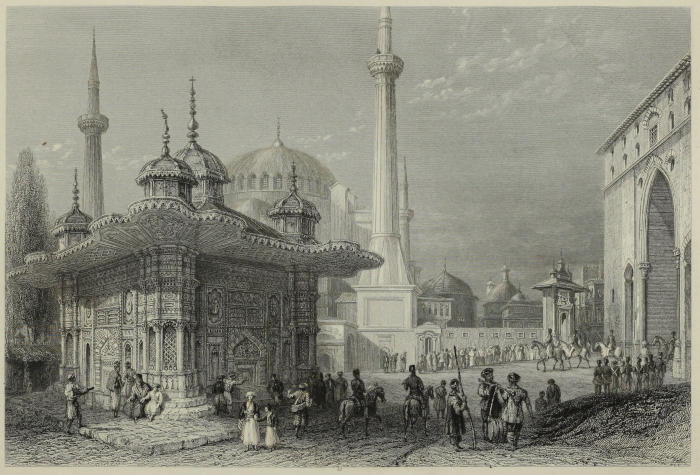
FOUNTAIN AND SQUARE OF ST. SOPHIA.
FOUNTAÍNE ET PLACE STE SOPHIE. DER SOPHIENPLATZ MIT SPRINGBRUNNEN.
W. H. Bartlett. T. Higham.
London. Published for the Proprietors, by Geo: Virtue, 26, Ivy Lane, 1839.
Directly opposite to this glittering pavilion, called the Kiosque of Justice, is situated the magnificent portal which gives its name to the Turkish government—the “Sublime Porte”—a stately and imposing gate of entrance to the great public offices of the Empire. This noble and finely-proportioned structure, perhaps one of the most striking in the world, is flanked by two deep niches, containing slabs of marble, whereon are exposed the heads of such criminals below the rank of Pashas, or enemies taken in battle or captured by stratagem, as it is the pleasure of the monarch to reveal to the eyes of the people; and the gilded kiosque, to which allusion has been made, owes its appellation to the circumstance, that it is from thence that the Sultan ascertains the effect of the exhibition upon the populace, and the fact that his orders have been executed by the proper functionaries.
The principal and highest entrance to the Seraï Bournou occupies one side of a square, of which the Mosque of St. Sophia encloses a second; while the remainder is formed by lines of mean-looking houses and coffee-shops. A very beautiful fountain, now fast falling to decay, stands in the centre of the space; whence the water gushes forth in an ample volume, dancing and glittering in the sun-light. It is a fine specimen of the ancient Moorish architecture, and is surmounted by five domes—one occupying the centre of the pile, and richly perforated with transparent chiselling; while four minor lateral cupolas form the extremities of the roof, which is terminated by a deep overhanging cornice, highly ornamented with a heavy cornice and a series of minute arabesques. Two broad and steep steps of white marble lead to the building, which is, with the exception of the Kilidge Ali Pasha Djiamini at Top-hannè, the finest structure of the kind in the capital; and a group of sentinels and eunuchs loitering under the lofty portal of the Seraglio gate, give a last touch of orientalism to the picture.
The first court of this celebrated Palace cannot fail to disappoint the highly-wrought anticipations of the visitor, who imagines, when he has once succeeded in passing the magic threshold so rarely trodden by any foot save those of the monarch and his immediate court, that all the wonders of Eastern mystery and magnificence are to burst on him at once; and his astonishment may be conceived, when he finds himself standing in a spacious oblong enclosure, which is rather an excrescence than an appendage to the palace; in which the only striking object is one of the most enormous and beautiful maple-trees in the world, looking like a forest growing from a single trunk, chequering an immense space with light and shadow, and affording shelter to a perfect colony of beautiful blue doves. On the right hand of the court are situated the infirmaries, the wood-stores, and the bakehouses; on the left, the once elegant Greek church of St. Irene, now converted into an arsenal; and on a line with this desecrated edifice, the Mint, a handsome range of building, to which are attached the dwellings of the Chekir-Encine, or Superintendent of the Public Works; and the Tarafhannè, or Inspector of the same department.
Passing along beside a high wall, the visitor finds himself at the Orta Kapousi, or Middle Gate, a place of death and doom, where rivers of blood are declared to have been shed. This gate is flanked by two towers, forming a saillie; and near it is the Djillāt Odossi, or executioner’s apartment, the temporary prison of condemned Vèzirs, who, on their entrance to the Seraï, when they had fallen under the suspicion and displeasure of the Sultan, were arrested on this spot without previous warning; and hence the Turkish expression, “arrested between the two doors.” In case of exile, their sentence was read to them on this spot, and its fulfilment enforced by the officers of the Seraï; in that of death, it was at once carried into effect by the tenant of the tower. Above the gate-way is a range of iron spikes, on which the forfeited heads were exposed to blacken in the sunshine; while on the wall immediately beneath, a yafta, or proclamation of the crime which had drawn down the destruction of the culprit, was affixed to the wall. These yaftas were written in large characters, on a scroll shaped like a cone, and remained exposed so long as the weather spared them, unless the bostanji of the guard could be bribed by the friends of the victim, when they generally disappeared.
It was at the Orta Kapousi that the celebrated mortar of the Ulema is said to have been formerly deposited, but no trace of it now remains; and a hope may be indulged that this revolting instrument of torture never really had existence. Indeed, every vision of death and suffering is swept from the mind as the threshold of the Orta Kapousi is passed, and the pilgrim stands at the entrance of the third court. The gate, fraught with images of doom as it is approached from without, is all gaiety, gilding, and glitter, within. No sound of wail, no voice of weeping is permitted to penetrate deeper into the dwelling of the Light of the World, and Brother of the Sun! In the thickness of the wall is situated a guard-room, where the eunuchs of the palace vary their monotonous and imprisoned existence by bandying vapid pleasantries with the lounging and listless soldiery; weapons both for use and ornament are hung upon the walls, and a range of low sofas afford the means of rest and enjoyment to the guard. The other face of the gate is screened by a rich projecting roof, all paint and gilding, which advances at least five feet beyond the façade of the building, and is supported by two lofty columns of white marble, whose shafts are wrought into the semblance of palm-trees, and whose heavily carved capitals are surmounted by square pillars overlaid with mosaic and gilded arabesques. The roof itself is pointed, and crowned by a flashing crescent of gold; while underneath it is divided into a lattice-work of gilt bars, traversing a ground of the brightest blue, and looking like a sheet of turquoise.
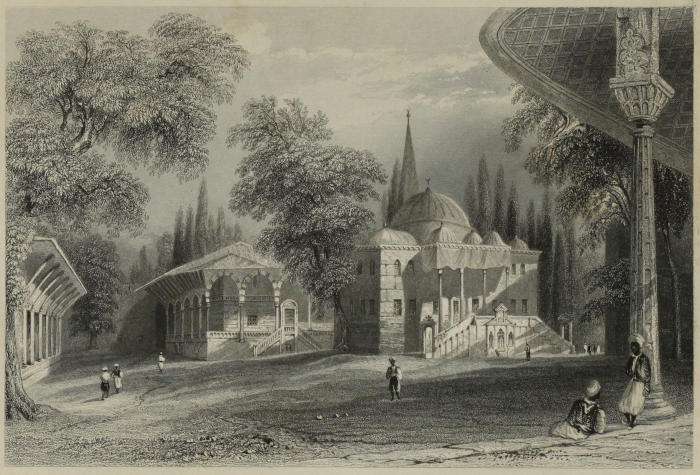
THIRD COURT OF THE SERAÏ BOURNOU.
W. H. Bartlett. J. B. Allen.
London. Published for the Proprietors, by Geo: Virtue, 26, Ivy Lane, 1839.
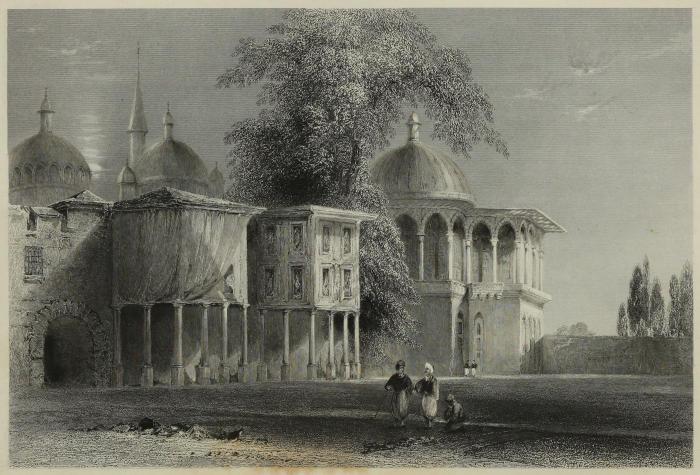
FOURTH COURT OF THE SERAÏ BOURNOU.
QUATRIÈME COUR DU SÉRAI BOURNOU DER VIERTE HOF DES SERAI BOURNOU
W. H. Bartlett. S. Bradshaw.
London. Published for the Proprietors, by Geo: Virtue, 26, Ivy Lane, 1840.
The elaborately tesselated pavement beneath, apparently intended to represent the reflection of the roof, is composed of curious stones, cemented together with some preparation, which, in its present state, appears as though liquid gold had been used to connect the different portions; and the effect of the whole is so extraordinary, so sumptuous, and so totally unlike any thing that can be seen in Europe, that it is presumed that any apology for this somewhat prolix description will be deemed unnecessary; and the rather, that very few Franks have yet penetrated into the mysteries of this stronghold of the Mahommedan Emperors. The court into which this magnificent gate gives entrance, contains the Throne-room and the Library. The former is the State Reception-room in which Abdul Hamet Khan, the father of the present Sultan, received the European ministers, and the Great Officers of the Empire on all occasions of ceremony. It is a handsome building, surmounted by a dome, and approached by a double flight of steps, having a fountain in the centre, and forming a terrace, protected by an awning of crimson silk. The interior is simple in its arrangement, and perfect in its proportions. The ceiling is heavy with arabesques, and rich with gilding; and the shadows of the mighty maples and thickly-planted cypresses which overhang it, tend to increase its beauty.
The Imperial Library occupies a range of kiosques in the Saracenic taste, with open peristyles, whose columns support a row of arches of the most graceful dimensions, and is said to possess treasures in manuscripts of untold value; but the hour is not yet arrived when those treasures will be laid bare to the research of the student, and the antiquary, the philosopher, and the man of science. Meanwhile, the coup-d’œil is charming; and it is almost with regret that the visitor finds himself hurried on to the fourth court, containing the beautiful edifice sometimes called the Kiosque of Bagdat. Here it is asserted that the jewels of the Constantines, and the treasures of all the preadamite Sultans are secured; that the towers are vaulted, and that each is a mine of wealth. Here also, it is said, that rebellious beauties have pined away a joyless existence, when they have been bold enough to oppose the power of their personal attractions to the despotic pleasure of a sensual master, who would not destroy his own hope while there remained a prospect of subjecting their distaste to his arbitrary will.
Beyond the fourth court is situated the “Garden of Delight,” in which stand the gilded kiosques appropriated to the harem, and the young princes of the Imperial house. Here, all is a confusion of glare and glitter; parterres, only less gorgeous than the buildings which rise among them; and pavilions, besprent with paint and gilding, looking as bright as the flowers which blossom on every side. Clusters of roses, blooming in baskets of gilded wicker-work; fountains, murmuring sweet music under the deep shadows of overhanging boughs: and in every direction, the carefully-latticed and jealously-guarded casements of the harem, which no infidel foot may tread with impunity.
None of the ladies belonging to the household of the present Sultan inhabit the Seraï Bournou, save when he is himself an inmate of the palace; and the extensive harem is now solely occupied by half a dozen octogenarian wives of the Sultan Selim, whose age preserved them from the fate of the younger and more beautiful portion of his establishment; who, in accordance with Eastern ideas of expediency, were put to death on the accession of the present Sultan, lest they should dishonour themselves by an alliance with a subject, after having formed part of the household of the sovereign: but notwithstanding this fact, the harem is sacred, and no prying eye nor intrusive foot is permitted to disturb the peaceful repose of the worthy relicts of the unfortunate, misguided, and martyred Selim.