TURKISH HOUSES ON THE BOSPHORUS.
Reading edition
“It was indeed a wide extensive building Which opened on their view, and o’er the front There seem’d to be besprent a deal of gilding, And various hues, as in the Turkish wont— A gaudy taste; for they are little skill’d in The arts of which these lands were once the font: Each villa on the Bosphorus looks a screen New painted, or a pretty opera-scene.” Byron.
However the description of the noble poet which heads the present chapter may apply to many of the country residences on the channel, it cannot be denied that to others it is entirely inapplicable; for there are only too great a number which resemble nothing less than
“A screen new painted.”
The shores of the Bosphorus are a study—not only for their beauty, but because, in the general aspect of the dwellings that fringe them, the traveller may read a great moral lesson; for Turkey is a country where the population do not fall back upon the past, where they are almost careless of the future, and where the present is every thing. The Turk builds for himself, toils for himself, intrigues for himself, as his father did before him; and leaves his children to strive and to create in their turn with the “Inshallah!” of an earnest and unaffected philosophy. Fortune, even in the West, is a fickle tenure; but in the East, it is sometimes the mere ephemera of a day; and thus, as the Osmanli rises in that favour which alone can lend it, he at once erects or purchases a residence suited to his brightening prospects, gay with temporary ornament and evanescent decoration, whose freshness may even thus chance to outlive his prosperity. Should it do otherwise, he gladly renews the paint and the gilding, and repairs the ravages of the weather, or the effects of accident; but when, as is frequently the case, it outlasts his fortunes, he contents himself with the faded and discoloured reliques of by-gone luxury, and satisfies himself by making the dwelling habitable, and awaiting a more golden season to renew its vanished glories.
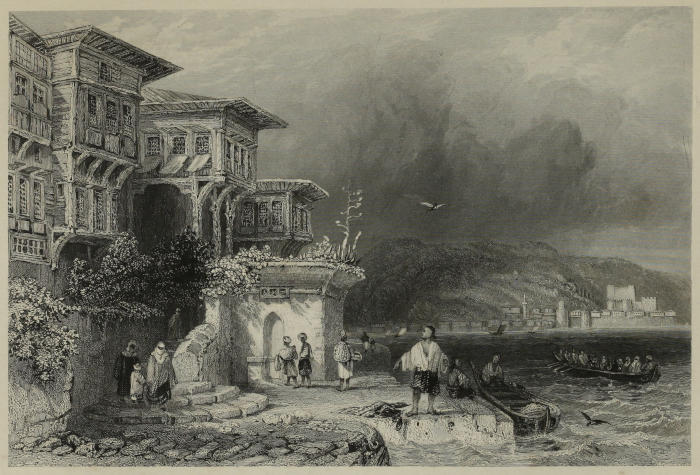
TURKISH COUNTRY HOUSES, ON THE BOSPHORUS.
W. H. Bartlett. J. C. Bentley.
London. Published for the Proprietors, by Geo: Virtue, 26, Ivy Lane, 1838.
Thus, as the light caïque of the observer skims over the ripple, the circumstances of almost every householder on the Bosphorus may be ascertained by the appearance of his dwelling. The residence of the favourite and the courtier is indeed a “wide extensive building,” over whose front is “besprent a deal of gilding, and various hues.” The lattices of the harem are gaily painted, the terraces are bright with flowers, the marble steps against which the blue ripple chafes in the sunshine are thronged with attendants, and the caïque that awaits its owner at their base is like a fairy bark, glittering with gold and crimson. Arabesques adorn the walls, and pretty kiosques peep from among the leaves of the tall trees of the extensive gardens; the perfume of flowers and the sounds of music come blended along the water, and the very atmosphere breathes prosperity.
The discarded Bey and the disgraced Minister boast dwellings as stately and as proud, but the trace of change is over all. A heavy hand has fallen upon the edifice, and the bright colours have faded beneath its pressure. Grass grows upon the marble terraces; the wind finds its way into the apartments through shivered glass and shattered lattices; and a certain parade of decay, which leaves an impression of design upon the mind, is palpable throughout.
But the empty residence of the exile tells a far sadder tale. There all is real and unstudied ruin; the grass and weeds are rank in the fissures of the pavement; the hingeless shutters rattle in the wind; the mouldering roof no longer excludes the rain, which forms a thousand discoloured currents through the faded frescoes of the desolate and echoing apartments; doves build in the galleries, and locusts are loud among the garden-branches; theirs is the only song that awakens the deserted groves.
The houses of the Armenians and Greeks (the raïahs, or vassals of the Porte,) are universally painted a dull red, or lead colour; the gayer tints in which the Turks delight being prohibited to them, while the Jews are compelled to confine themselves to black; and among the wealthier raïahs it is common to paint a residence which is unusually spacious, in two distinct colours, to produce the effect of its being separate dwellings.
Nothing can be more irregular, and consequently more picturesque, than the style of building on the Bosphorus; for the Turks are such sincere lovers of nature, that they invariably throw out a bay, or contract a wing, when by so doing they can secure a fine view, or a pretty peep, not otherwise attainable; and as these present themselves at every turn of the channel, the Turkish country houses have much the appearance of buildings that have been put together by fragments.
When it is remembered that these houses are backed by a chain of fertile and richly-wooded hills, forming a succession of gardens and pleasure-grounds, and are washed by the rapid current of the Bosphorus, it will be readily conceded that they present a coup-d’œil probably unique; while the salubrity of the air, the elasticity of the atmosphere, the constant movement upon the channel—which may, without affectation, be denominated the high-way of the capital—and the splendid scenery which they command on all sides, render them, as summer residences, well worthy of the universal popularity which they enjoy.
In many instances the buildings are raised along the extreme edge of the shore, and are unprotected, even by a terrace; and the upper stories generally projecting beyond the basement, they hang over the water in a singular manner. Nor do they always enjoy this privilege with impunity, as the channel is several feet in depth under their very windows; and it not unfrequently happens, that the wind failing when a vessel is beating on a “tack,” and the current impelling it onward with a force which it is unable to resist, portions of the rigging become entangled with the houses, bowsprits enter the windows of the saloons and carry away the roof, and the most ridiculous accidents are the result. But the inhabitants will not sacrifice a positive enjoyment to a probable evil; and thus they build their water-palaces as daringly as though no intrusive bark ever parted with its gleaming prow the bright waves over which they fling their long dark shadows.
Not the least beauty of these singular residences consists in their hanging terraces, frequently latticed in for the convenience of the harem, which make the Bosphorus fragrant with the breath of flowers; and the little canals terminating in arched entrances for the caïques of the establishment, which are thus admitted to a large basin in the centre of the court-yard, where the fair inhabitants may embark and disembark at their pleasure, without being subjected to the profaning gaze of the passers-by.
The interior of these interesting dwellings is generally fitted up with much taste, and always with a careful regard to cheerfulness. The walls are painted in frescoes, with landscapes, fruits, or flowers; and the ceilings are always beautifully ornamented. In short, they are as fanciful, and almost as frail, as fairy-palaces.