THE PALACE OF BELISARIUS.
Reading edition
“To what base uses may we come at last!” Shakspeare.
The ruin known by the name of the Palace of Belisarius, is situated at an angle of the city walls; and, according to the authority of the learned Constantius, Archbishop of Senaï, and Ex-Patriarch of Constantinople, (still in exile for his work on the Antiquities of Byzantium,) it was one of the Imperial residences of the first Constantine; and he asserts, that it owes its present designation to the fact of its being placed in a quarter of the city called Balata, a corruption of Balati, or the Gate of the Palace, which has gradually grown, from the hasty and undigested impressions of Frank travellers, into the Palace of Belisarius. There are the remains of a lofty and handsome gate-way, and the disposition of the masonry is highly extolled by architects; but to the mere tourist, the ruined Palace of Constantine, reft of its old-world associations, is possessed of little interest; and that little is absolutely negatived by the price which he is compelled to pay for a visit to its neighbourhood. To all oriental travellers it will be sufficient to state that the building has been given up to the Jews as a pauper-hospital, for them to understand at once that it is almost unapproachable, being the head-quarters of filth, and the hotbed of pestilence, where every sense is pained by scents and sights calculated to inspire dread and disgust.
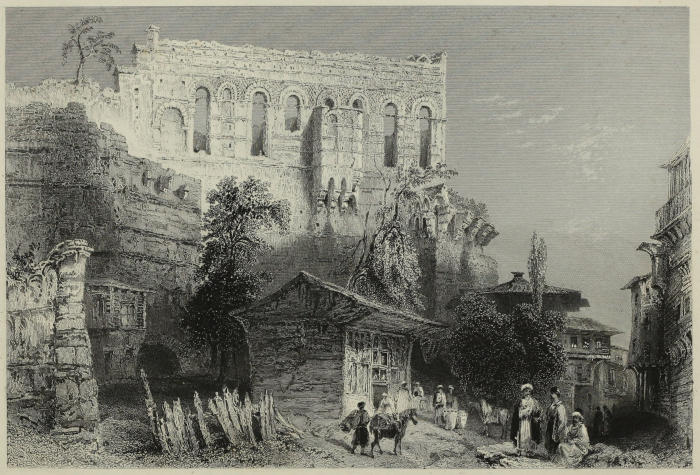
PALACE OF BELISARIUS.
PALAIS DE BÉLISAIRE. DER PALLAST DES BELISARIUS.
W. H. Bartlett. F. W. Topham.
London. Published for the Proprietors, by Geo: Virtue, 26, Ivy Lane, 1839.
Masses of the fallen masonry cumber the foundations of the ruin, and every niche is alive with its noisome tenant; here it is a sallow and fleshless crone, whose lean and shrivelled hands can with difficulty disengage themselves from the filthy rags which are wrapped about her, in order to stretch themselves supplicatingly towards the stranger; while her cracked voice screams out in doggrel Spanish a petition for relief, as servile as it is eager; there it is a reckless child, with the marked features of its race, rolling naked under the hot sunshine, and gambolling with the wretched and half-starved dogs of the miserable colony. On one side the visitor is jostled by disease, and on the other persecuted by importunity; while a number of wretched houses have grown up about the ruin, whose dilapidated roofs, shattered lattices, and windows stuffed with rags and grass to exclude the weather, are in melancholy keeping with their inhabitants.
Under these circumstances it will readily be believed that a visit to the desecrated palace of Constantine requires a painful effort on the part of an European traveller, whose eyes are taxed with the contemplation and contact of the most nauseous objects; and whose sympathies cannot fail to be excited by a congregated misery which he must feel his utter incapacity to relieve. Nor can the most determined antiquary hope to discover any relic of old to repay him for even an hour’s sojourn within the ruin, when he remembers that it is thickly tenanted by a horde of necessitous and keen-witted Hebrews, who are familiar with every recess of the dilapidated edifice.
From afar off the crumbling pile is a noble and majestic object, but, like many and more familiar things, it will not bear a nearer contact without losing all its best attributes. Close beside it the common sewers of the city empty themselves into the port; and, altogether, it may well be said, in the words of Shakspeare—
“It is unsavoury, and smacks not with our humour.”