ENTRANCE TO THE BLACK SEA.
Reading edition
“Then by the lightning’s blaze to mark Some toiling tempest-shatter’d bark; Her vain distress-guns hear: And when a second sheet of light Flash’d o’er the blackness of the night— To see no vessel there!” Coleridge.
The entrance to the Black Sea, as seen from the summit of the Jouchi-Daghi, or Giant’s Mountain, (the spot selected by the artist,) is the grandest coup-d’œil on the Bosphorus. As the line of shore terminates on either hand, the picturesque and jagged rocks suddenly yield to a low and sandy stretch of coast; and beyond are visible the “Blue Symplegades,” heaving up their dark and irregular masses from the encircling waters of the Sea of Storms, which, stretching far away on all sides, is ultimately blent with the horizon.
The ruins of two Genoese Castles crown the abrupt peaks of a portion of the mountain-chain of which the Jouchi-Daghi is the monarch. One of them, whose mouldering walls descend nearly to the lip of the channel, has its beautiful legend of womanly high-heartedness; for a tale is there recorded of a young fair girl, scarcely yet arrived at the first years of womanhood, the daughter of the Governor, who defended the fortress for three entire days after the death of her father, who fell mortally wounded by a poisoned arrow, as he was gallantly meeting the enemy; and with a diminished and despairing garrison, boldly held the castle until she was herself killed in its defence. Fable has now peopled the gray old pile with supernatural visitants; but if the spirit of that high and heroic girl still presides within the walls, their contact can scarcely be dreaded.
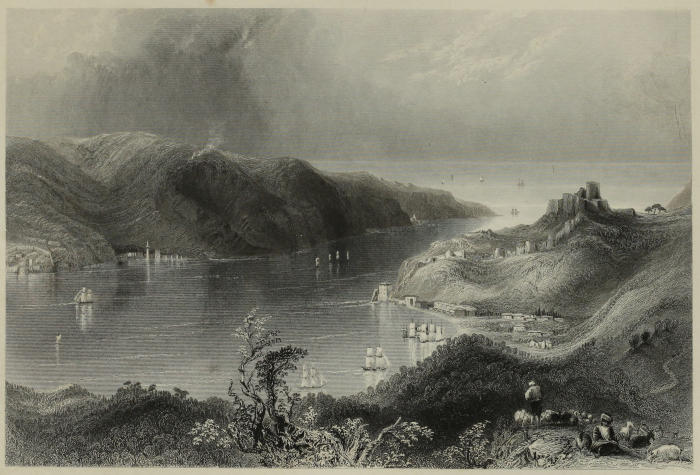
ENTRANCE TO THE BLACK SEA. (From the Giant’s Grave.)
ENTRÉE DE LA MER NOIRE, VUE DU TOMBEAU DU GÉANT. SCENERIE DES SCHWARZEN MEERES VON DER RIESENGRUFT HER.
W. H. Bartlett. S. Bradshaw.
London. Published for the Proprietors, by Geo: Virtue, 26, Ivy Lane, 1838.
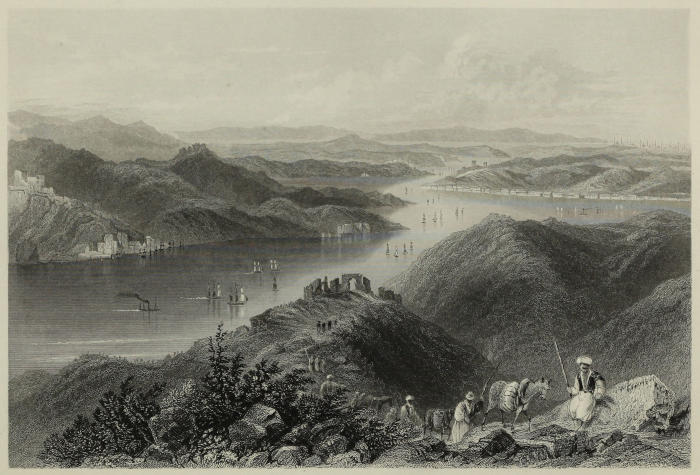
THE BOSPHORUS. (Opposite the Genoese Castle)
LE BOSPHORE VU DU COTÉ OPPOSÉ AU CHATEAU GÉNOIS. DER BOSPHORUS, GEGENÜBER DEM GENUESISCHEN SCHLOSS.
W. H. Bartlett. E. Benjamin.
London. Published for the Proprietors, by Geo: Virtue, 26, Ivy Lane, 1839.
It is impossible to write of the Bosphorus without enthusiasm, for both its historical and fabulous associations serve to deepen its actual beauty; while the endless variety of its perspective keeps the eye and the mind continually on the stretch, never cheating either the one or the other of the anticipated feast. Could it be contemplated in its entire length, and swept from sea to sea by one long gaze, much of its charm would necessarily be lost with its novelty; but as it winds in graceful curves between its enchanting shores, it is like a chain of cunningly wrought gold, of which, as it uncoils, every link appears more beautiful than the last. The caïque of the traveller is one moment overshadowed by the tall trees of the “Hill of the Thousand Nightingales,” and in the next instant it is darting past a brightly-painted palace; now it is with some difficulty urged forward against the eddying Sheitan Akindissi, or Devil’s Current, where the mad waves leap to its high and pointed prow; and now, as by some sudden spell, it is again gliding over a surface blue, and clear, and almost rippleless. Valleys, gay in their eternal greenery, are succeeded by steep and wooded hills; villages fringe the little bays, and villas crown the picturesque and fantastic heights; a double line of fortresses stud the shores from the castle of Mahomet to the entrance of the Black Sea; cemeteries, contrasting their white head-stones with the dark foliage of the cypresses by which they are overshadowed, lean on the hill-side, and stretch to the very edge of the channel; and between and among these objects, pass, in perpetual movement, the gilded galleys of the Sultan, the splendid barges of the ministers, the graceful caïques of the veiled beauties of the city, ships of war, Arab barks, quaint in their form and covering, merchant-brigs, and every description of small craft; now seeming, in the distance, to be plying among the trees by which the channel is overhung, and anon shaking out their white sails to meet the shifting wind, and bounding into the centre of the stream.
From the European side of the strait, immediately opposite the old Genoese Castle, the coup-d’œil is, perhaps, even more beautiful than on that of Asia, for the traveller commands from thence a scene of unparalleled variety, as he looks towards Constantinople. Far away, on the extreme right, cluster the domes and minarets of the hill-seated city, while the distant line is continued by the shores of Asia Minor, dominated by Mount Olympus, and sweeping the horizon until the eye is unable to follow them. At their base lies the sea of Marmora, looking calm and sunny like some inland lake; while the foreground of the picture is formed by the undulating banks and glorious channel of the Bosphorus—castled rocks, laughing valleys, bays, where the busy caïques come and go like aquatic birds over the ripple—and gay green woods, which change both in form and in colour as the fresh breeze sweeps through their leafy depths. Nor is it the least curious feature of the scene, that, as the boat of the wanderer dances upon the channel-wave, his ear catches the gay sounds of laughter, or the voices of his fellow-men, from both sides of the stream—alike from the shores of Europe and of Asia—and he feels himself to be, for the moment, a connecting link between two distinct portions of the earth!
From the time-worn ruins of the old Genoese Castle, the opposite shore is full of scenic interest. A succession of small fortresses, niched into the débouches of several of the low valleys at the base of the rocky chain, gleam out gay and white against the dark background of the mountains, and pretty villages, and overhanging groves, are mirrored in the blue waters of the channel.
Therapia and Buyukdèrè, (or the Great Bay,) however, deserve more especial mention, being the favourite summer residences of the European Ambassadors, and, consequently, the occasional focus of the Frank aristocracy. Both are beautifully situated: Buyukdèrè stands boldly near the very junction of the two seas, while Therapia is less exposed to the tempest-blasts of the “storm-vexed Euxine,” by occupying a station higher up the channel. It is backed by a richly-wooded hill, on which the houses of the upper town have, however, considerably and very picturesquely encroached. And here the English and French embassies, since the great fire of Pera, when the ambassadorial residences were destroyed, have entirely established themselves, only occasionally visiting the city; and hence the commerce of the place has become very respectable, and the appearance of its inhabitants acquired no slight tinge of the restlessness and business-like manner of their Frank visitors.
The lower town occupies the edge of a small bay, the point of land by which it is terminated standing out abruptly into the channel, as if for the mere purpose of effect, and a long terrace stretching away from its opposite face. On this terrace stand the two ambassadorial residences; the “Palace” of the English Legation being a small, half-ruinous, irregularly-gabled wooden building, without “mark or likelihood,” and that of France, by comparison, a handsome and spacious edifice, with a noble garden.
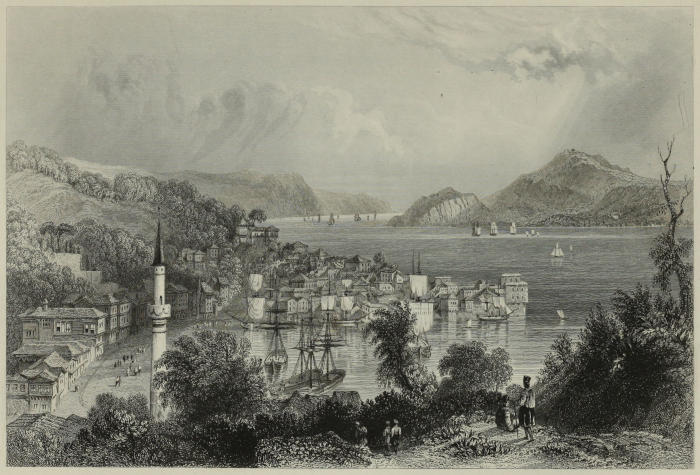
THERAPIA AND THE GIANT’S GRAVE.
THÉRAPIA ET LE TOMBEAU DES GÉANS. THERAPIA UND DIE RIESENGRUFT.
W. H. Bartlett. R. Wallis.
London. Published for the Proprietors, by Geo: Virtue, 26, Ivy Lane, 1839.
At Therapia the Sultan has both a summer-palace and a kiosque, each touching upon the channel. The former is a plain unpretending pile, looking extremely like a manufactory, scantily furnished, and but rarely visited by its Imperial owner; but the grounds attached to it are most magnificent, and extend over three leagues of land, the whole of which is enclosed by high walls. The ornamental timber is of the rarest and finest description, and the entire face of the height behind the palace is thickly and richly wooded, while fountains, kiosques, and terraces, abound. These gardens are generally visited on horseback, in consequence of their great extent; and nothing can be more delicious on a sultry day, when the mountain-tops are steaming under the hot sunshine, than to loiter among the groves, or along the majestic avenues of these lordly grounds, with the leaves quivering above your head, and the long shadows lying dark and cool upon your path. The kiosque is an octagonal, brightly-painted, many-windowed retreat, commanding views on all sides of the Bosphorus and its shores, and overshadowed by a couple of very fine maple-trees. Buyukdèrè is altogether on a grander scale; backed by a noble meadow, gay and green, at whose extremity is seen the stately aqueduct of Baghtchè-Keuï, it extends gracefully along the lip of the shore at the base of a sloping ridge, (the terminus of one of the branches of Mount Hæmus,) rich with vineyards and gardens. Its houses are light and handsome, fringing the channel for a considerable distance, and only parted from it by a stately terrace of immense length and breadth, the favourite promenade of the inhabitants.
Nothing can be more beautiful than the view from Buyukdèrè on a summer night, when the intense blue of the sky is reflected by the waves of the “ocean-stream,” which take a fringe of pearl as they heave themselves gently against the terrace, and then break away in light; while the moon, clear, and polished like a silver shield, floods earth and sea with lustre, and the stars tremble brightly about her, as though they were too glad for rest.
But the sublimity of a tempest from the same spot, as it rolls onward from the Euxine to the Bosphorus, mocks at description. Fold upon fold, shade upon shade, the dense vapour rolls along, wrapping itself about the hills, and draping them in darkness; the distance becomes blotted out—space is no longer a feature of the scene—and as the awe-inspiring storm-cloud spreads itself over every object, the hoarse voice of the blast sweeps onward with it, deepening its terrors; while, through the impenetrable gloom, in every lapse of the wind, the ear is deafened by the wild dash of the angry billows, as they chafe against the rocky barriers of the coast!
The nerves must be strong indeed which would not be shaken in such an hour, when standing on the Jouchi-Daghi, amid three storm-tossed seas, and under a sky freighted with terrors; a sail, perchance, labouring in the distance, tempest-shattered, but toiling on for life, revealed only at intervals as the fierce but transient lightning cuts like a fiery scymetar through the thick vapour, and lost at last, none can tell how nor where, amid the shrill requiem of the sea-birds.
Nor must the Giant’s Mountain itself be passed over in silence, claiming, as it does, the notice of the traveller, not more by its stateliness of outline, than by its romantic legend; both the one and the other being occasionally so enveloped in clouds, that it is difficult to determine the exact features of either.
This noble height is, during the summer months, a favourite resort of the Franks, who, fanned by the cool breezes from the Black Sea, and regaled by one of the finest views in nature, give pic-nic parties and dances under the shade of the trees, or in the neat wooden tenement appropriated to visitors, near the Tekiè, or Convent, which occupies its summit. The Dervishes who inhabit this mountain-hermitage derive no inconsiderable portion of their revenue from the presents tendered by their guests, and willingly show to the stranger their small but well-kept chapel, and the grave of their gigantic hero, who has given his name to the spot; and with the most devout and solemn simplicity, the narrow oblong enclosure, thickly planted with rose and jasmine-trees, called the “Giant’s Grave,” is then pointed out by the simple recluses. It is about fifty feet in length, guarded with the most religious care, lighted by a lamp which is constantly kept burning in one of the alcoves, and rich in propitiatory offerings of strips of cloth, and rags of every tint and texture.
The Musselmauns affirm that the “illustrious dead” was a Dervish, whose sanctity equalled his stature; a belief which does him infinite honour, as he is said to have seated himself on the summit of the mountain, while he bathed his feet in the cool waters of Buyukdèrè. His mode of interment must, consequently, have been similar to the planting of a flag-staff, as the grave is not too long to admit the breadth of his shoulders; and this perpendicular burial can alone account for its comparatively pigmy dimensions—unless, indeed, the mountain is hallowed only by containing a mere fragment of his remains. His history, and the epoch in which he flourished, are alike unknown; but as his sanctity is undoubted, they are minor facts, unworthy of analysis.
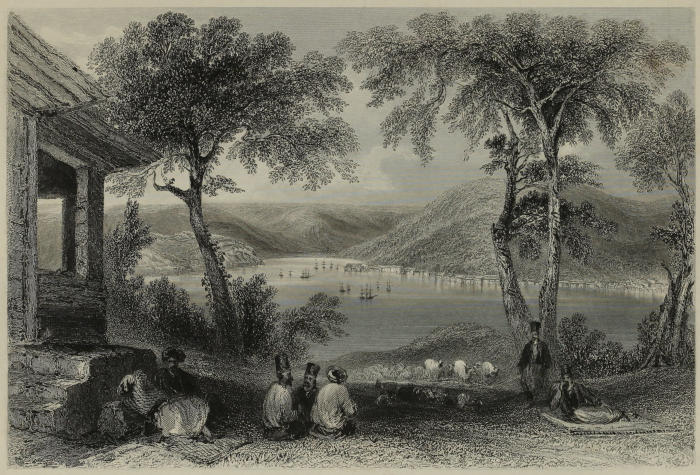
BUYUKDÈRÈ. (From the Giant’s Grave.)
BUYUKDÈRÈ, VU DU TOMBEAU DU GÉANT. BUYUKDÈRÈ VOM RIESENGRABE HER.
W. H. Bartlett. S. Bradshaw.
London. Published for the Proprietors, by Geo: Virtue, 26, Ivy Lane, 1839.
Such is the Mahommedan tradition; that of the Christians, if quite as apocryphal, is at least much more poetical.
Their legend saith, that the grave of the Jouchi-Daghi contains the bones of a huge and ferocious giant, to whom the Symplegades were thralled vassals; and who, from his station on the mountain-crest, watched the approach of every vessel that ventured to brave the billows of the Euxine. It was at his beck that the subject-islands wandered over the waters, and crushed between their rocky sides all those unwary barks which, tempted by the vision of a new El Dorado beyond the channel, sought to force the passage of the Bosphorus. It was he also, who, fearful lest any daring vessel might escape through the rocky barrier during his transient and infrequent slumber, created that swift and dangerous reaction of the tide midway of the channel, well known as the “Devil’s Current;” while he is likewise accused of devouring drowning mariners, conjuring up tempests, and of having tinged the waters of the Black Sea by performing his ablutions in its polluted bosom!
Such is the legend of the Jouchi-Daghi, and such the glorious scene spread out beneath it.