YENI DJAMI.
Reading edition
“Lightly tread, ’tis hallowed ground.”
The beautiful mosque of Yeni Djami, known also as that of Sultana Validè, was built by the mother of Mahomet IV., and is esteemed one of the most magnificent in the capital. The minarets are peculiarly elegant, each being encircled by no less than three galleries, of the most minute and thickly-perforated sculpture, in the Saracenic taste. The portal is of ponderous size, and the brazen gates are thickly studded with mother-of-pearl; three lofty arches enclose an open peristyle, terraced in, and sufficiently spacious to contain more than a hundred persons. The double range of exterior galleries, running along the façade of the temple, are of fine and delicate workmanship, and the arches by which they are formed, are chastely and beautifully designed. The principal dome springs majestically from the centre of the spacious roof, and rests upon four lesser ones, which appear to lift it to the clouds; while the tomb of the illustrious founder nestles beneath the more lofty edifice, comparatively minute in size, but equally elegant in construction.
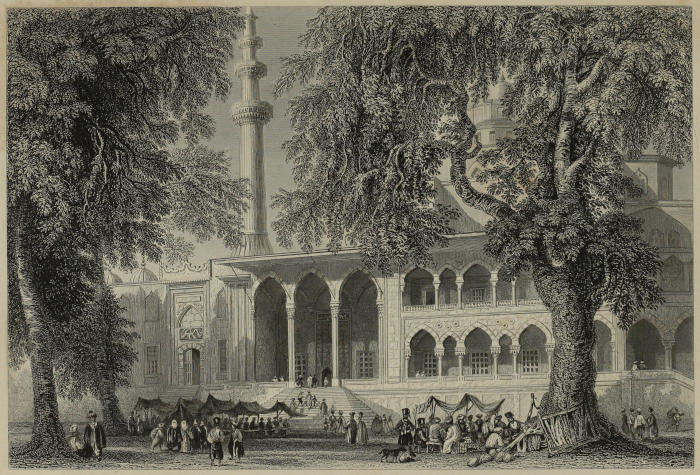
YENI DJAMI, OR MOSQUE OF THE SULTANA VALIDÈ.
W. H. Bartlett. J. C. Varrall.
London. Published for the Proprietors, by Geo: Virtue, 26, Ivy Lane, 1838.
The mosque stands near the edge of the harbour, and its court stretches down almost to the water. It is overshadowed by two of the most majestic maple-trees in the city, whose gnarled and knotted trunks and fantastically twisted branches bespeak them of a date coeval with that of the gleaming temple which they so greatly embellish. Beneath their long cool shadows congregate groups of idlers, attracted thither by the calm stillness and refreshing breezes; and there they loiter for hours, erecting in the court their awnings of striped cotton, and spreading their mats for the mid-day siesta; while the melon and sherbet-venders ply their fragrant trade, and the perfumed vapour of the Salonica tobacco exhales from many a chibouque.
The court of Yeni Djami generally presents the characteristic scene which I have here described; and of the mosque itself, the Turks have a popular tradition, that it was built from the produce of one of the Sultana-mother’s diamond-studded slippers, piously disposed of for the purpose of its erection; a legend which doubtlessly owes its origin to the probable fact of the expenses having been defrayed from the bishmalik (or slipper-money) of the imperial lady—a national grant to the female members of the reigning family, bearing some analogy to the “privy purse” in England.