SCUTARI.
Reading edition
“——the place of thousand tombs That shine beneath, while dark above The sad but living cypress glooms And withers not, though branch and leaf Are stamp’d with an eternal grief, Like early unrequited love.” Byron.
The first object connected with the city of Constantinople visible to the voyager who approaches it from the Dardanelles, is the cypress canopy of the great Cemetery of Scutari. Its dark mass of funereal foliage rests like a thundercloud “no bigger than a man’s hand” against the clear blue sky for a time; and then, as the vessel ploughs her way through the yielding waters, gradually looms out larger and larger upon the horizon, until the mind begins to take in some idea of its vast extent.
This extraordinary necropolis, perhaps the largest and most picturesque in the world, stretches its cold and silent shadows over hill and valley, covering upwards of three miles of country with the sable livery of death, and shutting out the sun-light from unnumbered graves. The Moslem, when he breathes his last, may truly be said to have sunk into “the quiet grave;” for his ashes are never desecrated for the sake of the poor space which they fill up; no second tenant ever crushes yet more deeply the remains of the original occupant of each narrow tomb; and thus the burial-places yearly extend themselves in every direction, and form a prominent feature in the Turkish landscape.
Nothing can be conceived more solemn than the effect of the deep and chilling gloom of the Cemetery of Scutari, with its thousand intersecting paths dimly perceptible in the noonday twilight; and its million head-stones leaning against each other, as though to dispute every inch of the thrice-holy earth they occupy.
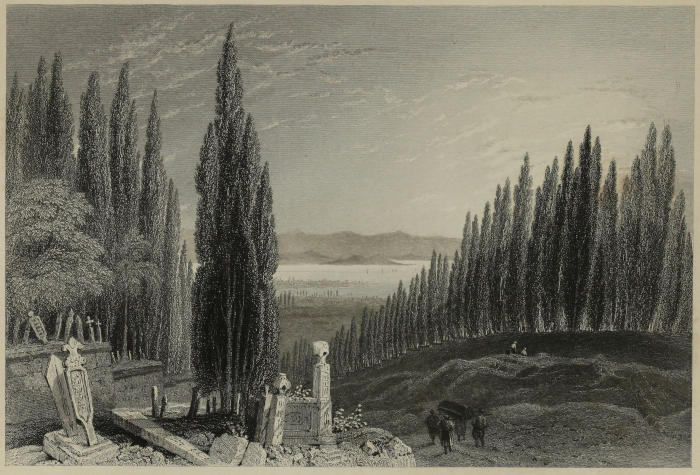
CEMETERY OF SCUTARI.
W. H. Bartlett. J. T. Willmore.
London. Published for the Proprietors, by Geo: Virtue, 26, Ivy Lane, 1838.
As the Turks have a superstition, in which they place implicit faith, that ere the end of the world the Mahommedans are to be expelled from Europe, they universally covet a grave in this Asiatic wilderness of tombs, in order to preserve their ashes from the contaminating contact of the giaour; and thus, year after year, the cypress forest encroaches on the purple vineyard, and the golden cornfield; the blossoming fruit-trees, and the graceful maize waving its long and flexible leaves to the breeze, gradually disappear. The scythe of the reaper and the knife of the vintager are no longer busy; for the harvest now preparing where the husbandman once toiled, can be gathered in only on the Last Day!
It is the custom at every Turkish burial for the officiating Imaum, or priest, to plant one cypress at the head and another at the foot of each grave; and hence, although the greater number necessarily perish for want of air and space, those which survive still stand sufficiently close to form a dense and gloomy forest. In a few instances, open spaces have been left (similar to that selected by the artist) in order to promote the entrance of the exterior air, and thus prevent the danger of infection from the exhalations of the graves; but the greater portion of the cemetery is one unbroken stretch of death-cumbered gloom, where turbaned head-stones and lettered columns gleam out among the dark boles of the cypresses like spectres of the past. Many a lesson may be learnt within the silent precincts of this vast necropolis. The gilded tombs enclosed within railings, and surmounted either by a rose-branch to designate the mistress, or a turban to indicate the master of the family, surrounded by the same emblems more minutely executed, are pompously inscribed with the names and titles of some powerful and wealthy race, who lie apart, and moulder unmingled with more common dust; though the depth of their slumber and the quiet of their rest are enjoyed as fully by the tenants of the less aristocratic graves on every side. The time-worn tablet, whose weight has pressed down the crumbling soil beneath it until it has lost its hold, lies half buried among the rank grass on one hand; while on the other, gilded and dazzling columns tell their tale of death, undefaced by the foul weather-stains which have made their predecessors recordless; and thus the work of years goes on—generation succeeds to generation even in this city of the dead—there lie the departed of yesterday and to-day, and there is “ample space and verge enough” for those who are to follow to-morrow. But a darker consciousness even than this grows on the wanderer who penetrates the depths of the still necropolis, as he pauses beside a group of lofty and turban-crested columns, each rising from a small square slab of stone—they tell of death, but the minute block of granite or marble at their base does not indicate a grave, for there is not the space allowed, narrow as are the limits needed, to lay the limbs of a human being decently and reverently in the earth. The eye of the stranger has not deceived him; for each of those small stones covers only the head of a victim to his own folly, or to the intrigues of others, whose dishonoured trunk found a fouler resting-place—some baffled politician, or betrayed traitor, or hated rival, cut off amid his dream of pride and power, and denied even the grave which would have once more levelled him with his kind. What a mockery are the elaborate turbans carved above each dissevered head; minutely tracing forth in their form, and fold, and size, the rank of the poor victim of whom a mere portion lies beneath, and serving as a perpetual scoff—the more bitter, that it is wordless! but the graves of love are there also, flower-strown, and tended by the gentle hand of regret and tenderness; and it is a relief to turn to these, and to forget that any hand save That One which holds the breath of a world within its palm, has helped to people the cypress-canopied Cemetery.
Every Turkish burial-place has its local superstition, but that of Scutari is the wildest and the most poetical of them all, and must not be passed over in silence.
The Bosphorus is haunted by clouds of birds, about the size of thrushes, and of dark plumage save on the breast, where the feathers are of a pale blue; they are said to be a species of alcedo, but as the Turks will not permit them to be destroyed, and it would be dangerous for any Frank to fire on them, the ornithologist has had no opportunity of determining the fact. These singular birds are never seen either to feed or to alight; nor will they deviate from their course even to admit the passage of a caïque, when, as occasionally occurs, they are flying very low; they merely rise a few feet higher in some instances, and in others suffer the boat to cleave its way through them without appearing to heed the fact. They fly rapidly, and in perfect stillness, from the Black Sea to the Propontis, where they instantly turn and wend their way back to the Euxine; arrived there, they wheel again, and return to the Sea of Marmora; and thus, from day-dawn till twilight, from day to day, and from month to month, they come and go along the channel without any apparent end or aim—without an instant’s repose, without food, and without the slightest deviation from their course.
No instance of one of these singular birds having been picked up dead has ever occurred; and so mysterious and unearthly are their habits, that they have obtained the appellation of the “damned souls,” from a tradition, partially believed, that they are the condemned spirits of the unholy ones, whose ashes have found a resting-place in the great cemetery, but whose spiritual essence is not permitted to mingle with the purer immortality of their less sinful neighbours. This superstition is supposed to have arisen from the circumstance, that, during a time of tempest, when the storm-wind will not permit the migratory flight of the birds along the channel, they fly skrieking to the cypress forest of the necropolis for shelter; and as these are the only periods at which they are known to emit a sound, the credulous in such matters—and in the East they are not few—have decided that their sharp thrilling cry is one of agony; and that they are compelled, during the continuance of the elemental warfare, to narrate to each other the catalogue of crime which has cut them off from the repose of the grave, and condemned them to everlasting wandering over the face of the waters!
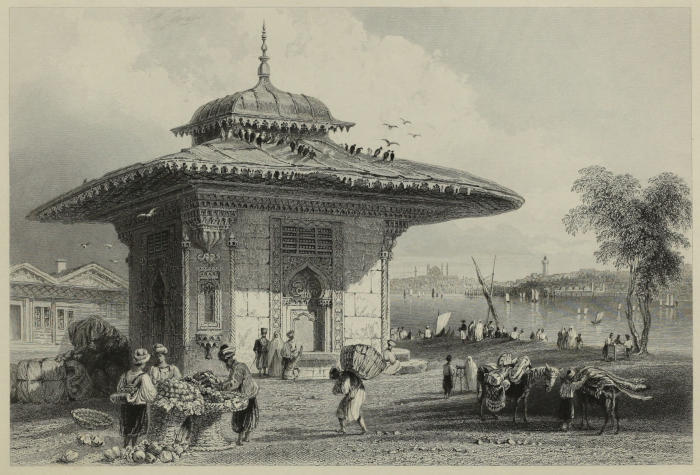
FOUNTAIN AT SCUTARI.
W. H. Bartlett. R. Wallis.
London. Published for the Proprietors, by Geo: Virtue, 26, Ivy Lane, 1839.
But in describing the peculiarities of the great Asiatic Cemetery, the “Silver City” of Scutari, to which it is so striking an appendage, must not be passed over without notice. Its gleaming houses crowd the graceful point of land which forms the termination of the mountain-chain that shuts in the Asian side of the Bosphorus, and then falls back only to be bathed at its base by the wider and wilder waves of the Sea of Marmora. Nothing can be imagined more perfectly beautiful than the position of the town of Scutari, as it sweeps round this graceful point, and throws the long shadows of its arrowy minarets far across the ripple of the Bosphorus towards the European shore; and then, where the rocky coast, at the base of which it is set like a pearl, recedes before the billows of the Propontis, is itself overshaded by the majestic Bulgurlhu Daghi, dark and frowning, and standing out amid the clear blue of heaven in stern defiance, a mark for the storm and the tempest; while as the sun-light falls upon the shimmering waters at its foot, towards which the hanging gardens of the principal dwellings lovingly incline, clothing the rocky descent with fringes of changeful embroidery, its graceful outlines are lengthened or widened in fairy circles as the fitful breeze plays over the surface of the glittering sea. Clusters of houses are framed in by luxuriant foliage; imperial kiosques, painted in rainbow tints, give an air of midsummer gladness to its shores; verdure descends in rich masses to the very lip of the two seas by which it is laved; and not an arrow’s flight from its quay stands the “Maiden’s Tower,” a small and picturesque castle, built upon so diminutive a rock that its foundations cover the whole surface, and give to the edifice the appearance of floating upon the waves.
This little fortress, with its lofty tower and castellated walls, is also the subject of a legend; and thus it runs:—A certain Sultan, whose name is now forgotten, had a most fair daughter, the only child which had been vouchsafed to him by the Prophet, and on whom his heart was anchored, as on his best hope. Beautiful as a Houri, graceful as a Peri, and gay as the summer wind when it sweeps over the rose-garden of Nishapor, the girl was growing into womanhood, when the anxious father consulted a celebrated astronomer on her future destiny; who, after having carefully turned over the party-coloured pages of the mysterious volume of human fate, uttered the frightful prophecy, that, in her eighteenth year, she was to become the prey of a serpent.
Horror-stricken at so dreadful a denunciation, the agonized Sultan caused the erection of the Guz-couli, or Maiden’s Tower, wherein he immured his lovely daughter; in order, by thus cutting her off from the very earth until the fateful period should be overpast, to remove even the possibility of the threatened calamity. “But,” pursues the legend, “who can war against his kismet?[22] Who can control his felech?[23] What is written, is written; and the page of the future had been read.” Death came to the princess in a case of fresh figs from Smyrna, in which a small asp had been concealed; and she was found on her eighteenth birth-day dead upon her sofa, with the fruit beside her; and the reptile, like that which poisoned the crimson tide in the veins of the imperial Cleopatra, lying gorged and loathsome upon her bosom!
The tale is a pretty one; but there is another tradition, which terminates somewhat differently, and which clothes the serpent in the garb of a young Persian prince, whose curiosity having been aroused by the marvellous whisperings around him of the matchless beauty of the imprisoned fair-one, had dared to row his caïque by night beneath the very walls of the Guz-couli; and had contrived an interview with the captive, won her heart, and contrived by means of a silken cord and a strong arm, to carry her off at the very crisis of her fate! The reader can select his own version of the “eventful historie.”
The Fruit-market of Scutari touches on the shore; and in the midst stands an ancient fountain, of simple but pleasing architecture. The volume of water is very great, and its quality almost unrivalled; it descends from the dusky mountain of Bulgurlhu; and from some superstition, which it would be difficult to comprehend, the Turks never permit its supply to be appropriated by the inhabitants of the European shore of the channel, even on occasions of the greatest drought; and thus, in 1836, when water was frightfully scarce, and was transported from the villages at the very mouth of the Black Sea to the thirsting city, at immense cost both of time and money, the fountain of Scutari was suffered to run to waste, and to pour the overflow of its tempting and abundant streams into the Bosphorus.
The view from the market across the Channel is very beautiful; and the locality in itself eminently characteristic and interesting. The profuse supply of the most luscious and delicious fruits is amazing to an European eye, while the prices at which they are sold are equally astonishing. The grapes and melons of Scutari are renowned throughout the East; its figs almost rival those of Smyrna; and there is no island throughout the Archipelago where the pomegranate is richer or more juicy. Oranges, lemons, peaches, and the delicate golden apple, which resembles that of the West only in form, also abound; and with a handful of piastres, the amused Frank, determined on a harmless experiment, may freight his caïque with an offering which would do no discredit to Pomona herself.