FOUNTAIN IN GALATA.
Reading edition
“’Tis a little thing To give a cup of water; yet its draught Of cool refreshment, drain’d by fever’d lips, May give a shock of pleasure to the frame More exquisite than when nectarean juice Renews the life of joy in happiest hours.” Ion.
The fountains of Constantinople and its environs are all more or less elegant; and among the most beautiful, both as regards architecture and ornament, may be classed the subject of the present sketch, which occupies the centre of a small square, at the foot of the steep ascent leading up from the merchant-suburb of Galata to the “Infidel Hill” of Pera.
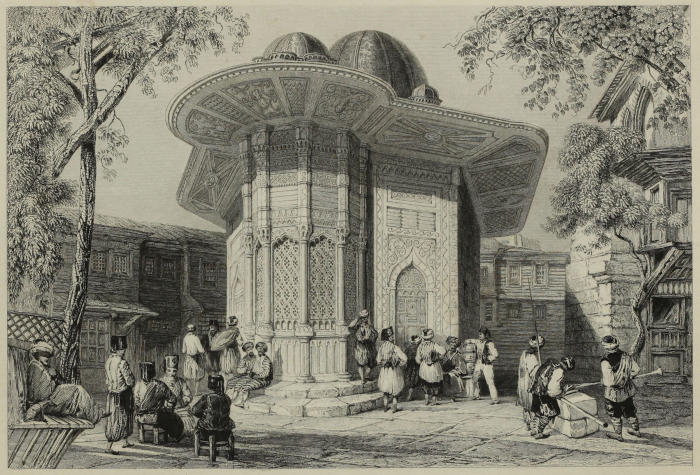
FOUNTAIN IN GALATA.
W. H. Bartlett. H. Griffiths.
London. Published for the Proprietors, by Geo: Virtue, 26, Ivy Lane, 1838.
Its form is singularly graceful and well-proportioned; and as the hand of innovation has not yet touched its massive and deeply-projecting cornice, it is perhaps as correct a specimen of the pure Moorish style as any now existing in the city. Four small domes compose the roof; and they are circled by a net-work of dentated sculpture, which gives them a light and pretty appearance, and relieves the eye as it glances upward from the face of the fountain, which is beautifully and profusely painted in arabesques, as well as the wide and undulating cornice at the base of the domes.
Five slender pillars of white marble divide the bayed front of the building into four equal compartments, which are screened to about midway of its height by a gilded lattice-work, behind whose protecting shadow stands a range of brass vessels, occupying the lip of a reservoir containing a constant supply of cool water for the use of the thirsty passenger; while on either side of this, the principal face of the fountain, stretch two receding wings, where exterior basins, fed with a flow of water which rarely fails in its volume, offer a constant and abundant mean of comfort and cleanliness to the immediate neighbourhood.
Coffee-kiosques, sheltered from the summer heats by rude wooden terraces, overshadowed by acacia-trees and wild vines, occupy a portion of the square; and the quiet-loving Moslem smokes his chibouque in luxurious repose, under the very shade of the fountain whence he draws his cool and healthful draught. Here the khamals[15] deposit the heavy bale, which has been slung upon two long poles resting on their shoulders, being secure at once of rest and refreshment; and recover their failing breath ere they venture on the steep ascent, whose rugged paving doubles its difficulty. Here the lounging household servant, a slave only in name, loiters away an idle half-hour, collecting or retailing the gossip of the neighbourhood. Here the crouching Jew offers for sale his paltry mouth-pieces of artificial amber or discoloured ivory; the first of these being made from the dust of the gum, and the fragments of those which break under the hands of the workmen—an accident so common with amber, as considerably to enhance the price of the perfect article. Here, too, the wayfarer and the idler alike linger willingly; and seated upon low wicker stools, not raised more than a few inches from the ground, they form groups of picturesque comfort in admirable keeping with the locality, as they smoke their chibouques, sip their coffee, and drain deep draughts of the clear water of the fountain. The houses which surround the square give a perfect idea of Turkish domestic architecture: the projecting story above the ground-floor, supported by stout buttresses of timber, and thickly set with latticed windows, is the harem of the establishment; while the owner of the dwelling plies his trade or vends his wares below, squatted on a wooden counter close beside the street, with his slippers lying near him, his pipe between his lips, and his goods hung all round his shop.
Among the prettiest of these small trades is that of the sherbet[16] and mohalibè[17] merchants, whose tinkling fountains of metal, pouring forth streams of lemonade and other cool drinks, are very inviting to the passer by; while the large carefully-kept trays of white wood, with the blancmange covered by a fine cloth moistened with rosewater, are scarcely less enticing. The shops of the boudaka[18] venders are also very attractive, as the forms of most of the bowls are extremely elegant, and the gilding and enamelling of many of the more costly even curious. Near this fountain is situated the street of the pipe-stick makers, a race of men who are sure of success in their calling, and who are comparatively independent in their manner of doing business; and many a bargain is struck between the itinerant dealer and these worthy perforators of cherry-sticks and jasmin-wood, under the wild vines and acacias of the pretty fountain in the square.