THE FERRY AT SCUTARI.
Reading edition
“The tints of beauty, which the sun above Spread, as though left as tokens of his love For that fair clime which had for ages given Earth’s loveliest pictures to his light from heaven.” James Bird.
Scutari, the Chrysopolis of the Greeks, occupying the promontory opposite Constantinople, won its ancient name from the circumstance that here, during their European wanderings, the Persians deposited their treasures, and paid their tribute. The Turks now call it Iskuidar, and entertain vast reverence for its wide necropolis; while the handsome Kislas, or barrack, which dominates the town, is an object of no less admiration to the Frank traveller.
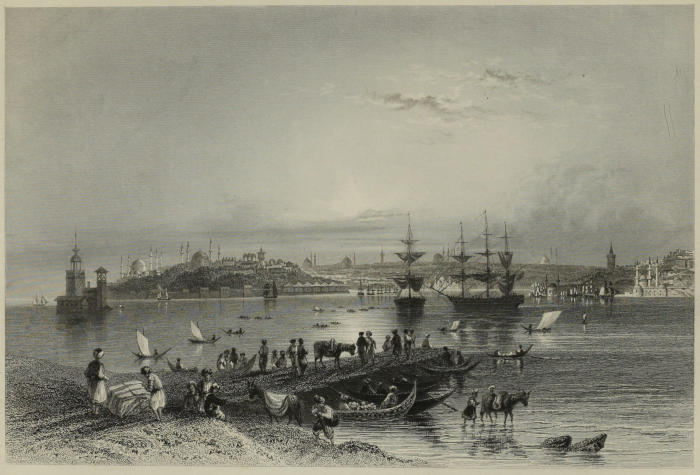
VIEW FROM THE FERRY AT SCUTARI.
VUE PRISE DU DÉTROIT, À SCUTARI PROSPECT VON DER FÄHRE ZU SCUTARI
W. H. Bartlett. R. Wallis.
London. Published for the Proprietors, by Geo: Virtue, 26, Ivy Lane, 1839.
Its main street, leading from the ferry to this military establishment, is much wider than any in Stamboul; lessening, however, from the plain upon which the barracks are built, where it degenerates into a narrow, and somewhat difficult road, continuing to the summit of the Bulgurlhu Daghi, a link of the Bithynian chain, dominating the Euxine. At its base stretches away the vast and sombre cemetery, of which mention has already been made; and beside it extends a wide plain, known as the “Pilgrim’s Plain,” from its being the starting point of the caravans assembling for Mecca. Here, on particular occasions, tens of thousands of the pious congregate, clothing the plain with tents and banners; and hence they start for the tomb of their Prophet;—the Ihrām, or holy dress, is assumed;—and from that moment they are no longer free to deprive any thing of life; indeed, to so extreme a pitch is this observance carried, that the very vermin upon their persons remain unmolested: a fact which accounts for the filthy and loathsome state of the santons and hadjis who infest the city, and whom to touch is almost infection. The dignity of hadji, however, is only conceded to those who have performed their pilgrimage; and such have hitherto been objects of marked respect, though recent innovations have greatly tended to diminish their consequence. Considerable inconvenience is at times experienced from these “chartered libertines,” who, under the guise of religion, drive a lucrative trade by making pilgrimages for more wealthy individuals, who are glad, by paying a liberal sum to these itinerant pietists to exempt themselves from an arduous, fatiguing, and hazardous journey; and as the accommodating creed of the Korān permits this deputy-devotion, there are swarms of vagabond-devotees ever ready to perform it for their more wealthy compatriots; and on their return to Constantinople, when they have received the wages of their venture, they infest the public thoroughfares with filth, to parade their holiness; and at night occupy the most squalid khans, or the ruined tombs, both of which are too often desecrated by their debaucheries.
Let it not be inferred, however, that all the hadjis are of this description: many of them leave their homes and their families full of pious ardour, and genuine enthusiasm, looking towards Mecca as the Jew looks towards Jerusalem, or the Christian towards eternity—full of hope, of faith, of long-suffering, and of charity; ready to help and to uphold their fainting brother on the way, and content to lay down their lives when the goal is won.
The start of a caravan is eminently picturesque and oriental; and as the writer of these sketches never had the advantage of being witness to one of these interesting ceremonies, it has been deemed desirable to give its description in the words of a distinguished traveller.
“In the spring of the year the pilgrims from Constantinople and the vicinity assemble on the large plain of Scutari; and, as it was a sight worth contemplating, I crossed the Bosphorus with some friends to see it. The whole of this extensive space seemed to be covered with a vast multitude, as if all the inhabitants of the city were about to proceed on their pilgrimage. After some time the wave of the multitude subsided, and they assumed a regular order. First appeared the Emir Hadji, or Leader of the Pilgrims, carried in a litter, or tartaravan, between stately mules, and accompanied by several others. Then the crowd arranged themselves according to their several companies, or corporations, each preceded by a banner, with some device to mark it, and attended by a train of camels bearing cradles or litters, to accommodate and carry on the sick who might faint by the way. They were accompanied by the Imaum, or officiating minister, to perform the functions of his office to all that needed, and crowds of antics, or jesters, who threw themselves into ridiculous postures to amuse them. Some were of another cast. They seemed like maniacs—they cried, and howled, and foamed at the mouth, and were supposed to be under the influence of a demon, to be expelled only by this pilgrimage. Then followed troops of armed horsemen, and, finally, droves of camels loaded with provisions and furniture, and among them torches to enlighten their march when they proceeded in the night.
“But the most remarkable object was the camel that bore the Mahmel, or covering of the Prophet’s Tomb. This seems to be essential to all tombs of his descendants, as those of the Sultans in their mausoleums at Constantinople are covered with them. This for Mecca consisted of bales of velvet, embossed with characters in gold, and containing sundry sentences from the Korān. The camel which bore it was white, and was considered so sacred as never to be employed for any other purpose, but exempt from all labour. He was adorned with plumes of red feathers, had bells suspended from him, and was caparisoned with rich housings. The people pressed eagerly to touch the holy animal, and those who could not come near unbound their turbans, and cast one end of it towards him, if haply any part of their dress might be sanctified by such contact. Even the air through which he passed had valuable qualities communicated to it. The multitude seemed to grasp it by handfuls, and thrust it into their bosoms, or placed it on their bare heads under their turbans. I found it was the general belief that this was the actual camel that bore Mahomet in his hegeira, or flight; and so it was not without reason they attributed extraordinary properties to the animal on whom Allah had conferred such a miraculous longevity.”[42]
The Imperial kiosque at Scutari is a lovely little edifice, built on the very edge of the rock overhanging the Propontis, and commanding a glorious view of Constantinople, the harbour, the European shore, and the sunny sea of Marmora, frequently crowded with shipping, awaiting a favourable wind to cast anchor in the Golden Horn. Its walls are painted in pale green; and its snow-white jalousies give to it a cheerful holiday look, which the plain but beautiful arrangements of its interior tend greatly to heighten. It is indeed as pretty a toy as even Imperial caprice could engender, and holds its place worthily among the fifty-seven residences of its illustrious owner.
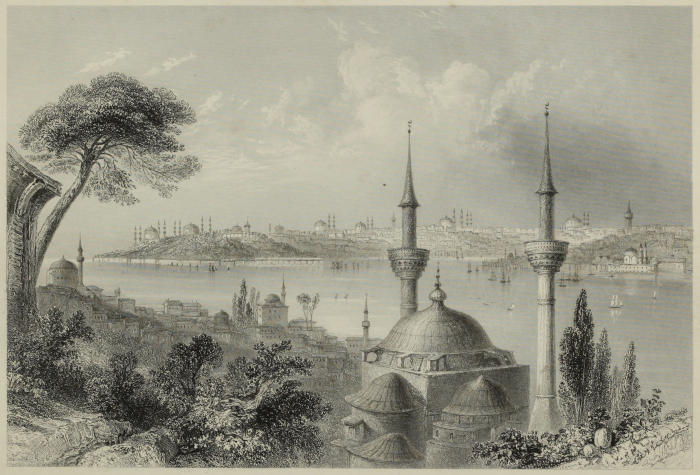
CONSTANTINOPLE. (From Scutari.)
CONSTANTINOPLE, VUE DE SCUTARI. CONSTANTINOPEL, VON SCUTARI AUS GESEHN.
W. H. Bartlett. J. Cousen.
London. Published for the Proprietors, by Geo: Virtue, 26, Ivy Lane, 1839.
The barrack of Scutari, which is occupied by the Imperial Guard, is remarkable even in Turkey, where these establishments are always princely both in their extent and construction: it is a quadrangle, flanked with square towers, built in three sections, gradually lessening, and each crested by a slight spire. The gate of entrance is lofty, and elaborately wrought in iron, giving ingress to a noble square or court, where twelve thousand men may be commodiously exercised; and surrounded on three sides by an open gallery, screening the long ranges of apartments above the basement of the building. The ground-floor is occupied by workshops; the whole of the clothing, cartridges, and other equipments, excepting arms, being manufactured within the precincts of the barrack, and very creditably produced. The kitchens are vast, cleanly, and convenient, and elaborately fitted with apparatus for steam, and the vessels used in cooking scrupulously kept; while the vegetable store, where piles of every description of herb and root necessary to the cooks are carefully housed, are floored, lined, and roofed with marble; and copious basins of the same material, are supplied with the purest and coolest water, from the fountain of the magnificent mosque of Selim III., which stands immediately opposite to the principal gate of the barrack.
The armouries, clothing-stores, and regimental schools, are all in the highest order; and no disrule awakens the ready echoes of the extensive building. Indeed, it would be difficult to find throughout the whole of Europe, a nobler military establishment than that of the Turkish Imperial Guard at Scutari.
Hence, a somewhat steep descent sweeps downward to the ferry, which is generally crowded with bales of merchandise, piles of fruit, laden donkeys, lounging hadjis, and busy boatmen, clamorous for passengers; while the magnificent views of Stamboul and its environs, which are commanded from the hanging gardens of the principal residences overlooking the Sea of Marmora, are almost beyond description.
Immediately before them runs the glittering current, sweeping the sunshiny waves onward from the Bosphorus into the far-reaching Propontis; girdling with liquid light the rocky foundations of the isle-seated Guz-Couli; and, finally, mingling with the world of waters mapped out before it; while beyond rises the long castellated wall of the ancient city of the Constantines, lost to the view at one point amid a cluster of Imperial kiosques, and at the other, beneath the gloomy shadows of the Yēaidhe—the mysterious prison of the Seven Towers—which link the land and seaward sides of the external wall, forming an angle eminently picturesque, from its startling contrast to every surrounding object. The original design of the fortress, as has been elsewhere stated, can no longer be traced beyond the walls, only four of the towers now remaining, the other three having been prostrated by earthquakes, and suffered to moulder away unrenewed.
At intervals along the wall appear the latticed kiosques of the Imperial Seraï, whence the incarcerated beauties of the harem look forth upon the bright scene without; while above and about them rise the shadowy plane-trees, the leafy beeches, lofty cypresses, feathery acacias, and other magnificent trees of the palace gardens. Away, amid the heaving waves, lies the archipelago of islands formerly called Demonesia, or the Demon Islands (since modified into the Princess’ Islands,) lying about nine miles from Constantinople, within a short row of the Asian coast. Of these, four are extremely fertile, and partially inhabited; the nearest to Stamboul is Proté, so called from its situation, it being the first approached from the Bosphorus. It is about three miles in extent; and is a favourite resort with the Greeks of the Fanar, many of whom spend the summer months in its pleasant valley, situated between two rather abrupt acclivities. A small village is built on the east side of the island; and on one of the heights stands a monastery, looming out cold and bare against the horizon, without a tree to soften down its rigid outline,—a mark alike for the hot sunshine and the laden storm-cloud.
The second of the group is known as “Platé,” from its being a dead flat; though many of the Franks, disregarding the ancient Greek name, call it “Gull Island,” from the immense number of those birds which are to be found there, feeding on the clustering marine plants by which it is covered, and rearing their young, undisturbed by the vicinity of a busy and crowded city.
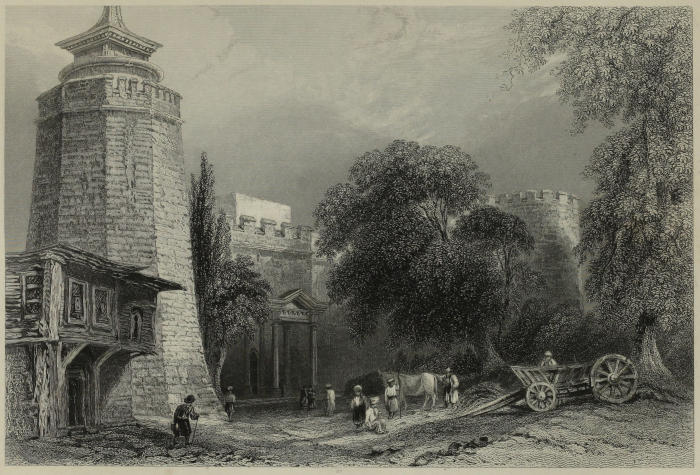
ENTRANCE TO THE SEVEN TOWERS.
ENTRÉE DES SEPT-TOURS. EINGANG ZUM CASTELL DER SIEBEN THÜRME.
W. H. Bartlett. E. Benjamin.
London. Published for the Proprietors, by Geo: Virtue, 26, Ivy Lane, 1839.
The next island, Oxea, is the highest of the whole, and is surrounded by steep and rugged precipices, which render it extremely picturesque from the water; particularly on the eastern side, where the bend of the shore forms a fine bay, beautifully framed in by tall and jagged rocks. On this island still exist some very interesting and curious remains of the reservoirs which formerly supplied the whole archipelago with water; fresh springs being rare on any of the other islands. Two of them yet remain almost perfect, and the water which they contain is clear and pure. The ruins of various edifices are also apparent in many of the precipitous portions of the islands: walls of bricks made flat, and cemented together with lime and powdered tiles, are to be found on all sides, and small water-cisterns are numerous in every direction. The most remarkable vegetable production of the island is the giant fennel, which here grows commonly twelve feet in height, and almost assumes the importance of a forest tree, as it spreads abroad the deep shadows of its feathery umbels.
The next island is that of Pitya. It is small, and boasts but slight remnants of the abundance of pine wood with which it is stated to have been once covered; possessing, moreover, no single object of interest to compensate for the loss; while Antigone, the ancient Panormus, about a mile beyond, boasts its vineyards and its villages, its monastery crowning an eminence which dominates the whole island; and the presence of the learned and illustrious exile, Constantius, Archbishop of Mount Sinai, and ex-Patriarch of Constantinople—a prelate renowned alike for his virtues and his erudition, who was deposed and banished by the Turks for his literary productions; not the least obnoxious among them being a Statistical Account of the past and present State of Constantinople, printed at Venice in 1824, in modern Greek, for the use of his countrymen—a work during whose compilation he had incurred considerable personal risk, disguising himself as a dervish, in order to penetrate into their sanctuaries; and which had cost him not only his liberty, but even great pecuniary embarrassment, his income in exile being barely sufficient to secure to him the common comforts of life.
From Antigone the traveller proceeds to Chalki, perhaps the most interesting islet of the group, from the fact that it abounds with spars, and that the remains of mines are still perceptible, as well as piles of the waste flung from the shafts centuries ago. At Chalki stands the monastery of the Trinity, probably so named from the fact that it occupies one of the three headlands for which the island is remarkable. It was once very extensive, but was nearly destroyed by fire; the wing containing the chapel is, however, still perfect, and its porch is an object of great curiosity to travellers, from the fact of its containing an extraordinary and somewhat grotesque representation of the Last Day. On a second height stands another convent, dedicated to the Virgin; and approached by a very fine road, commanding glorious views of the surrounding landscape, and fringed with arbutus, cistus, myrtle, and pine trees, among which the convent is embosomed.
The first resident British Ambassador at the Ottoman Court retired to this island in order to recruit his health, which had suffered from the climate, and ultimately died here. His tomb is now destroyed, and the inscription-stone is inserted sideways in the wall above the entrance-gate of the monastery, whence it cannot be removed without an Imperial firman.
Four noble lines of cypress trees, sweeping downward to the shore, lead to a splendid palace, formerly belonging to Prince Mavroyeni, who after serving in the Turkish army against Russia, was decapitated by the Grand Vèzir for some alleged offence; which proved, however, so inadequate in the eyes of the Sultan, that he struck off the heads of the Vèzir and his son, and bestowed the palace and gardens of the unhappy victim upon the family of Affendooli, whose representative was executed at the commencement of the Greek revolution. The house was sacked by the Turks, and then became for a time the summer residence of the Austrian minister, Baron Ottenfels; but it is now a favourite resort of the Sultan, who has caused it to be fitted up in the most costly manner; and who occasionally, during his sojourn on the island, gives sumptuous balls in the European style to the respectable Greek inhabitants and visitors.
Next comes Prinkipo, celebrated for the cruelties and subsequent exile of Irene, the widow of Flavius Leo, who gave its name to the island, which is the largest and most populous of the group. The town, seated on its eastern shore, contains upwards of three hundred inhabitants; its circumference is about eight miles, and the remains of a convent still exist, which was formerly tenanted by a sisterhood of fifty nuns. A monastery in a state of dilapidation, dedicated to the Transfiguration, and now occupied by a solitary monk, gray with age, stands on the summit of one of the heights; while another, crowning the loftiest hill on the island, and inscribed to St. George, is celebrated for its sanctity, and much frequented by the Greeks.
The two remaining islands of Neandros and Antirovithi are mere rocks, wholly uninhabited, and only occasionally visited for the purposes of sport, as they abound with sea-fowl and rabbits.
On the verge of the horizon rises Mount Olympus, with its crown of snow, and mantle of vapour; while far away stretches the rocky coast of Asia, hemming in one of the noblest scenes of earth and water under the wide canopy of heaven.