MOSQUE OF SULTANA VALIDÈ, FROM THE PORT.
Reading edition
“Look on this picture, and on this; A miniature resemblance.” Shakspeare.
The handsome court of the Mosque of Yeni Djami has been already described, but the whole effect of the edifice from the water is too striking to be neglected by the artist.
The white and dazzling marble of which it is built, its slender and highly-ornamented minarets, its stately portal, and solemn stillness, are brought out in such fine relief against the dark and dingy buildings which cumber the port, and which are loud with industry and contention—that while the mere traveller involuntarily wishes to transport the gleaming temple to a more consistent locality, the painter forgets the turmoil, the filth, and the uproar amid which he gazes on it, in his anxiety to transfer to the pages of his sketch-book so beautiful an object.
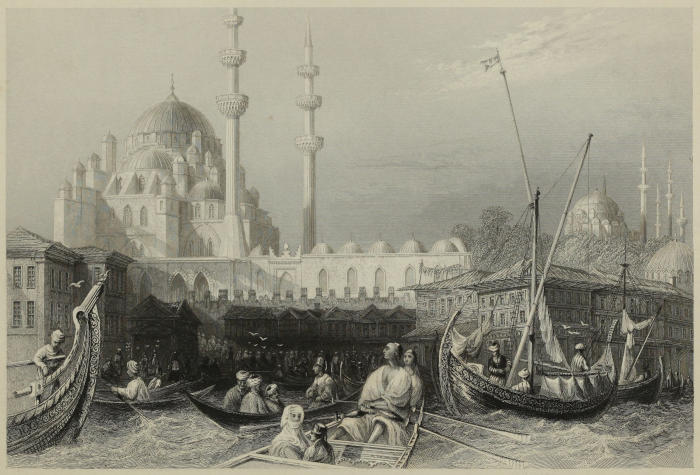
MOSQUE OF SULTANA VALIDÈ. (From the Port.)
W. H. Bartlett. W. Wallis.
London. Published for the Proprietors, by Geo: Virtue, 26, Ivy Lane, 1839.
The Mosque of the Sultana Validè stands almost on the edge of the port, from which its court is only separated by the Balook, or Fish Bazār; and this point being the ferry between Galata and Stamboul, is constantly thronged with boats. And here it is that almost every Frank first lands in the “City of the Faithful.” The scene is a singular one to the western traveller; and the noise and bustle of the busy crowd are totally at variance with all his preconceived ideas of the grave and turbaned easterns. The sharp shrill voice of the irritable and loquacious Greek, the expostulatory vehemence of the angry Armenian, the solemn intonations of the stately Turk, the hurried greetings of the merchants passing to and from the bazārs, and the vociferous appeals of the rival boatmen to the impatient passengers, swell on the air together; while the confusion on the water emulates that on land.
Sharp and high-prowed Arab barks, taking in their lading, and exposing their carved and gilded ornaments to the contact of the swift caïques that shoot along among them, and the heavy clumsy-looking European boats constantly plying between the shore and the vessels to which they belong; local functionaries darting past on their errands of hidden import; the caïque of the idler, with its crimson carpet, its comfortable cushions, and its drowsy caïquejhes, awaiting, half asleep, the return of their lounging employer; the ferry-boat, with its dingy gilding, and eager owner; the well-kept and graceful caïque of the princely harem, glittering with ornament and bright with beauty, bearing the veiled favourite and her muffled slaves to the other shore; the barge of the Minister, shooting over the water with the speed of a wild bird, and flinging the silver spray right and left like a shower of diamonds, as the sturdy rowers bend to their toil;—or, perchance, in the distance, even the passing bark of the Padishah[19] himself, on his way to the shady retreats of Kyat-Khana, moving along beneath the sunshine, one bright mass of glittering gold. And high above all this movement, and hurry, and human coil, towers the snowy temple of the unhappy Sultana Validè: near it sleeps in peace its imperial founder in her splendid mausoleum; and day by day the busy scene is renewed, the picturesque groupes are variously repeated, and the deep blue Heaven smiles down on all alike; while the clear surface of the port reflects at once the solemn Mosque, the quiet tomb, and the flitting shadows of each chance caïque and its busy freight.