BEBEC, ON THE BOSPHORUS.
Reading edition
“Nor oft I’ve seen such sight, nor heard such song, As woo’d the eye, and thrill’d the Bosphorus along.” Byron.
This very pretty village, situated about midway of the Bosphorus, and stretching for a considerable distance along the European shore, is chiefly remarkable from the channel for its beautifully-shaded square, overarched by forest-trees, of gigantic growth, and an Imperial Kiosque, formerly an object of much mystery and dread, but which has now lost in romance as much as it has gained in beauty; for having become a favourite retreat of the Sultan, it has lately been gaily, and, indeed, tastefully painted.
The Kiosque of Bebec possesses an historical interest from the fact that it was at one time the appointed rendezvous of those European ambassadors with whom the Sultan wished to confer without the cognisance of the other Frank ministers, or of the members of his own government. At that period it was suffered to remain in a state of partial disrepair, in order that it might not attract attention; and thither the envoy whose presence was desired quietly proceeded in his barge, without state or ceremony of any description; and, having landed, entered the building, and awaited the arrival of the Moslem monarch; there, with closed jalousies, through which they could themselves see every thing which passed along the channel without being visible to any one, sat the Sultan and the minister weaving the intricate web of diplomacy; and thence, when the conference was ended, they departed with the same mystery and caution. Of the present Sultan, however, it may truly be said that il a changé tout cela—he no longer gives audiences stealthily; and the Kiosque of Bebec has, consequently, become a mere Imperial pied-à-terre for an hour of relaxation.
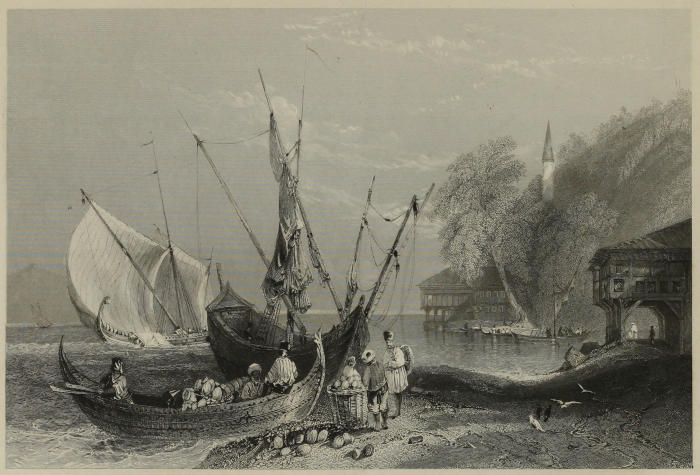
BEBEC, ON THE BOSPHORUS.
BEBEC, SUR LE BOSPHORE. BEBEC AM BOSPHORUS.
W. H. Bartlett. R. Brandard.
London. Published for the Proprietors, by Geo: Virtue, 26, Ivy Lane, 1839.
Nor was this the only remarkable feature in the history of this summer-pavilion; for it was once the chosen lounge of the famous, or rather celebrated Ali Pasha of Tepeleni, whose tiger heart and bitter expiation have alike been the theme of story and of song. In this Kiosque he is affirmed to have spent some hours each day when he was Camaican to the Vèzir, ere he was removed to his command at Yanina; and to have amused his idleness by studying the “human face divine” as keenly, and far more cruelly, than Lavater; as he ever carried his deductions to a pitch fatal to those on whom he speculated; for he had no sooner suffered his eye to rest for a moment on some physiognomy which displeased him, than a motion of his hand arrested the progress of the passing boat; the obnoxious countenance was brought into immediate contact with that of the ruthless dignitary, and the unhappy individual by whom it was owned was sternly greeted with an assurance that he must be a rogue, and the son of rogues, or that Allah the All-merciful! would never have cursed him with so ill-looking a face, whereon were written characters of evil, which the Pasha could read as though they had been inscribed by the pen of a khoja[46] upon a skin of parchment; a man wearing such a countenance must necessarily be a karadhan[47] of the vilest class, and all unfit to walk at large among the chosen people of Mahomet; and such being the case, the miserable victim of ugliness was forthwith consigned to the gallies to expiate his inferred crimes! Expostulation was vain, for the Camaican was a sophist; and with cat-like cruelty he was ever ready to sport a moment with the agonies of his victim, in order to congratulate the trembling wretch who quailed before him, gasping out assurances of his innocence of all offence, either against his faith or his neighbour, that the opportunity was taken from him of perpetrating all the misdeeds which were registered in his face, and from whose dark effects the Pasha had so fortunately rescued the public: for there they were; and if yet to do, the greater the blessing which had been vouchsafed to him in an interference that might prevent them altogether. And upon these premises, or rather to satisfy this caprice, it is seriously asserted that so many miserable and guiltless wretches were sent to suffer and to die amid the filth, and squalor, and toil of the public bagnio, that the Sultan found it necessary to interfere with the pursuit of his minister, and to compel a discontinuance of the pastime.
It was possibly from a consciousness of his own great personal beauty that Ali indulged in so inhuman a hatred towards those who were less physically gifted; and that his taste for bringing his victim into immediate contact with himself, grew out of the savage vanity of forcing upon him a sense of his own ugliness. Be that as it may, he is described by those who knew him as one of the mildest and most benevolent looking of men.
On the page of the poet the same record is inscribed; for thus “the Childe” bears witness to the fidelity of the description at a later period of the Pasha’s life:—
“In marble-paved pavilion, where a spring Of living water from the centre rose, Whose bubbling did a genial freshness fling, And soft voluptuous couches breathed repose, Ali reclined, a man of wars and woes; Yet in his lineaments ye cannot trace, While gentleness her milder radiance throws Along that aged venerable face, The deeds that lurk beneath, and stain him with disgrace. “It is not that yon hoary lengthening beard Ill suits the passions which belong to youth; Love conquers age—so Hafiz hath averr’d, So sings the Teian, and he sings in sooth— But crimes that scorn the tender voice of ruth, Beseeming all men ill, but most the man In years, have mark’d him with a tiger’s tooth; Blood follows blood, and through their mortal span, In bloodier acts conclude those who with blood began.”
On the crest of the hill behind Bebec, there is an oak wood, in whose depths is a small space covered with short fresh turf, without a single tree, where the human voice awakens a multiplied echo so singular as to have become a source of much amusement to its visitors. A horse, gallopped rapidly round the enclosure, produces precisely the effect upon the ear of a distant charge of cavalry; and a peal of laughter is so extraordinarily prolonged, as almost to turn wonder into pain.
The village of Bebec is principally inhabited by Greeks.