THE MAUSOLEUM OF SOLYMAN “THE MAGNIFICENT.”
Reading edition
“A dome with convoluted roof, whose fold Projected o’er a gate of polished stone; A hoary tree, in stateliness grown old, The germ of by-past ages, now unknown; A wild vine wreathing round the regal gold And azure of the tinted pane; a tone Of sadness sighing through the lofty gloom Of a tall cypress.” MS. Poem.
A beautiful covered way, leading from the outer court of Solimaniè, and richly trellised with those luxuriant and leafy parasites so common in the East, leads to the splendid tomb of Solyman; a light and elegant sexangular building of white marble, overshadowed by one of those enormous plane-trees which defy all calculation of their age, and seem each a mimic forest in themselves. Clusters of the rare and beautiful purple lily, grow, as it were, out of the foundation of the edifice, and intrude their imperial blossoms within the sculptured screen that protects the arched colonnade by which it is surrounded. The whole exterior of the tomb is graceful and attractive; and it looks rather like a temple dedicated to cheerfulness, than a shrine for the ashes of the dead. The sunshine struggles through the fresh green leaves of the giant-tree, and falls flickeringly upon the marble steps, painting them with a thousand fantastic figures; and the blue doves which nestle amid its branches fill the air with their soft cooings, destroying the deep silence of the sacred spot. Altogether, the Mausoleum of the magnificent Solyman conveys no idea of death and the grave, nor is it forced upon you even when you step across the threshold on to the richly carpeted floor, and see before you the sarcophagi of the imperial founder of the building, of his successor, of Sultan Akhmet, and of the two daughters of Solyman. Those of the Sultan’s are surmounted by lofty and curiously folded turbans of white muslin, decorated with aigrettes; while those of the princesses are simply covered with shawls of green cashmere, much dilapidated by time. On a stand near the entrance, rests an admirable model of the Mosque at Mecca, and the Prophet’s tomb, with parties of pilgrims on their way to and from the holy city; it is well executed, and bears an appearance of great accuracy.
A few paces from the resting-place of Solyman is that of his favourite wife, the far-famed and tiger-hearted Roxalana, who, in the feelings of the mother, suffered those of the woman to be extinguished, and turned the holiest of virtues into crime. She also rests under a dome of marble, and her sarcophagus is overlaid with costly shawls. The same plane-tree darkens over the two tombs, but the vermilion patches flung by the painted windows on the bier of the inexorable Roxalana, seem like records of the innocent blood shed to feed her ambition. Not satisfied with the proud distinction of having given birth to the Sultan’s eldest son, and of seeing the bitter tears wept over his grave by Solyman, who, to mark his grief for the untimely death of the ill-fated Mahomet, released a number of slaves on the day of his burial, that they might ever look back with veneration to his memory; the renegade Sultana, false alike to her God and to her sex, excited the infatuated sovereign to murder Mustapha, another of his sons by a rival beauty. Heavy accusations, laid by a reckless enemy, who possessed the ear and perverted the judgment of Solyman, were all-sufficient to secure the ruin of the young and high-hearted Mustapha; who, moreover, when summoned to the presence of his imperial father, entertained no suspicion of the treachery to which he was about to fall a victim.
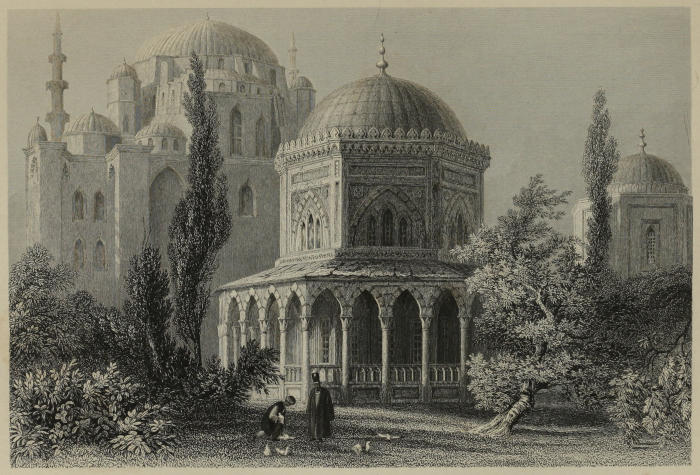
MAUSOLEUM OF SOLYMAN THE MAGNIFICENT AND ROXALANA.
W. H. Bartlett. J. Carter.
London. Published for the Proprietors, by Geo: Virtue, 26, Ivy Lane, 1839.
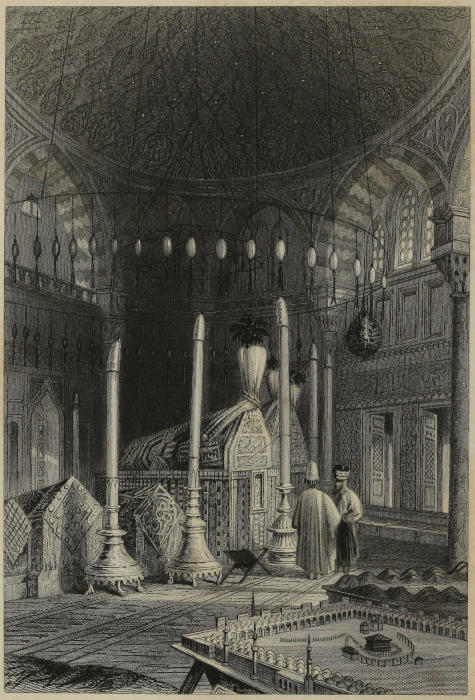
INTERIOR OF THE MAUSOLEUM OF SULTAN SOLYMAN.
W. H. Bartlett. W. Radclyffe.
London. Published for the Proprietors, by Geo: Virtue, 26, Ivy Lane, 1839.
To render the tragedy more complete, Mustapha, when he received the summons of the Sultan, was not alone; Zeangir, the son of Roxalana, to whom he was tenderly attached, was beside him; who, when the message was communicated to the prince, immediately determined on accompanying him to the camp of their common parent. On their arrival at the imperial tent, Mustapha was disarmed; and then first suspecting treachery, he advanced in silence beyond the line of guards who were posted over the person of the Sultan, and had scarcely done so, when four mutes sprang upon him, armed with the fatal bowstring; but life was young and strong in the betrayed prince, and he burst from their hold, and flung them from him with indignant pride, as he turned to alarm the troops, by whom he was greatly beloved, and in whom he felt, even at that awful moment, that he might depend. But no time was allowed him for the effort, for as he sought to escape, Solyman himself appeared at the entrance of the tent; and one look of rage, one gesture of vengeance, recalled the scattered senses of the mutes, who once more seizing their victim, strangled him under the eyes of his infuriated father, and then flung his quivering body on the carpet at his feet. It was the work of a moment; and the paralyzed Zeangir beheld the brother whom he fondly loved, and who had stood beside him in health and pride but a moment back, a livid and distorted corpse, like an unnatural barrier suddenly raised by crime between him and his father. From his wolf-hearted mother he had long shrank, for his gentle nature quailed before the dark workings of her iron spirit; and now two holy links were wrenched asunder which could never again be united—he had no longer a parent; and his brave brother, the idol of the troops and of the people, he was gone! Without a word, without a tear, the young prince cast himself upon the corse of the murdered Mustapha; and when the officious pity of some court parasite would have separated him from his dead brother, he was unconscious of the attempt: he was not born for blood, and his heart had burst upon the body of the victim! Once again Roxalana stood beside a dead son; but there was no compunction in her eyes, as they rested on the pale face of him whom her cruelty had murdered: there was no shadow over them, as when the grief of earth seems to throw a veil over the decrees of Heaven. They were bright with intense light—vivid with fearful brilliancy—they told a tale of vengeance!
The arrow was shot by a sure hand! Solyman, enslaved by the personal beauty, and cowed by the resistless passions of his wife, became the puppet of her will; and the moon had not yet grown old, when Roxalana once more held a death-warrant signed by the misguided Sultan. Mustapha had left behind him a son, a fair boy who had scarcely numbered ten summers—brave, and beautiful, and, until now, beloved. This was the new victim; but the implacable Sultana, fierce as she was, knew all the intensity and watchfulness of a mother’s love, and she felt that the vigilance of the new-made widow must be eluded. The boy was, therefore, on some fair pretence dispatched to a kiosque near Broussa, attended by a proper guard, and accompanied by his mother in a covered litter. In the plain beyond Moudania, the litter broke down; and the eunuch who was entrusted with the death-warrant, proposed to the little prince that they should together gallop forward to the city, and send back assistance. The gallant boy complied; and as he sprang from his horse at the door of the kiosque, the executioner stopped him on the threshold, and extending towards him the bowstring, intimated to him that such was the will of the Sultan.
“God is great!” said the brave boy, “and the Sultan is his shadow upon earth—I am ready.” And when she reached Broussa, the widow of Mustapha found that she was childless!