THE ARSENAL, (FROM PERA.)
Reading edition
The sunshine fell not on that place of graves, But wantoned with the waves, and with the hills, Blushed on the rose, and turned the leaves to gold: While shadows stretched in darkness o’er the dead.
The spot whence the artist has obtained his view of the Turkish Arsenal at Pieri Pasha, commands the harbour about midway, and, consequently, presents it to the eye under an essentially different character from that of any of his preceding sketches. The building itself terminates the long line of docks, warehouses, rope-walks, and workshops, appertaining to the Imperial establishment, which extends from Galata for a mile and a half along the lip of the water; and which, in whatever point of view it is considered, must be admitted to be highly creditable to the government. The wet docks are very ably constructed, and are enclosed within high walls of stone, whence a pair of noble gates open upon the harbour. The dry docks are also on a very magnificent scale, one of them (constructed by a French engineer) being nearly three hundred and fifty feet in length. The Tershana, or Admiralty, independently of its position, standing as it does upon a point of land projecting into the harbour, is in itself a very pleasing object; it is in the Russian taste, gaily and carefully painted, and has a noble entrance. It commands from its different casements the whole extent of the Golden Horn, which it sweeps from the village of Eyoub to the entrance of the sea of Marmora and the Bosphorus; and an upper suite of apartments have been richly fitted up for the occasional occupation of the Sultan, who frequently amuses himself by watching the progress of the magnificent ships built for his navy, and the business-like bustle of the workmen.
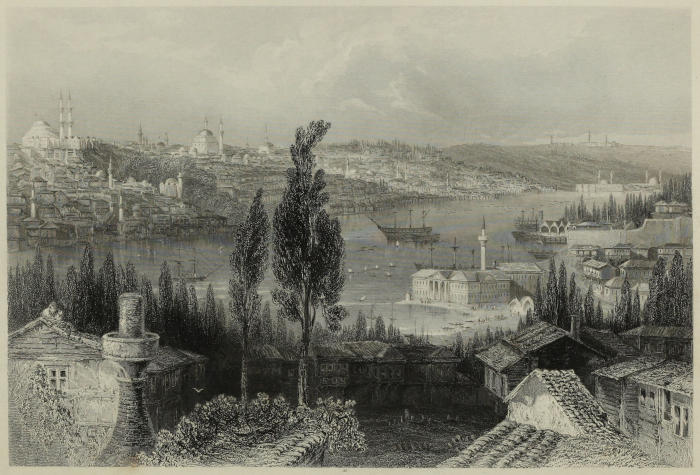
THE ARSENAL FROM PERA.
L’ARSENAL, VU DE PÉRA. DAS SEEARSENAL VON PERA HER.
W. H. Bartlett. S. Bradshaw.
London. Published for the Proprietors, by Geo: Virtue, 26, Ivy Lane, 1839.
The vessels which are constructed at Pieri Pasha are worthy of the Arsenal from which they emanate, being finely built, and perfectly equipped. The superintendent of the establishment is an American, in high favour with the Sultan; who, in order to preserve the brigs and ships of the line, only suffers them to cruise during the summer, and at the fall of each year causes them to be anchored in the Bosphorus, where they produce a beautiful effect from the shore.
Above the Admiralty stand the ruins of what was once the palace of the Capudan Pasha, looking more like the remains of an aqueduct than of a dwelling; and forming a long line of arches extremely picturesque in their effect. Before it spreads the harbour, bounded by the seven hills of the Golden City, and the wide and historical plain of Daoud Pasha; and beside it stands the barrack of Kassim Pasha, whence the cemetery of Pera stretches away, built in by houses, and covering every height and hollow, until it is bounded by the streets of the infidel faubourg.
The little nook which lay at the artist’s feet, as he looked upon the scene that I have endeavoured to describe, gives an admirable idea of this singular necropolis. Every house, whose upper stories overhang the graves, is filled with tenants, wholly unsaddened by their constant companionship with death; the head-stones are closely clustered together, each group denoting the resting-place of a family, and situated as near to the habitation of the surviving relatives as circumstances will permit; while rigid cypresses deepen the gloom of the death-glen, and parasitical plants trail along the walls, and wave their feathery branches over the mouldering sods.
It was in this very corner of the far-spreading cemetery, that, in the year 1836, a Frank lady, residing in Pera, was one day attracted by a line of graves, flung up on the border of a narrow pathway through the hollow; they had evidently all been filled since sunrise, for there was that fresh, humid, clammy look about the mould which it loses after four-and-twenty hours’ exposure to the atmosphere; and the work was still going on as she reached the spot. The idea of plague was instantly suggested; for, as her eye rapidly ran over the nineteen graves already completed, and then fell upon the four others which were in process of preparation, it was evident that some unusual cause must have produced so fatal an effect, this obscure nook being so very minute a portion of the burial-ground, as to receive seldom more than one new tenant weekly. It had been one of her favourite haunts; for she loved its stillness, its long deep shadows, and its almost unbroken solitude, coupled with the feeling that she was within sight and hearing of her fellow-beings, although apparently alone; and she was painfully startled by so unexpected an invasion of the hallowed spot.
Plague was indeed naturally the first thought, and she shuddered sickeningly as she uttered the inquiry: it was a relief to be negatively answered, though the tale of the grave-digger was sad enough. He was consigning to the earth the wretched fever-stricken victims who had been rescued from a life of slavery by an Austrian brig, then anchored in the Golden Horn. They had been taken by pirates in the Archipelago—youths, women, old men, and children! The ocean-robber, grown daring and haughty by success, had attacked the Austrian, and had been taken; but retribution came too late to the pirate to avail his wretched prisoners. They had all perished miserably within a few hours of each other, just as the minarets of Constantinople, cutting against the horizon, gave them a blessed glimpse of home; and this dark, silent glen had been selected as their resting-place—they could not have found one more fitting!